

Thursday, September 3, 2026
Science
No Result
View All Result
  • Login
  • HOME
  • SCIENCE NEWS
  • CONTACT US
  • HOME
  • SCIENCE NEWS
  • CONTACT US
No Result
View All Result
Scienmag
No Result
View All Result
Home Science News Space

Astronomers Identify Extremely Bright Quasar Lenses in New Findings

July 27, 2026
in Space
Grant Pearson
By Grant Pearson Scienmag Editorial Profile - Observational Astronomy
Reading Time: 2 mins read
0
Astronomers Identify Extremely Bright Quasar Lenses in New Findings

Astronomers Identify Extremely Bright Quasar Lenses in New Findings

65
SHARES
587
VIEWS
Share on FacebookShare on Twitter
ADVERTISEMENT

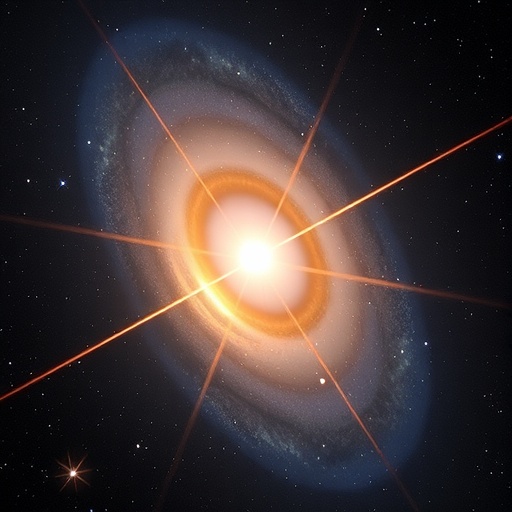
An international team of scientists has turned machine learning loose on one of astronomy’s most elusive targets: rare quasars that behave as strong gravitational lenses. In a new study, researchers report seven fresh candidate systems identified from the Dark Energy Spectroscopic Instrument (DESI) survey—doubling the number of known quasar lenses found by earlier efforts.

Quasars are intensely bright galactic cores powered by supermassive black holes. Their luminosity can outshine the galaxy hosting them, making it difficult to measure the surrounding structure precisely. Gravitational lensing offers a workaround: the quasar’s mass bends and magnifies light from nearby sources, producing telltale distortions that reveal information about both the lens and the environment around it.

Because strong lensing by quasars is uncommon, the team faced a key problem—there are not enough real examples to train a traditional detection pipeline. Instead, they built a training strategy using a mixture of genuine quasar spectra and background galaxy spectra, then generated mock lens systems. A neural network learned the subtle spectral signatures that distinguish “normal” quasars from those with lensing-related features.

The researchers analyzed a catalog of 800,000 quasar candidates from DESI DR1. After applying the model, the list was narrowed to 200 objects, which were then hand-reviewed before selecting seven final candidates. The systems lie at least 5–6 billion light-years from Earth, meaning the observations probe a distant cosmic epoch while also helping astronomers refine models of quasar and galaxy growth.

The work underscores a broader scientific motivation: quasars may represent “missing links” in the early universe, connecting black hole formation to the evolution of galaxies. By studying the correlation between galaxies and their central black holes, researchers hope to better understand why galaxies—and the black holes inside them—develop along particular pathways, including why some black holes appear dormant.

Future confirmation will rely on powerful space-based observatories such as the Hubble Space Telescope. Once deeper follow-up validates these candidates, the same AI framework could be extended to hunt for other rare spectral anomalies across massive survey datasets.

The study was published July 22 in The Astrophysical Journal, and it was supported by the U.S. Department of Energy and the EU Horizon 2020 program—an early sign that “viral” breakthroughs in astronomy may increasingly come from machine learning applied to big data.

Keywords

Quasar lenses, gravitational lensing, machine learning, neural networks, DESI, strong lenses, supermassive black holes, spectral analysis, early universe

Subject of Research: Quasars acting as strong gravitational lenses detected in DESI DR1
Article Title: Quasars Acting as Strong Lenses Found in DESI DR1
News Publication Date: 22-Jul-2026
Web References: https://science.nasa.gov/missions/webb/nasas-webb-will-use-quasars-to-unlock-the-secrets-of-the-early-universe/ ; https://www.iopscience.iop.org/article/10.3847/1538-4357/ae8014 ; https://www.desi.lbl.gov/
References: 10.3847/1538-4357/ae8014
Image Credits:

Article Title: Astronomers Identify Extremely Bright Quasar Lenses in New Findings

Article References: Original research article

Image Credits: AI Generated

DOI: Not provided

Keywords: astronomical survey data analysis, Bright quasar gravitational lensing detection, cosmic structure mapping, dark energy spectroscopic instrument survey, extragalactic astronomy research, gravitational lensing effects, high redshift quasars, identifying quasar lens systems, machine learning in astronomy, neural networks in astrophysics, rare quasar lens candidates, supermassive black holes in quasars

Cite Scienmag News

Grant Pearson. (July 27, 2026). Astronomers Identify Extremely Bright Quasar Lenses in New Findings. Scienmag. https://scienmag.com/astronomers-identify-extremely-bright-quasar-lenses-in-new-findings/

Grant Pearson. "Astronomers Identify Extremely Bright Quasar Lenses in New Findings." Scienmag, 27 July 2026, https://scienmag.com/astronomers-identify-extremely-bright-quasar-lenses-in-new-findings/. Accessed 3 September 2026.

Grant Pearson. "Astronomers Identify Extremely Bright Quasar Lenses in New Findings." Scienmag. July 27, 2026. https://scienmag.com/astronomers-identify-extremely-bright-quasar-lenses-in-new-findings/


Tags: astronomical survey data analysisBright quasar gravitational lensing detectioncosmic structure mappingdark energy spectroscopic instrument surveyextragalactic astronomy researchgravitational lensing effectshigh redshift quasarsidentifying quasar lens systemsmachine learning in astronomyneural networks in astrophysicsrare quasar lens candidatessupermassive black holes in quasars
Share26Tweet16
Previous Post

UNC-Chapel Hill Astronomers Detect One of the Universe’s Rarest Black Hole Events

Next Post

Groundbreaking Findings Show Magma Rising Beneath Laguna del Maule, Chile

Related Posts

Trafficability and excavatability of icy lunar regolith simulants quantified using cone penetration
Space

Trafficability and excavatability of icy lunar regolith simulants quantified using cone penetration

September 3, 2026
Why Decoding Alien Atmospheres Is Pushing Supercomputers to Their Limits
Space

Why Decoding Alien Atmospheres Is Pushing Supercomputers to Their Limits

September 3, 2026
Developing a sustainable human lunar presence using space resources
Space

Developing a sustainable human lunar presence using space resources

September 3, 2026
Mercury’s crust formed by extreme volcanism
Space

Mercury’s crust formed by extreme volcanism

September 3, 2026
Warm inflation in a braneworld scenario
Space

Warm inflation in a braneworld scenario

September 3, 2026
Subauroral Flows and Arcs Rewrite the Rules of Space Electrodynamics
Space

Subauroral Flows and Arcs Rewrite the Rules of Space Electrodynamics

August 30, 2026
Next Post
Groundbreaking Findings Show Magma Rising Beneath Laguna del Maule, Chile

Groundbreaking Findings Show Magma Rising Beneath Laguna del Maule, Chile

  • Mothers who receive childcare support from maternal grandparents show more optimized

    Mothers who receive childcare support from maternal grandparents show more parental warmth, finds NTU Singapore study

    27656 shares
    Share 11059 Tweet 6912
  • University of Seville Breaks 120-Year-Old Mystery, Revises a Key Einstein Concept

    1061 shares
    Share 424 Tweet 265
  • Bee body mass, pathogens and local climate influence heat tolerance

    682 shares
    Share 273 Tweet 171
  • Researchers record first-ever images and data of a shark experiencing a boat strike

    546 shares
    Share 218 Tweet 137
  • Groundbreaking Clinical Trial Reveals Lubiprostone Enhances Kidney Function

    531 shares
    Share 212 Tweet 133
Science

Embark on a thrilling journey of discovery with Scienmag.com—your ultimate source for cutting-edge breakthroughs. Immerse yourself in a world where curiosity knows no limits and tomorrow’s possibilities become today’s reality!

RECENT NEWS

  • Largest Study of Its Kind Reveals How Australian Dogs Fare Against Lymphoma
  • BRWD3 Mutation Identified in Female with X-Linked Intellectual Disability
  • Germans Weigh the Value of Digital Versus Offline Weight Loss
  • New relative power test measures fat burning peak in active postmenopausal women

Categories

  • Agriculture
  • Anthropology
  • Archaeology
  • Athmospheric
  • Biology
  • Biotechnology
  • Blog
  • Bussines
  • Cancer
  • Chemistry
  • Climate
  • Earth Science
  • Editorial Policy
  • Marine
  • Mathematics
  • Medicine
  • Pediatry
  • Policy
  • Psychology & Psychiatry
  • Science Education
  • Social Science
  • Space
  • Technology and Engineering

Subscribe to Blog via Email

Enter your email address to subscribe to this blog and receive notifications of new posts by email.

Join 5,151 other subscribers

© 2025 Scienmag - Science Magazine

Welcome Back!

Login to your account below

Forgotten Password?

Retrieve your password

Please enter your username or email address to reset your password.

Log In
No Result
View All Result
  • HOME
  • SCIENCE NEWS
  • CONTACT US

© 2025 Scienmag - Science Magazine

Discover more from Science

Subscribe now to keep reading and get access to the full archive.

Continue reading