


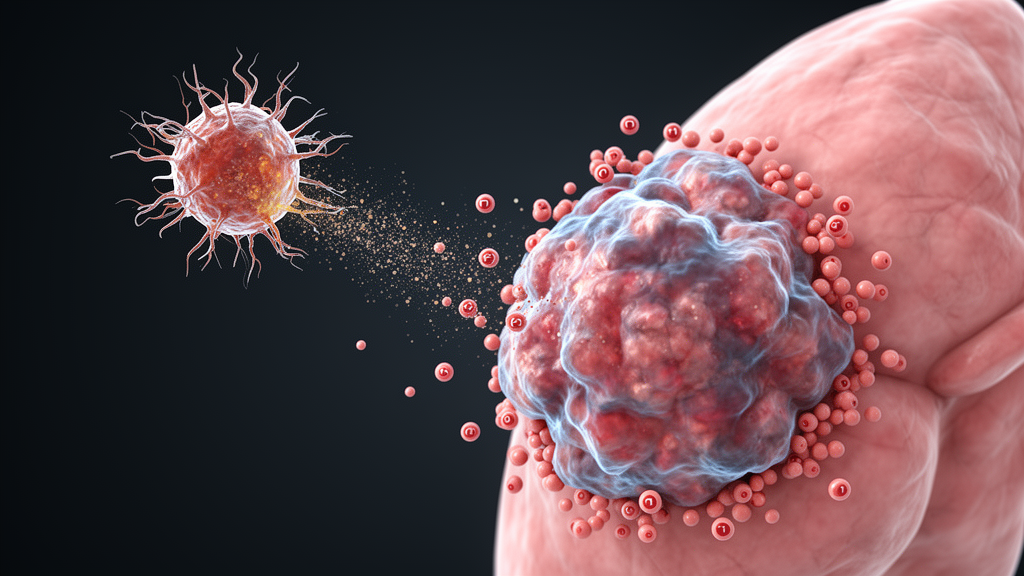
A carefully watched immunotherapy experiment has delivered a sobering but scientifically valuable verdict. In a phase I clinical trial, researchers tested a dendritic cell vaccine engineered to produce CCL21, a chemical signal that recruits immune cells, in combination with the checkpoint inhibitor pembrolizumab in patients with advanced non-small cell lung cancer. The combination proved safe and, according to detailed analyses of tumor biopsies, succeeded in drawing new T cells into tumors. Yet the therapy failed to produce a single objective tumor shrinkage, and the trial did not meet its primary endpoint. The results, published in Nature Communications, offer an unusually transparent look at why promising immune signals do not always translate into clinical benefit, and they illuminate the formidable barriers that still stand between immune cell traffic and effective cancer immunotherapy.
The trial, registered as NCT03546361, was built on a deceptively simple biological premise. Dendritic cells are the sentinels of the immune system: they sample material from their surroundings, process it, and present fragments of it to T cells, instructing those T cells on what to attack. In cancer vaccines, dendritic cells can be harvested from a patient, loaded or modified to carry tumor-associated signals, and returned to the body. The UCLA-led team went a step further by engineering the cells to express CCL21, a chemokine, or chemical attractant, that is normally produced in lymph nodes and serves to guide circulating lymphocytes toward sites where antigens are being presented. The hope was that injecting these CCL21-producing cells directly into lung tumors would convert the tumor itself into something resembling a lymph node, a beacon that would pull T cells out of circulation and into the tumor microenvironment, where they could recognize and destroy cancer cells.
Pembrolizumab was the second component of the strategy. The drug is an antibody that blocks PD-1, a receptor on T cells that functions as a molecular brake. Many tumors exploit this brake, inducing T cells that reach the tumor to become exhausted and inactive. By releasing the brake, pembrolizumab and other PD-1 pathway inhibitors have transformed the treatment of non-small cell lung cancer, the most common form of lung malignancy. But resistance is common: many patients never respond, and many who initially respond eventually progress. The rationale for combining the two approaches was complementary. The CCL21 vaccine was designed to increase the number and diversity of T cells entering the tumor, while pembrolizumab was intended to keep those newly arrived cells functional once inside. Each addressed a different point of failure in the anti-tumor immune response.
The trial was structured in two stages, following the conventional design of early-phase oncology studies. In the dose escalation phase, eleven patients received progressively larger quantities of the CCL21-modified dendritic cells, injected directly into tumors under image guidance, alongside standard pembrolizumab. The goal was to identify the maximum administered dose, the highest dose that could be given safely. That dose was determined to be 3 times 10 to the seventh cells per injection. A further twelve patients were then treated at this dose in a dose expansion cohort, bringing the total to twenty-three participants with advanced non-small cell lung cancer. Throughout, the investigators monitored safety, tumor response by imaging criteria, and, critically, changes in the immune landscape of the tumors themselves through serial biopsies.
On the safety front, the news was encouraging. The combination was well tolerated, an important finding for a cell-based therapy delivered directly into tumors. But the efficacy results were disappointing. No objective responses were recorded; not one patient experienced the degree of tumor shrinkage that would qualify as a partial or complete response under standard criteria. The trial therefore failed to meet its primary endpoint, the objective response rate. There was, however, a signal of modest activity: 36.8 percent of patients achieved a best response of stable disease, meaning their tumors neither grew substantially nor shrank. In advanced lung cancer, where untreated disease progresses relentlessly, disease stability is not nothing, but it falls far short of the durable regressions that checkpoint inhibitors can produce in responsive patients.
The most scientifically rich portion of the study came from the post-hoc analyses of longitudinal tumor biopsies, collected before and after treatment. Using modern genomic techniques, the researchers tracked how the cellular composition of the tumors changed over the course of therapy. They found that the vaccine-pembrolizumab combination did what it was designed to do at the level of cell traffic: tumors showed increased infiltration by CD4-positive T cells, the helper subset of the immune system, and by novel T cell clones, meaning T cells with receptors that had not previously been detected in the tumor. In other words, new immune recruits, cells that had not been patrolling the tumor before, were arriving after treatment. The chemokine beacon, at least in this respect, worked.
The biopsy data also revealed why some patients fared better than others, at least in terms of disease stability. Patients whose tumors remained stable showed greater T cell receptor diversity, a broader repertoire of distinct T cell specificities within the tumor, and greater expansion of novel clones following therapy. This pattern is consistent with a long-standing principle of tumor immunology: a diverse, polyclonal T cell response is harder for a tumor to escape than a narrow one, and the arrival of fresh clones suggests that the vaccine was genuinely educating and recruiting new immune specificities rather than merely amplifying cells already present. Disease stability, in this framing, was not a random outcome but the visible footprint of a broader and more dynamic immune response.
Yet the deeper analyses exposed two fundamental problems that likely prevented immune infiltration from becoming tumor destruction. First, many of the novel T cell clones that appeared after treatment failed to persist over time. They arrived, and then they faded, suggesting that the tumor environment could not sustain them, whether because their target antigens were absent, their stimulation was insufficient, or suppressive forces eliminated them. Second, the researchers identified immunosuppressive myeloid signaling signatures across multiple time points. Myeloid cells, a family of innate immune cells that includes macrophages and myeloid-derived suppressor cells, are notorious architects of the immunosuppressive tumor microenvironment. Their persistent signaling presence indicates that the vaccine strategy had not reprogrammed this suppressive layer, leaving newly recruited T cells to operate in a hostile terrain.
The investigators themselves framed the outcome with characteristic precision: CCL21 dendritic cell vaccination combined with pembrolizumab can promote T cell infiltration, but this did not translate into meaningful clinical efficacy, potentially because the T cell response lacked sufficient tumor specificity and because the therapy could not fully reprogram the tumor microenvironment. That distinction between tumor specificity and general immune activation is crucial. Recruiting T cells into a tumor is only useful if those T cells recognize antigens carried by the cancer cells. A vaccine that draws in T cells of uncertain or irrelevant specificity may fill a tumor with immune cells that look impressive under the microscope but cannot kill the malignant cells around them. Combined with an unreformed myeloid compartment actively dampening immunity, the result is cellular traffic without cellular warfare.
For the field, the trial is best read as a rigorous map of a failure mode rather than a dead end. It demonstrates that intratumoral chemokine-engineered dendritic cells are feasible, safe, and biologically active, and it provides a template for measuring whether next-generation designs actually change the tumor microenvironment. Future efforts will likely need to ensure that recruited T cells are directed against true tumor antigens, perhaps through personalized neoantigen targeting, and to pair vaccination with agents that neutralize myeloid-mediated suppression. The patients who enrolled, and the detailed molecular record their tumors provided, have converted a negative efficacy result into a detailed hypothesis about what a successful version of this strategy must overcome. In immunotherapy, as this study makes plain, getting immune cells through the door is only the first step; keeping them there, aimed at the right targets, and unopposed by the tumor’s defenses is the far harder task ahead.
Subject of Research: A phase I trial of a CCL21 gene-modified dendritic cell vaccine combined with pembrolizumab in advanced non-small cell lung cancer
Article Title: A CCL21 gene-modified dendritic cell vaccine combined with pembrolizumab in advanced non-small cell lung cancer: a phase I trial
Article References: Oh, M. S., Lisberg, A. E., Dumitras, C., Tran, L. M., Salehi-Rad, R., Krysan, K., Lim, R. J., Shabihkhani, M., Romero, T., Li, S., Zeng, W., Jing, Z., Li, R., Kahangi, B. P., Tsvetkova, O., Suh, R. D., Abtin, F., Genshaft, S. J., Oh, S. S., … Dubinett, S. M. (2026). A CCL21 gene-modified dendritic cell vaccine combined with pembrolizumab in advanced non-small cell lung cancer: a phase I trial. Nature Communications. https://doi.org/10.1038/s41467-026-78130-7
Image Credits: AI Generated
DOI: 10.1038/s41467-026-78130-7
Keywords: CCL21, dendritic cell vaccine, pembrolizumab, non-small cell lung cancer, immunotherapy, phase I trial, T cell infiltration, tumor microenvironment, immune checkpoint inhibitors, myeloid suppression, T cell receptor diversity, cancer vaccine
Cite Scienmag News
Nathaniel Bowman. (October 18, 2026). Engineered Dendritic Cell Vaccine Draws Immune Cells Into Lung Tumors but Falls Short of Shrinkage. Scienmag. https://scienmag.com/engineered-dendritic-cell-vaccine-draws-immune-cells-into-lung-tumors-but-falls-short-of-shrinkage/
Nathaniel Bowman. "Engineered Dendritic Cell Vaccine Draws Immune Cells Into Lung Tumors but Falls Short of Shrinkage." Scienmag, 18 October 2026, https://scienmag.com/engineered-dendritic-cell-vaccine-draws-immune-cells-into-lung-tumors-but-falls-short-of-shrinkage/. Accessed 18 October 2026.
Nathaniel Bowman. "Engineered Dendritic Cell Vaccine Draws Immune Cells Into Lung Tumors but Falls Short of Shrinkage." Scienmag. October 18, 2026. https://scienmag.com/engineered-dendritic-cell-vaccine-draws-immune-cells-into-lung-tumors-but-falls-short-of-shrinkage/


