


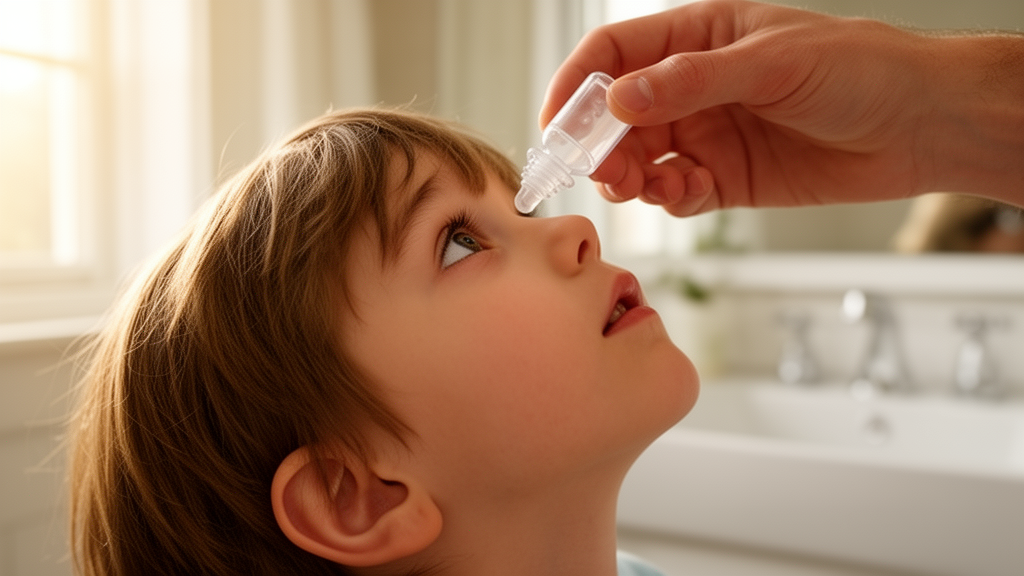
Childhood myopia has quietly become one of the most consequential epidemics of our time, and the drops that could slow it may cost less than a cup of coffee a month in some countries. A systematic review published in Frontiers in Pharmacology has, for the first time, brought together the economic evidence on low-dose atropine for pediatric myopia control, and the verdict is striking: across every model-based economic evaluation that met the review’s criteria, the intervention was found to be cost-effective or outright cost-saving compared with standard optical correction. The findings arrive at a moment when the global prevalence of myopia in children has climbed from 24 percent in 1990 to 35 percent in 2023, with projections pointing toward 40 percent by 2040 and roughly half the world’s children affected by mid-century.
The scale of the economic burden is difficult to overstate. Annual direct costs of vision correction alone are estimated at USD 328 billion worldwide, and high myopia, defined as refractive error of at least minus six diopters, adds a further USD 244 billion per year in direct healthcare expenses and productivity losses. High myopia carries lifelong risks of irreversible vision loss through macular degeneration, retinal detachment, and glaucoma, complications that transform a childhood refractive error into a decades-long medical and financial liability. Against this backdrop, low-dose atropine, at concentrations between 0.01 and 0.05 percent, has emerged as the frontline pharmacological therapy, capable of slowing myopia progression by 50 to 60 percent in clinical trials with minimal side effects.
The review, conducted by researchers from Sunway University in Malaysia, Hospital Raja Permaisuri Bainun in Ipoh, Thermo Fisher Scientific in Kuala Lumpur, and Universitas Airlangga in Indonesia, followed PRISMA guidelines and was registered in PROSPERO under identifier CRD420251009680. The team searched PubMed, Embase, the Cochrane Library, Web of Science, and ProQuest, replicating and updating a search strategy from a prior cost-effectiveness review of myopia interventions. From 374 initially identified studies, narrowed to 280 unique records after duplicate removal, only four model-based economic evaluations ultimately satisfied the inclusion criteria, originating from Hong Kong, New Zealand, Australia and China, and France and the United Kingdom. A supplemental search in May 2026 added one further study, bringing the final count to four.
What the four studies lacked in number, they made up for in methodological diversity. Two employed Markov cohort state-transition models, which track children through discrete health states such as low, moderate, and high myopia, while two used probabilistic cohort decision-analytic models that simulate continuous refractive trajectories from childhood to adulthood. All four adopted a societal perspective, capturing not only direct medical costs but also transportation, caregiver time, and productivity losses. Each applied a 3 percent annual discount rate to future costs, with sensitivity analyses testing alternative rates. Time horizons ranged from five years for incident myopia to lifetime horizons extending to life expectancy, capturing the downstream consequences of myopia progression and vision impairment.
The headline numbers are remarkable. In a New Zealand cost-utility model, screening plus atropine 0.01 percent yielded an incremental cost-effectiveness ratio of approximately NZD 1,590 per quality-adjusted life year gained, equivalent to about USD 1,188 in 2024 terms. That figure sits at just 2.7 percent of the country’s conventional willingness-to-pay threshold of NZD 58,000 per QALY, derived from a GDP-per-capita method, making the strategy extremely cost-effective by any standard. The same model estimated that the screening-plus-treatment program would prevent seven blindness cases per 100,000 children screened, with a number needed to treat of 14,286 to prevent a single case of blindness.
In Hong Kong, a five-year cost-effectiveness analysis using a three-state Markov model reported ICERs of USD 220 per diopter of spherical equivalent reduction for atropine 0.05 percent, a dominant strategy, and USD 275 per diopter for 0.01 percent, standardized to USD 291 and USD 233 respectively in 2024 dollars. These values fell within 2.2 to 2.75 percent of the study’s novel willingness-to-pay range of USD 0 to 10,000 per diopter. The analysis also incorporated axial length as a secondary outcome, with 0.05 percent atropine reducing axial length progression by 1.80 millimeters and 0.01 percent by 1.02 millimeters over the modeled period. Notably, this was the only study to formally cost adverse event management, including allergic conjunctivitis and photophobia.
The lifetime models told perhaps the most compelling story. In Australia and China, a probabilistic lifetime cohort cost model found atropine to be the cheapest lifetime option in China, with a cost ratio of approximately 0.49 relative to conventional correction, and cost-saving in Australia at a ratio of 0.92 under 3 percent discounting. The European adaptation, extending the same methodology to France and the United Kingdom, found lifetime savings of USD 7,585 in France and USD 15,155 in the UK for faster progressors, with cost ratios of 0.77 and 0.69 respectively. For slower progressors, the intervention was cost-neutral in the UK and slightly more expensive in France, at a ratio of 1.03. The pattern is clear: the economic advantage of atropine grows with the child’s risk of rapid progression, because preventing high myopia and its complications is where the real money is saved.
A crucial technical insight from the review concerns what actually drives costs. During the finite two-to-ten-year treatment period, the main short-term cost drivers are not the drops themselves but the additional ophthalmology and optometry visits, refraction, and monitoring that accompany the therapy. Atropine eye drop prices varied enormously across settings, from USD 1.50 per month in mainland China to USD 21.52 in Australia, USD 53.69 in subsidized France, and USD 84.23 in the United Kingdom where families paid out of pocket. In lifetime models, total costs are dominated not by these acquisition prices but by the refractive outcome achieved in adulthood and the resulting risk of myopia-related complications and low-vision care. This explains why longer time horizons consistently show greater economic benefit, as the avoidance of pathological myopia, with a disability weight of 0.184 in the Global Burden of Disease framework, dwarfs the modest childhood treatment costs.
The review also flagged a coming inflection point in the field. Most existing economic evaluations modeled compounded, off-label atropine, but licensed pharmaceutical products such as Eikance in New Zealand and Australia and Ryjunea in Europe are now entering practice, potentially altering prices, dispensing pathways, and reimbursement arrangements. The authors caution that cost-effectiveness is highly context-dependent, varying with local drug pricing, prescribing and monitoring pathways, whether care is ophthalmologist-led or optometrist-led, and health-system financing. ICERs from current models cannot be directly transferred to Malaysia or other ASEAN settings without local adaptation, a point of particular relevance for middle-income health systems where atropine remains closely tied to ophthalmologist-led care and government subsidies, such as those in France, may be absent.
Despite the limited number of studies and their methodological heterogeneity, the evidence consistently supports low-dose atropine as a cost-effective or cost-saving intervention compared with conventional single-vision correction. The review’s authors call for future studies to validate current model assumptions with long-term real-world data, particularly on treatment duration, rebound after cessation, and the lifetime impact of preventing high myopia, and to update economic models to reflect licensed product pricing. As childhood myopia continues its relentless global march, the message from the economics is unambiguous: a modest investment in childhood myopia control may be repaid many times over in avoided complications, reduced productivity losses, and preserved vision across a lifetime.
Subject of Research: Health
Article Title: Systematic review of atropine cost-effectiveness in childhood myopia management
Article References: Sui, C. F., Ng, C. H., Soh, Y. C., Lee, K. S., Hermansyah, A., & Ming, L. C. (2026). Systematic review of atropine cost-effectiveness in childhood myopia management. Frontiers in Pharmacology, 17, Article 1836579. https://doi.org/10.3389/fphar.2026.1836579
Image Credits: AI Generated
DOI: 10.3389/fphar.2026.1836579
Keywords: myopia, atropine, cost-effectiveness, pediatric ophthalmology, health economics, systematic review, Systematic, review, childhood, management, scientific research
Cite Scienmag News
Ophelia Keating. (October 18, 2026). Cheap Eye Drops Could Save Billions in the Fight Against Childhood Myopia. Scienmag. https://scienmag.com/cheap-eye-drops-could-save-billions-in-the-fight-against-childhood-myopia/
Ophelia Keating. "Cheap Eye Drops Could Save Billions in the Fight Against Childhood Myopia." Scienmag, 18 October 2026, https://scienmag.com/cheap-eye-drops-could-save-billions-in-the-fight-against-childhood-myopia/. Accessed 18 October 2026.
Ophelia Keating. "Cheap Eye Drops Could Save Billions in the Fight Against Childhood Myopia." Scienmag. October 18, 2026. https://scienmag.com/cheap-eye-drops-could-save-billions-in-the-fight-against-childhood-myopia/


