


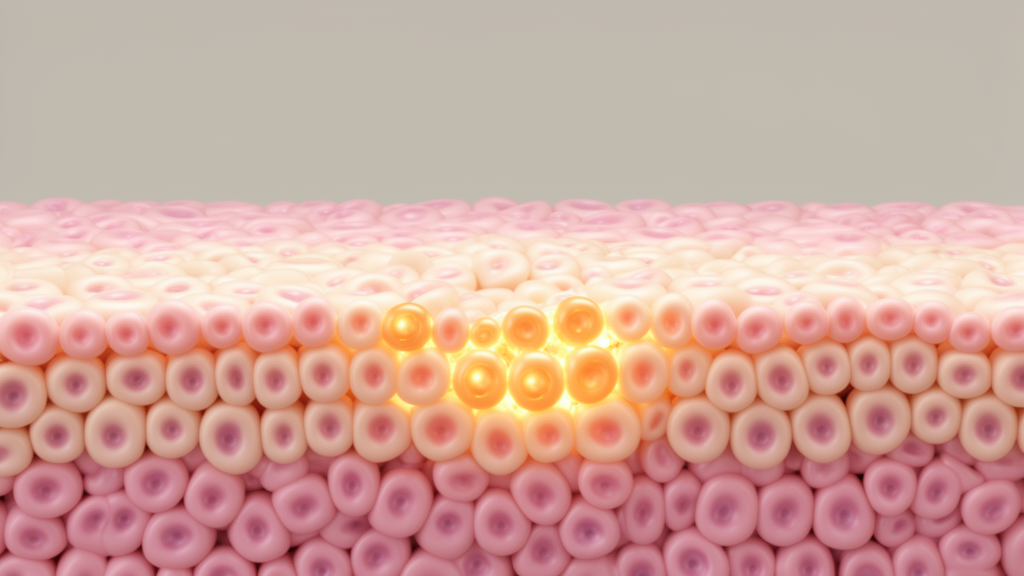
In a discovery that reshapes how scientists think about the earliest stages of cancer, researchers have shown that a mutation famously abundant in healthy tissue may actually protect against malignant transformation rather than promote it. A study published in Genome Medicine on 15 October 2026 reveals that mutations in the gene NOTCH1, which are strongly favored during the expansion of cell clones in histologically normal esophageal tissue, provide little to no advantage during the leap from normal clone to full-blown esophageal squamous-cell carcinoma. More strikingly, the team found that early NOTCH1 mutations actively suppress the evolutionary path toward cancer by reducing selection for mutations in TP53 and RB1, two of the most notorious tumor suppressor genes in human malignancy.
The finding comes from a team led by Kira A. Glasmacher and Vincent L. Cannataro of Emmanuel College in Boston, together with Jeffrey D. Mandell, Mia Jackson, Nic Fisk, and Jeffrey P. Townsend of Yale University and the University of Rhode Island. Their work tackles one of the most confusing puzzles in modern cancer biology: why do mutations found at high frequency in completely normal tissue also appear frequently in tumors arising from that same tissue? The intuitive answer, that these mutations must therefore help cause cancer, turns out to be misleading, and the new study quantifies precisely why.
To untangle the puzzle, the researchers employed a quantitative evolutionary framework designed to separate two processes that are usually conflated: the underlying rate at which mutations occur, and the selective advantage, if any, that a mutation confers on the cells carrying it. A mutation can be common simply because it happens often, because it gives cells a proliferative edge, or both. Disentangling these forces requires estimating selection separately at each step of tumor development, rather than assuming that a mutation’s prevalence reflects a constant advantage throughout the entire trajectory from healthy cell to malignancy.
The team applied this framework to sequence data from 2,171 samples, spanning two critical transitions in esophageal disease. The first transition runs from organogenesis, the original formation of the organ during development, to clonal histologically normal esophageal epithelium, patches of tissue that look entirely normal under the microscope but are dominated by descendants of a single mutated cell. The second transition runs from that clonal normal tissue to esophageal squamous-cell carcinoma, one of the most lethal cancers worldwide. By estimating step-specific selection on recurrent somatic mutations at each transition, the researchers could ask whether a mutation’s advantage changes as disease progresses.
The answer, for NOTCH1, was emphatically yes. During the clonal expansion of normal esophageal epithelium, NOTCH1 mutations were strongly positively selected, which fully explains their remarkably high prevalence in that tissue, a phenomenon documented in earlier studies that found large fractions of the normal esophageal lining colonized by NOTCH1-mutant clones. Yet when the researchers measured selection during the progression from clonal normal tissue to carcinoma, the signal vanished. There was little to no positive selection for mutations in NOTCH1, the closely related NOTCH2, or the planar cell polarity gene FAT1 during this malignant transition. In other words, these alterations promote cellular expansion in normal tissue but do not drive the transformation of an established normal clone into cancer.
That step-specific pattern alone would be noteworthy, but the study went further and uncovered the mechanistic basis for it. For the first time, the researchers demonstrated that NOTCH1 mutations exhibit antagonistic epistasis with mutations in TP53 and RB1. Epistasis refers to the phenomenon in which the effect of one mutation depends on the presence or absence of another; antagonistic epistasis means the combination is less favorable than the sum of its parts. Here, the presence of a NOTCH1 mutation reduces the selective advantage that TP53 or RB1 mutations would otherwise confer during tumor development, effectively dampening the evolutionary push toward malignancy.
The authors propose a biological interpretation grounded in the known functions of these genes. NOTCH1 acts as a tumor suppressor in esophageal epithelium, and its loss permits cells to expand within the structured, homeostatic environment of normal tissue, where its constraint on proliferation normally matters. TP53, the guardian of the genome, and RB1, a master regulator of the cell cycle, become critically important once cells begin accumulating the genomic chaos characteristic of frank malignancy. The new data suggest that when NOTCH1 is already disabled, the fitness landscape shifts: disrupting TP53 or RB1 yields less additional benefit, and clones carrying both types of alterations fail to gain the momentum that TP53 or RB1 loss alone would provide.
Consistent with this model, the team’s analysis of somatic copy-number alterations, large-scale gains and losses of chromosomal segments that typify advanced cancers, revealed that the copy-number changes associated with later esophageal squamous-cell carcinoma progression were more strongly selected in samples that already carried TP53 mutations. This observation supports the idea that TP53 disruption creates a genomic context more permissive for malignant evolution, a permissiveness that early NOTCH1 mutation appears to deny. The researchers also examined single-cell transcriptomic profiles to place these evolutionary patterns within the broader cellular changes that accompany progression, integrating mutational, structural, and expression-level evidence into a single coherent picture.
The conceptual implications are profound. Cancer evolution is often imagined as a relay race in which each successive driver mutation hands off a growing advantage to the next. This study shows instead that the fitness landscape is not fixed but shifts dramatically across disease stages, and that the value of any given mutation depends on the mutational company it keeps. A mutation that wins the competition in normal tissue may be neutral, or even a liability, in a tumor. Early somatic mutations can promote clonal expansion without promoting cancer, and in some cases they may actively constrain it by reducing selection for the later driver events that malignant transformation requires.
These insights carry practical weight for early detection, prevention, and therapy. Screening strategies that flag NOTCH1 mutations in esophageal biopsies as ominous precursors may need revision, since the mutation’s presence could indicate a clone that is expanding harmlessly, or even one whose evolutionary door to malignancy has been partly closed. The authors argue that precision approaches must account for the shifting fitness landscape across premalignant and malignant stages, prioritizing interventions according to which mutations actually drive progression at each step rather than assuming that prevalence equals pathogenicity. As sequencing of normal tissue becomes routine, distinguishing evolutionary dead ends from genuine threats will be essential, and this study provides a quantitative template for making that distinction rigorously.
Subject of Research: Step-specific selection and epistasis of somatic mutations during progression from normal esophageal epithelium to esophageal squamous-cell carcinoma
Article Title: Early NOTCH1 mutation is positively selected but epistatically suppresses evolution of later esophageal squamous-cell carcinoma drivers
Article References: Early NOTCH1 mutation is positively selected but epistatically suppresses evolution of later esophageal squamous-cell carcinoma drivers. (n.d.). https://doi.org/10.1186/s13073-026-01779-8
Image Credits: AI Generated
DOI: 10.1186/s13073-026-01779-8
Keywords: NOTCH1, esophageal squamous-cell carcinoma, somatic evolution, epistasis, TP53, RB1, clonal expansion, tumor suppressor genes, copy-number alterations, cancer progression, selection, Genome Medicine
Cite Scienmag News
Juliet Wilcox. (October 15, 2026). Early NOTCH1 Mutation Shields Esophageal Tissue from Turning Cancerous. Scienmag. https://scienmag.com/early-notch1-mutation-shields-esophageal-tissue-from-turning-cancerous/
Juliet Wilcox. "Early NOTCH1 Mutation Shields Esophageal Tissue from Turning Cancerous." Scienmag, 15 October 2026, https://scienmag.com/early-notch1-mutation-shields-esophageal-tissue-from-turning-cancerous/. Accessed 15 October 2026.
Juliet Wilcox. "Early NOTCH1 Mutation Shields Esophageal Tissue from Turning Cancerous." Scienmag. October 15, 2026. https://scienmag.com/early-notch1-mutation-shields-esophageal-tissue-from-turning-cancerous/


