


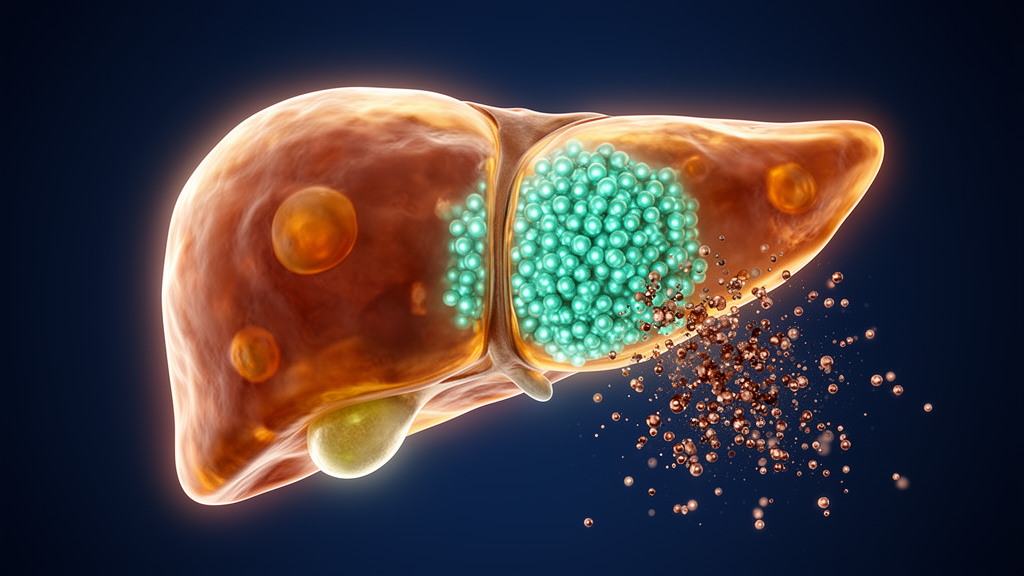
Wilson disease has long been understood as a disorder of copper plumbing: a broken ATP7B transporter means the metal piles up in the liver until the organ begins to fail. What has remained stubbornly unclear is precisely how the accumulating copper kills hepatocytes. A new study published in the Journal of Molecular Medicine offers the most detailed answer yet, tracing a molecular chain that runs from copper-saturated cell nuclei to a silenced fat-handling gene and, ultimately, to ferroptosis, the iron-dependent form of cell death driven by runaway lipid peroxidation. The work, led by Yingjie Li and corresponding authors Yimin Zhang and Ning Zhou, positions the PPARα–FABP1 signaling axis as the critical intermediary between copper toxicity and lethal membrane damage.
The research team began with the human disease itself. Examining liver tissue from patients with Wilson disease, they documented a constellation of metabolic injuries: impaired antioxidant capacity, abundant markers of lipid peroxidation, and, crucially, a coordinated downregulation of two linked molecules, the nuclear receptor PPARα and its downstream target FABP1, the liver fatty acid-binding protein. The same pattern appeared in the Atp7b-deficient mouse model, the standard animal proxy for the disease, and it was visible at both the transcriptomic and proteomic levels. That consistency across species and measurement platforms suggested the pair was not an incidental casualty of liver damage but an active participant in it.
To test causality, the investigators turned to hepatocytes grown in culture and exposed them to copper. The metal accumulated in the nuclear-enriched fraction of the cells, consistent with earlier reports that excess copper impairs hepatic nuclear receptor function, and it repressed PPARα and FABP1 expression in a time-dependent manner. With the protective axis weakened, the cells became strikingly vulnerable to RSL3, a chemical tool that inhibits the lipid-repair enzyme GPX4 and thereby triggers ferroptosis. Copper exposure lowered the threshold at which RSL3 killed the cells and amplified lipid peroxidation, the biochemical signature of the ferroptotic process.
The team then ran the experiment in reverse. Silencing PPARα or FABP1 in hepatocytes reproduced the copper effect almost exactly, lowering the resistance of the cells to ferroptotic stress and boosting peroxidation. Conversely, pharmacological inhibition of ferroptosis partially rescued the copper-treated cells, confirming that the cell death pathway in play was ferroptosis rather than apoptosis or necrosis. Together, the gain-of-function and loss-of-function data make a strong argument that the PPARα–FABP1 axis is not merely correlated with copper toxicity but functionally required for hepatocyte survival under copper overload.
Why would losing FABP1 matter so much? The protein is among the most abundant in the hepatocyte cytosol, where it shuttles fatty acids and, importantly, buffers polyunsaturated fatty acids, the very lipid species most prone to peroxidation. Prior work has shown that L-FABP directly interacts with PPARα in primary hepatocytes and that the protein carries intrinsic antioxidant activity. When FABP1 levels fall, polyunsaturated fatty acids are left exposed to oxidative attack, and the resulting peroxidized phospholipids, particularly those derived from arachidonic acid, are known to be the navigational signals that steer cells toward ferroptosis.
The lipidomics evidence reinforced this mechanistic picture. By integrating previously published lipidomic datasets, the researchers found that peroxidized polyunsaturated fatty acids accumulate in Wilson disease, matching the oxylipin profiles reported in patient plasma and in mouse models of the disorder. In their own experiments, overexpressing FABP1 mitigated arachidonic acid–driven lipid peroxidation and protected cells from ferroptosis. In other words, restoring the fat-binding protein partially rebuilt the cellular firewall that copper had torn down, providing a proof of concept that the axis can be targeted therapeutically.
The clinical implications extend beyond mechanism into prognosis. The team measured hepatic FABP1 expression and circulating FABP1 levels in their patient cohort and found that both declined as disease severity increased. Lower FABP1 was associated with greater inflammatory activity and more advanced fibrosis stage, and the circulating levels showed moderate predictive value for adverse outcomes. If these findings hold up in larger and more diverse cohorts, a simple blood measurement of FABP1 could eventually complement existing tools for staging Wilson disease and flagging patients at risk of rapid progression, an appealing prospect in a condition where early diagnosis dramatically alters the trajectory.
The study also reframes a long-running debate about how copper kills liver cells. Recent literature has highlighted cuproptosis, a copper-triggered cell death mechanism involving mitochondrial protein aggregation, as a candidate explanation for copper toxicity. The new data do not settle that debate, but they add a parallel and arguably better-substantiated route: copper suppresses a nuclear receptor program, the loss of that program strips away lipid protection, and the cell slides into ferroptosis. Notably, the PPARα–FABP1–ferroptosis connection has precedent elsewhere; downregulation of the axis has been implicated in ferroptosis in IgA nephropathy and in the lipid-rich microenvironment of gastric cancer metastasis, suggesting a broadly conserved vulnerability that Wilson disease happens to exploit.
Therapeutically, the findings point in two directions. The established standard of care for Wilson disease, copper chelation and zinc therapy to block metal absorption, remains the foundation, and the new work does not challenge it. But the study suggests that patients may benefit from approaches that shore up the ferroptosis defense system directly, whether by activating PPARα, restoring FABP1, or deploying ferroptosis inhibitors, particularly during acute presentations when copper levels cannot be lowered overnight. Ferroptosis has already been implicated as an inflammatory trigger in other liver diseases, including nonalcoholic steatohepatitis, so agents that dampen lipid peroxidation could have value across a spectrum of hepatic injury, with Wilson disease as a genetically defined setting in which to test them.
Caveats remain. The rescue effects of ferroptosis inhibition were partial, indicating that copper inflicts damage through additional pathways that the PPARα–FABP1 axis does not capture. The predictive value of circulating FABP1 was moderate rather than decisive, and the clinical cohort, while ethically approved and conducted under the Declaration of Helsinki, will need expansion before biomarker claims become practice. Still, the study delivers something Wilson disease research has lacked: a coherent, experimentally validated mechanism that connects the metal, a master metabolic regulator, a fat-binding protein, and a defined mode of cell death, all anchored to measurable correlates of human disease severity. It turns a decades-old question, how copper destroys the liver, into a set of answerable, and potentially druggable, molecular problems.
Subject of Research: Copper-induced suppression of the PPARα–FABP1 axis and ferroptosis in Wilson disease
Article Title: Copper-induced suppression of the PPARα–FABP1 axis sensitizes hepatocytes to ferroptosis in Wilson disease
Article References: Li, Y., Wu, Y., Zhou, Y., Zhao, L., Xu, Z., Zhang, Y., & Zhou, N. (2026). Copper-induced suppression of the PPARα–FABP1 axis sensitizes hepatocytes to ferroptosis in Wilson disease. Journal of Molecular Medicine, 104(1), Article 119. https://doi.org/10.1007/s00109-026-02725-2
Image Credits: AI Generated
DOI: 10.1007/s00109-026-02725-2
Keywords: Wilson disease, copper overload, ferroptosis, PPARα, FABP1, lipid peroxidation, hepatocytes, liver fibrosis, ATP7B, polyunsaturated fatty acids, nuclear receptor, biomarker
Cite Scienmag News
Juliet Wilcox. (October 9, 2026). Copper Overload Silences a Key Liver Fat Gene, Pushing Cells Into Ferroptosis in Wilson Disease. Scienmag. https://scienmag.com/copper-overload-silences-a-key-liver-fat-gene-pushing-cells-into-ferroptosis-in-wilson-disease/
Juliet Wilcox. "Copper Overload Silences a Key Liver Fat Gene, Pushing Cells Into Ferroptosis in Wilson Disease." Scienmag, 9 October 2026, https://scienmag.com/copper-overload-silences-a-key-liver-fat-gene-pushing-cells-into-ferroptosis-in-wilson-disease/. Accessed 9 October 2026.
Juliet Wilcox. "Copper Overload Silences a Key Liver Fat Gene, Pushing Cells Into Ferroptosis in Wilson Disease." Scienmag. October 9, 2026. https://scienmag.com/copper-overload-silences-a-key-liver-fat-gene-pushing-cells-into-ferroptosis-in-wilson-disease/


