


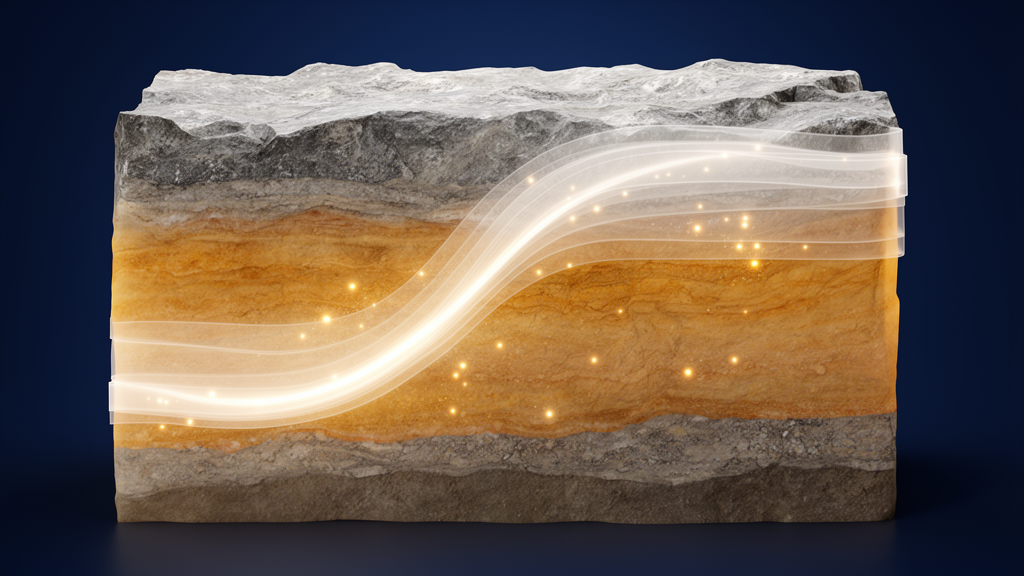
Pore pressure is one of those invisible quantities that quietly decides whether a drilling campaign ends in triumph or in a multimillion-dollar blowout. It is the pressure of the fluids trapped within the tiny spaces of rock deep underground, and it exerts a first-order control on drilling safety and on the integrity of the traps that hold oil and gas in place. Yet despite its importance, pore pressure is almost never measured directly. Engineers must infer it indirectly from wireline logs, the electrical and physical fingerprints recorded by instruments lowered into a borehole. A new study published in Earth Science Informatics by Akbar Ali, Rongyi Qian, Majid Khan and Zhenning Ma tackles a stubborn gap in this inference problem: what happens when the one log that conventional methods depend on, the sonic log, simply is not there?
The setting is the Kohat Plateau of Pakistan, a structurally complex fold-and-thrust belt at the northwestern edge of the Himalayan collision zone, where Jurassic carbonates hold the target reservoirs. Carbonate reservoirs are notoriously unforgiving for pressure prediction. Unlike shales, where compaction trends are relatively well behaved, carbonates cement, dissolve and recrystallize in ways that scramble the relationships between rock properties and pressure. Add to that the practical reality that pressure measurements are sparse and sonic logs are frequently missing from older wells, and you have a problem that has resisted routine solutions. Conventional pressure transforms, including the classic Eaton method introduced in 1969 and refined in 1975, assume that a sonic travel-time log is available to detect departures from normal compaction. When that log is absent, the whole workflow stalls.
The research team’s answer is a machine-learning workflow that never touches a sonic log at any stage. Instead of relying on acoustic travel time, the reference pressure is anchored to the resistivity log, an approach with deep historical roots stretching back to electrical-survey-based pressure estimation in offshore Louisiana in the 1960s. The models themselves are trained on density, porosity and gamma-ray curves, three measurements that almost every drilled well already possesses regardless of its age or the logging program it received. That choice transforms the accessibility of the method: wells that were previously useless for pressure prediction suddenly become usable, which matters enormously in mature basins where legacy wells are often the only subsurface data available.
Four machine-learning algorithms were put through their paces: LightGBM and CatBoost, two fast and widely used gradient-boosting frameworks; NGBoost, a variant designed specifically to output probabilistic predictions; and a Gaussian process regression model, a Bayesian method whose mathematical structure naturally produces an uncertainty estimate alongside every prediction. The data were divided using a 60/20/20 split into training, validation and test partitions, with the validation set used for early stopping to prevent overfitting. Critically, all reported performance metrics were computed on the held-out test set, meaning the numbers describe how the models behave on data they had never seen rather than how well they memorized their training examples.
The Gaussian process emerged as the clear winner, achieving a coefficient of determination of 0.94, a root-mean-square error of 586 pounds per square inch, and a mean absolute percentage error of 5.5 percent on the test data. CatBoost and LightGBM followed closely behind, with R-squared values of 0.91 and 0.90 respectively. On raw accuracy alone, the spread between the models looks modest. But the study’s most revealing result concerns not accuracy at all, and it is the kind of finding that could change how the industry audits its own predictive tools.
Every model was asked to issue a 90 percent prediction interval, a range within which the true pressure should fall nine times out of ten if the model’s self-assessment is honest. When the researchers checked those intervals empirically against the test set, the Gaussian process covered 94.3 percent of the true values, remarkably close to the nominal 90 percent target. The two gradient-boosting models, by contrast, covered only about 66 percent of test points within their stated intervals. In plain terms, they were over-confident: they claimed a level of certainty their predictions did not deserve. For a drilling engineer deciding how heavy to make the drilling mud, the difference between a model that is right nine times in ten and one that is right two times in three is not a statistical footnote. It is the margin between a safe operation and an unexpected kick, lost circulation, or worse.
To make the predictions interpretable rather than opaque, the team applied SHAP attribution, a technique from explainable machine learning that decomposes each individual prediction into the contributions of its input features. This means every pressure estimate comes with an accounting of which logs produced it and by how much. The analysis showed that overburden stress and bulk density dominated the predictions, a result that is theoretically satisfying because it aligns with effective-stress theory, the foundational framework in which pore pressure reflects the balance between the weight of overlying rock and the support provided by fluid pressure. When a black-box model’s internal logic reproduces the physics that geoscientists expect, confidence in its outputs becomes easier to justify.
The workflow did not stop at pore pressure. The team used Eaton’s fracture-pressure formulation to estimate the fracture gradient, the pressure at which the rock itself would begin to crack and accept fluid. Together, the pore pressure and fracture gradient define the mud-weight window, the range of drilling fluid densities that keeps the wellbore stable: too light, and formation fluids flow into the well; too heavy, and the formation fractures. For the Jurassic carbonate of the Kohat Plateau, the resulting window spans roughly 1.05 to 1.6 grams per cubic centimeter, narrowing wherever pore pressure runs elevated. That narrowing is precisely where drilling risk concentrates, and precisely where an accurate pressure forecast earns its keep.
Perhaps the study’s most practically important insight is how uncertainty propagates into operational decisions. In a conventional, deterministic workflow, the lower edge of the mud-weight window is set by the central estimate of pore pressure, a single number with no error bars attached. In the uncertainty-aware version, the operative lower limit becomes the upper edge of the pore-pressure prediction interval rather than its central estimate. The engineer plans against the pessimistic end of the range, not the average. This is, as the authors frame it, the practical difference between a deterministic and an uncertainty-aware pressure prediction: the same numbers, but a more conservative and defensible margin of safety built into every decision.
The broader implications reach well beyond one plateau in Pakistan. Carbonate reservoirs host a substantial share of the world’s remaining hydrocarbon resources, and many of the wells penetrating them predate modern logging suites. A workflow that extracts reliable pressure information from density, porosity, gamma-ray and resistivity curves alone, attaches calibrated uncertainty to every estimate, and explains itself through feature attribution, offers a template for revisiting legacy wells across the Middle East, Central Asia and beyond. Just as significant is the methodological caution the study delivers to the machine-learning community in the geosciences: accuracy metrics alone can flatter a model, while interval coverage exposes its over-confidence. As algorithms increasingly inform high-stakes subsurface decisions, the lesson from the Kohat Plateau is that a prediction is only as trustworthy as its honest accounting of what it does not know.
Subject of Research: Uncertainty-aware machine learning for pore pressure prediction from conventional wireline logs in carbonate reservoirs
Article Title: Uncertainty aware machine learning for pore pressure prediction in carbonate reservoirs
Article References: Ali, A., Qian, R., Khan, M., & Ma, Z. (2026). Uncertainty aware machine learning for pore pressure prediction in carbonate reservoirs. Earth Science Informatics, 19(11), Article 206. https://doi.org/10.1007/s12145-026-02261-0
Image Credits: AI Generated
DOI: 10.1007/s12145-026-02261-0
Keywords: pore pressure, machine learning, carbonate reservoirs, uncertainty quantification, Gaussian process regression, gradient boosting, SHAP, fracture gradient, Eaton method, drilling safety, Kohat Plateau, well logs
Cite Scienmag News
Violet Maxwell. (October 9, 2026). Machine Learning Predicts Pore Pressure Without Sonic Logs, With Honest Error Bars. Scienmag. https://scienmag.com/machine-learning-predicts-pore-pressure-without-sonic-logs-with-honest-error-bars/
Violet Maxwell. "Machine Learning Predicts Pore Pressure Without Sonic Logs, With Honest Error Bars." Scienmag, 9 October 2026, https://scienmag.com/machine-learning-predicts-pore-pressure-without-sonic-logs-with-honest-error-bars/. Accessed 9 October 2026.
Violet Maxwell. "Machine Learning Predicts Pore Pressure Without Sonic Logs, With Honest Error Bars." Scienmag. October 9, 2026. https://scienmag.com/machine-learning-predicts-pore-pressure-without-sonic-logs-with-honest-error-bars/


