


Pancreatic cancer cells leave an electrical fingerprint on extracellular vesicles, tiny packages released into the bloodstream, according to a Rice University study that used a charge-separating device to enrich cancer-associated particles in blood samples from 112 people. Researchers found that activating mutant KRAS increased both the release of extracellular vesicles, or EVs, and their negative electrical charge. When the device separated EVs from serum samples, those from people with pancreatic cancer showed greater enrichment in the more negatively charged population than samples from healthy participants or patients with pancreatitis.
The peer-reviewed study, published September 1, 2026, in ACS Nano , investigated whether pancreatic cancer alters a physical property of EVs that could be used to isolate potentially informative particles. EVs can contain DNA and other material from the cells that produced them, including cancer cells. The difficulty is that tumor-derived vesicles are mixed among a much larger population released by healthy tissues.
As study co-lead author Kshipra Kapoor explained, the challenge is not simply finding tiny particles in the crowded bloodstream, but identifying those carrying meaningful information. The team focused on KRAS, a gene that acts as a switch for cell growth. When mutated, the switch can remain in the “on” position, allowing uncontrolled growth; mutations in KRAS are a major factor in pancreatic cancer.
In laboratory-grown pancreatic cancer cells, activating mutant KRAS caused the cells to release more EVs. Those EVs also exhibited a stronger negative electrical charge. The researchers found that DNA and other materials on the vesicles’ outer surfaces contributed to this electrical signature, suggesting that the mutation affects not only the quantity of particles released but also a physical trait that can potentially distinguish a cancer-associated subset.
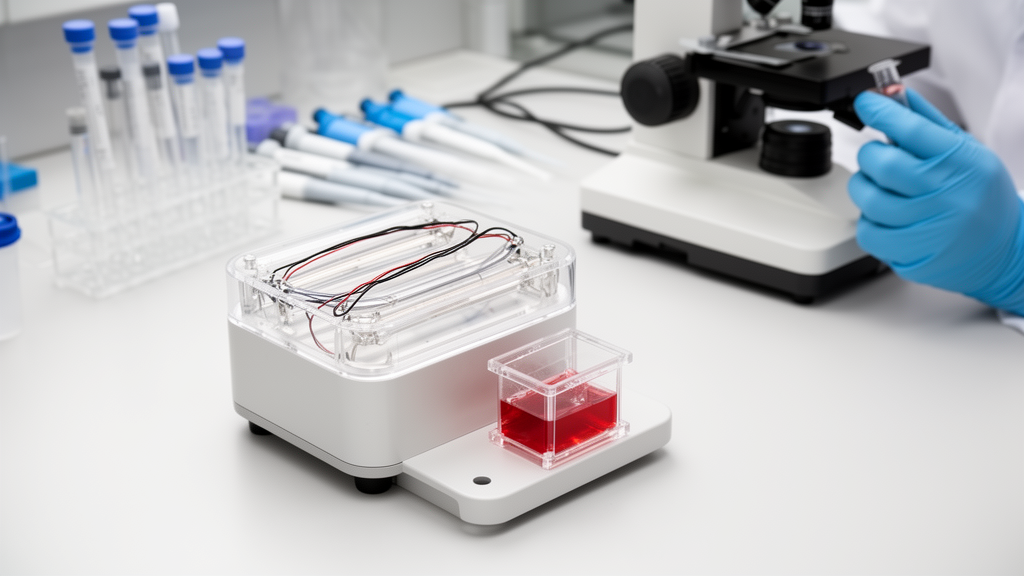
To exploit that difference, the researchers designed a microfluidic electrophoresis device that moves minute quantities of blood serum through narrow channels and separates EVs according to electrical charge. The instrument allows researchers to collect the more strongly negatively charged vesicles. This differs from methods that separate particles according to size or weight or use specially designed molecules for capture: the new device capitalizes on an electrical property that EVs already possess.
The team tested it on 112 samples drawn from healthy individuals, patients with pancreatic cancer and patients with pancreatitis, an inflammatory condition of the pancreas. Simply averaging the electrical charge of all EVs in a sample did not distinguish pancreatic cancer samples from healthy ones. The cancer-associated particles remained masked by the much larger vesicle population circulating in blood.
Once the device separated the vesicles, however, the difference became clearer: samples from patients with pancreatic cancer showed greater enrichment in the more negatively charged EV population. The experiment therefore showed that charge-based sorting can uncover a population difference that an undifferentiated measurement obscures. It did not establish a clinical diagnostic test or demonstrate improved patient outcomes; instead, it provides a laboratory enrichment method for studying pancreatic cancer-associated signals.
The work also follows a broader urgency around the disease: the news release noted that pancreatic cancer is frequently diagnosed only after it has spread and cited a five-year survival rate of 13%.
Subject of Research: Electrical charge separation of blood extracellular vesicles for enriching pancreatic cancer-associated signals
Article Title: Electrical fingerprint on tiny cell particles could offer new way to spot pancreatic cancer signals
Article References: Electrical fingerprint on tiny cell particles could offer new way to spot pancreatic cancer signals. Original publication (Bibliographic details unavailable.)
Image Credits: AI Generated
DOI: Not provided
Keywords: pancreatic cancer, extracellular vesicles, KRAS, blood biomarkers, microfluidics, electrophoresis, cancer detection, tumor-derived vesicles, bioelectricity, Electrical, fingerprint, tiny
Cite Scienmag News
Nathaniel Bowman. (October 26, 2026). Charge sorting enriches pancreatic cancer-associated vesicles in human blood samples. Scienmag. https://scienmag.com/charge-sorting-enriches-pancreatic-cancer-associated-vesicles-in-human-blood-samples/
Nathaniel Bowman. "Charge sorting enriches pancreatic cancer-associated vesicles in human blood samples." Scienmag, 26 October 2026, https://scienmag.com/charge-sorting-enriches-pancreatic-cancer-associated-vesicles-in-human-blood-samples/. Accessed 26 October 2026.
Nathaniel Bowman. "Charge sorting enriches pancreatic cancer-associated vesicles in human blood samples." Scienmag. October 26, 2026. https://scienmag.com/charge-sorting-enriches-pancreatic-cancer-associated-vesicles-in-human-blood-samples/


