


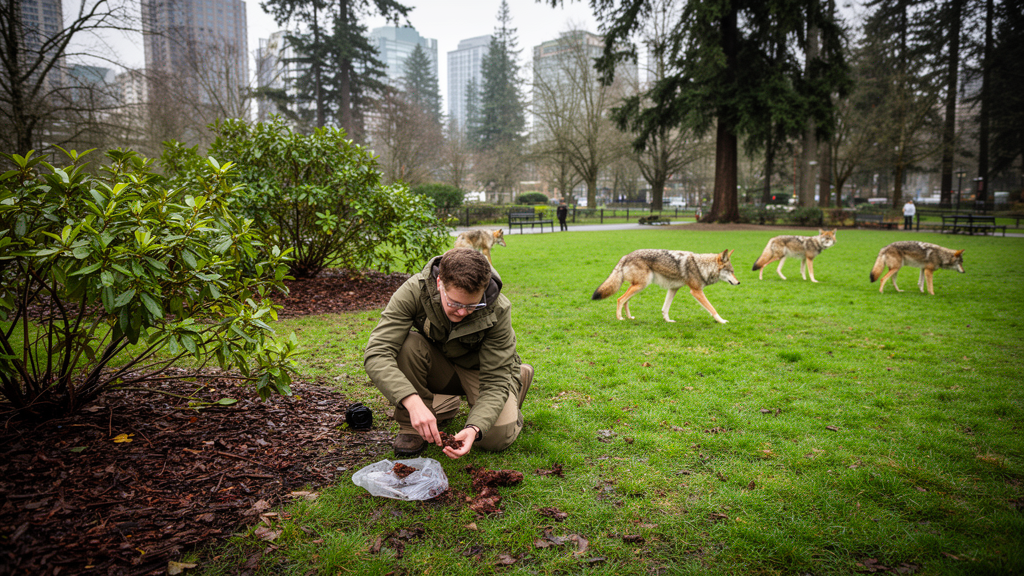
Researchers estimated the difference by analyzing 842 coyote scats collected throughout Seattle and at field sites near Winthrop in north-central Washington and Chewelah in the northeastern part of the state. The comparison identifies 213 individual coyotes and suggests that the broader urban setting can support substantially more coyotes than the sampled wild areas, although the research does not isolate which urban conditions caused the difference. “We observed a ninefold increase in coyote density in Seattle compared to more natural and wild areas of the state,” said Laura Prugh, a University of Washington professor of environmental and forest sciences and the study’s lead author.
The analysis was published Sept. 10 in Environmental Research: Ecology. Coyotes have colonized every major metropolitan area in North America over the past century and are now commonly seen in Seattle’s parks and neighborhoods, but the lack of formal abundance data has made it difficult for researchers to track population trends.
Long-term population information also remains limited, so the new estimate provides a formal comparison among sampled areas rather than a complete account of how Seattle’s coyote population has changed through time. For the study, researchers collected scat throughout Seattle and in wild study areas near Winthrop and Chewelah. To calculate density, they repeatedly collected samples and determined how often scats from the same animal appeared in the samples, allowing them to identify 213 coyotes across the 842 deposits.
This individual-recognition approach supported estimates of coyote abundance and the construction of maps showing relative density across the sampled landscape. It was an indirect method based on scat encounters, not a direct census of every coyote in Seattle or in the two wild areas. The reported result therefore describes the density estimated from the study’s sampling and comparison areas, which were specifically Seattle and two field locations elsewhere in Washington.
The team also examined whether conditions within the city helped explain variation in coyote density. It compared the coyote maps with maps showing pollution levels, tree cover, buildings and roads, human population density and income level. Of those factors, only human population density appeared related to coyote density within Seattle.
Specifically, coyote density was lower in more densely populated parts of the city. That within-city relationship did not mean Seattle contained fewer coyotes than sparsely populated wild areas. The city as a whole had a much higher estimated coyote density, showing that the association between people and coyotes differed when neighborhoods inside the city were compared with the broader urban and wild settings.
“In Seattle, human population density had a negative effect on coyote density,” Prugh said. “But when you compare coyote abundance in Seattle to areas with far fewer people, the coyote population was much higher in the city.” The finding complicates the idea that coyotes are principally deterred by human presence. Although urban coyotes generally avoid people and can display territorial or aggressive behavior, the conditions associated with dense human populations can also favor their survival.
The analysis does not show that human density itself attracts coyotes or that proximity to people is beneficial to them. Rather, it documents a negative association within Seattle and contrasts that pattern with the striking city-to-wild density estimate. One set of possible influences involves predators and human-directed mortality.
In wild areas, larger carnivores such as wolves and mountain lions hunt coyotes, while farmers and landowners are more likely to kill coyotes to protect livestock. Urban coyotes have fewer such predators and can occupy the ecological position of an apex predator within the city. Motor vehicles and disease are described as the regular causes of mortality among urban coyotes, but those hazards did not prevent their estimated density from exceeding that of the wild study areas.
Food may provide another part of the explanation. Analysis of the scats showed that urban coyotes ate a diet more than twice as diverse as that of wild coyotes, although berries and rabbits were the leading foods in both groups. Seattle’s abundance of potential food can coexist with its concentrations of people, and the broader diet offers more than one possible food source for animals living in a heavily modified landscape.
Instead, the measured result was greater dietary diversity among urban animals, while food availability was discussed as part of the ecological context in which Seattle coyotes persist at high estimated density. Rabbits may be an especially important link between the city’s ecology and its coyote population. Rabbits are a preferred prey species for coyotes in most ecosystems, and the abundance of rabbits can affect coyotes.
Seattle has also experienced a “bunny boom” over the past few decades that changed urban ecology and may have helped draw coyotes to the region. “Coyotes and rabbits have a natural relationship, even in a highly altered environment like Seattle,” Prugh said. She added that rabbit density could be an even stronger predictor of coyotes than human density, but noted that there were not enough data to test that idea.
Rabbit abundance therefore remains a proposed explanation rather than a demonstrated mechanism in the ninefold comparison. The researchers also considered what the results imply for the city’s coyotes and the limits of control efforts. Because coyotes are territorial, fights over access to space can help control their population when other predators are absent.
A city can support only a finite number of animals, but Prugh said it was uncertain whether Seattle had reached that limit. Anecdotal evidence indicates that sightings have become more common over the past few decades, although the study cannot turn that observation into a measured population trend. Sightings are most common at dusk and dawn, but coyotes are now also appearing in broad daylight.
They tend to avoid people, while residents have raised concerns about coyotes preying on pets and showing territorial or aggressive behavior. The research also highlights an overlooked ecological role for coyotes in urban environments. Rabbits can frustrate gardeners by eating young plants, while coyotes may reduce that pressure by eating the rabbits.
Prugh emphasized that deciding whether there are too many or too few coyotes is ultimately a societal question, but said that the answer may not alter their presence. “Coyotes are here to stay in cities, and it is up to us to learn how to live with them,” she said. The study estimates a pronounced density difference and identifies food, predation, mortality, human density and rabbit abundance as factors relevant to interpretation.
It does not establish how coyote numbers will change in the future, whether Seattle has reached its ecological limit, or whether a particular level of coyote abundance is preferable. It does show that a coyote population can be unusually dense in a major city, with the study’s scat-based estimate placing Seattle’s coyotes at nine times the density observed in the sampled wild areas of Washington.
Subject of Research: Urbanization and coyote population density in Seattle and Washington
Article Title: Coyote density is 9 times higher in Seattle than in Washington’s wild lands
Article References: Coyote density is 9 times higher in Seattle than in Washington’s wild lands. Original publication (Bibliographic details unavailable.)
Image Credits: AI Generated
DOI: Not provided
Keywords: coyotes, Seattle, urban ecology, animal density, Washington state, scat analysis, rabbit predation, diet diversity, urbanization, peer-reviewed research, Coyote, density
Cite Scienmag News
Margaret Porter. (October 26, 2026). Peer-reviewed scat study finds Seattle coyote density ninefold above wild Washington. Scienmag. https://scienmag.com/peer-reviewed-scat-study-finds-seattle-coyote-density-ninefold-above-wild-washington/
Margaret Porter. "Peer-reviewed scat study finds Seattle coyote density ninefold above wild Washington." Scienmag, 26 October 2026, https://scienmag.com/peer-reviewed-scat-study-finds-seattle-coyote-density-ninefold-above-wild-washington/. Accessed 26 October 2026.
Margaret Porter. "Peer-reviewed scat study finds Seattle coyote density ninefold above wild Washington." Scienmag. October 26, 2026. https://scienmag.com/peer-reviewed-scat-study-finds-seattle-coyote-density-ninefold-above-wild-washington/


