


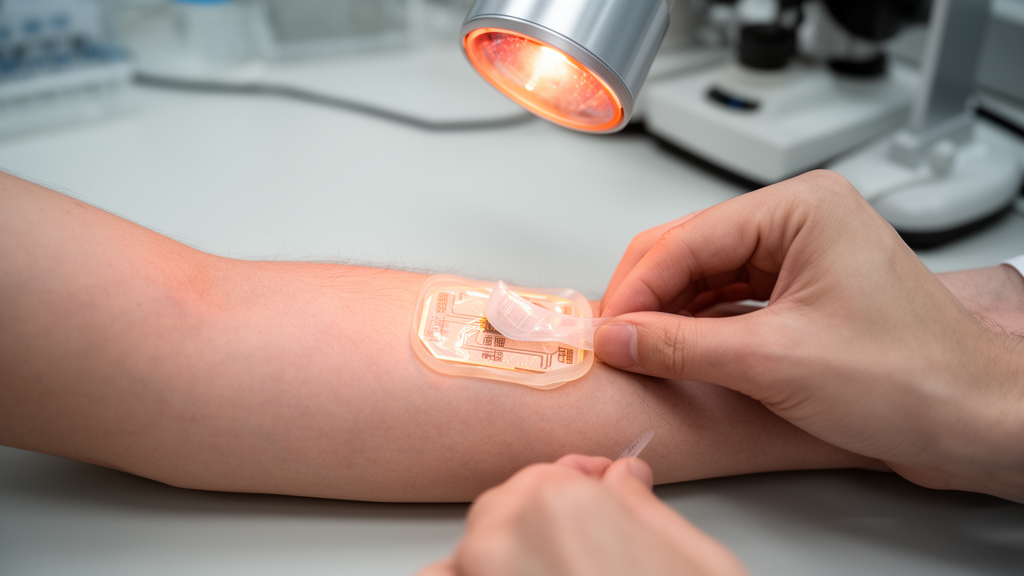
A peer-reviewed materials study reports that a shape-memory polymer adhesive can maintain stable attachment to skin during use and then detach with reduced force after mild heating. In experiments, thermal activation reduced adhesion energy by up to approximately 99%, while the patch continued to provide stable attachment and acquire biosignals through integrated wireless sensing devices. The work was led by researchers at Pohang University of Science and Technology, with collaborators at Texas Tech University and Northwestern University, and was published in Nature Communications.
Skin-mounted medical monitors, including sensors for cardiac activity, respiration and motion, must remain firmly attached to collect reliable physiological signals. Conventional medical adhesives are designed primarily to maximize adhesion, but that strength can produce large peeling forces and stress concentrations at the skin surface. Repeated attachment and removal can cause irritation, epidermal damage and skin stripping, particularly in neonates, older adults and critically ill patients. The team addressed the removal problem by controlling the mechanical interface between the device and the skin rather than relying only on the adhesive material itself. The results were obtained from mechanical and materials experiments using a skin phantom and human skin; the study was not a clinical trial measuring patient outcomes.
The adhesive uses a shape-memory polymer programmed to recover a predetermined geometry when exposed to a specific temperature. In its dormant state, pyramidal structures on the patch surface are flattened, allowing broad contact with the skin and stable attachment. When the material is mildly heated above its glass transition temperature, the pyramids recover their original geometry. This change creates gaps at the skin-adhesive interface and reduces the effective contact area, allowing the patch to detach with substantially lower force. Three-dimensional digital image correlation was used to visualize deformation beneath the skin surface during detachment. Compared with the dormant state, the activated polymer adhesive markedly reduced peel force and suppressed subsurface deformation in both test surfaces. These observations support the demonstrated low-force detachment mechanism, rather than establishing reduced injury rates in patients.
The researchers also added a kirigami-inspired structure to improve conformability on curved body regions, including joints, and to improve moisture transport through the adhesive layer. They integrated the material with wireless mechano-acoustic sensors, which acquired biosignals during normal attachment and controlled detachment after thermal activation. The system therefore demonstrated the intended combination of stable operation while attached and mechanically easier removal when activated. The release is controlled on demand through temperature, allowing adhesion to change during a device’s operating cycle. The study’s results support further investigation for repeatedly attached skin-interfaced biomedical devices, including monitoring systems used in neonatal intensive care, geriatric care and long-term patient monitoring, but the supplied findings do not establish clinical safety, reduced skin injury or improved patient outcomes.
Subject of Research: Shape-memory polymer adhesives for on-demand, low-force detachment from skin
Article Title: A smart adhesive patch that sticks securely and releases gently without damaging skin
Article References: A smart adhesive patch that sticks securely and releases gently without damaging skin. Original publication (Bibliographic details unavailable.)
Image Credits: AI Generated
DOI: Not provided
Keywords: shape-memory polymer, medical adhesive, skin-device interface, low-force detachment, thermal activation, microstructured surfaces, 3D digital image correlation, biosensors, skin injury, smart, adhesive, patch
Cite Scienmag News
Ophelia Keating. (October 26, 2026). Shape-memory patch enables low-force skin-device detachment. Scienmag. https://scienmag.com/shape-memory-patch-enables-low-force-skin-device-detachment/
Ophelia Keating. "Shape-memory patch enables low-force skin-device detachment." Scienmag, 26 October 2026, https://scienmag.com/shape-memory-patch-enables-low-force-skin-device-detachment/. Accessed 26 October 2026.
Ophelia Keating. "Shape-memory patch enables low-force skin-device detachment." Scienmag. October 26, 2026. https://scienmag.com/shape-memory-patch-enables-low-force-skin-device-detachment/


