
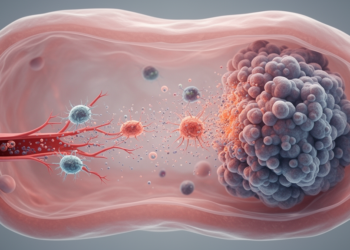
Bioprinted Coronary Artery Model Recreates Kawasaki Disease in the Lab
A 3D bioprinted human coronary artery equivalent reproduces Kawasaki disease vasculitis using patient serum and enables rapid drug screening.
Researchers at the University of Southampton show that a mild saponin-based lysis protocol preserves the viability of Gram-positive bacteria extracted ...
Researchers have engineered an elliptical inertial microfluidic device that isolates circulating tumor cells from blood with high efficiency and minimal ...
A new perspective in Biocontaminant outlines an integrated biosensing framework for shifting aquatic pathogen monitoring from periodic single-target laboratory tests ...
A new microfluidic method called spatial Hi-C maps genome-wide 3D chromatin folding directly within intact brain tissue sections, revealing lobule-specific ...
A new hybrid simulation framework shows that a cancer cell's shape sets its deformation pathway in blood flow while membrane ...
South Korean engineers have developed a wireless induction-heating platform that lyses C. elegans cells and completes PCR amplification in about ...
Researchers at Syracuse University report that compression-induced creases in soft surfaces can remotely gate, sort, merge, and even compute with ...
A new review details how electrochemical biosensors are being engineered to detect rare circulating tumor cells and ctDNA, bringing minimally ...
Researchers have built microscopic robots that combine onboard temperature sensing, CMOS logic and electrochemical cilia to pump fluid in ways ...
© 2025 Scienmag - Science Magazine
