


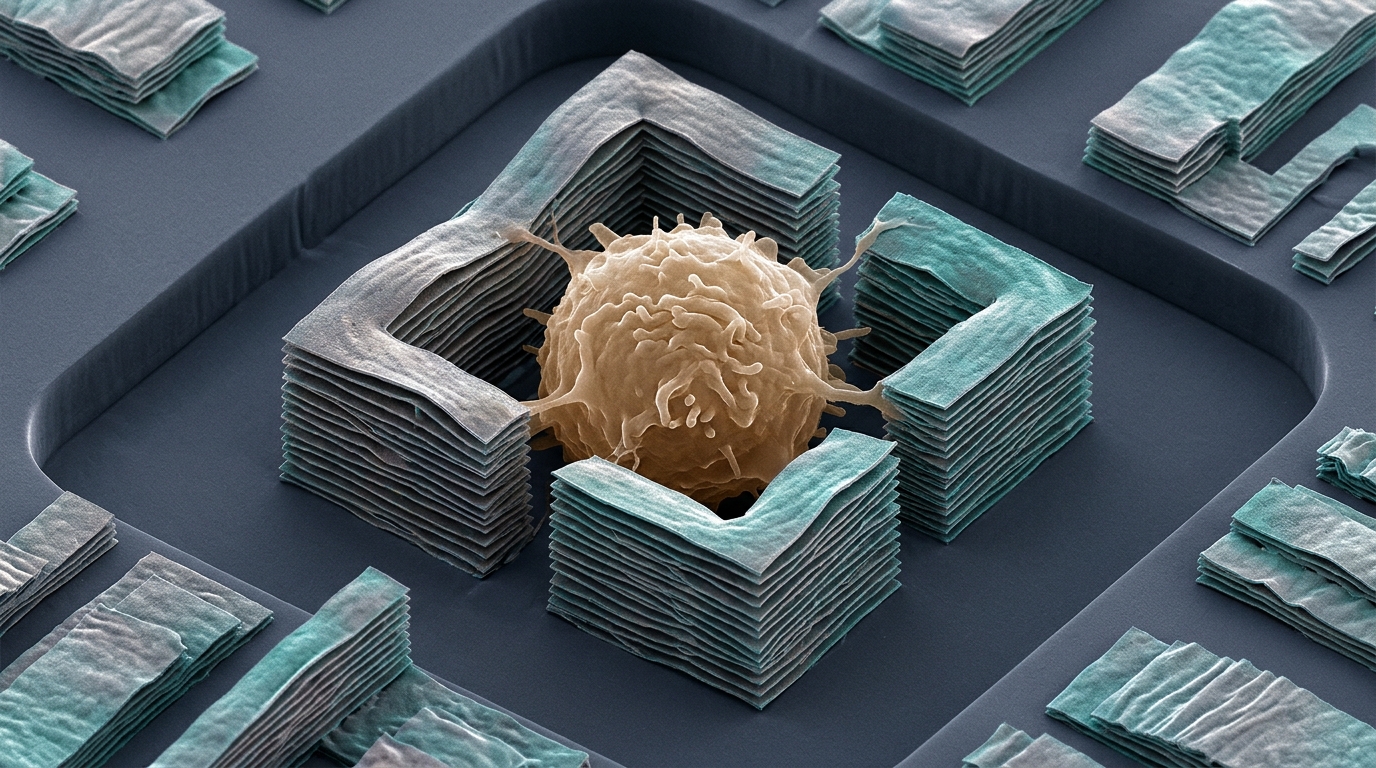
A research team led by Anas Alazzam has demonstrated a decoupled microfabrication strategy that pairs solvent-swollen polymer architectures with solution-processed Ti3C2Tx MXene thin films to construct three-dimensional microelectrodes for label-free single-cell impedance sensing. Traditional microfluidic impedance systems rely primarily on planar electrode geometries, which are often limited in their spatial interaction with biological samples suspended within fluidic channel volumes. Although non-planar architectures can expand electroactive surface areas and project electric fields into microchannels, their practical integration has long been hindered by complex fabrication workflows that demand specialized cleanroom techniques, high-temperature carbonization, vacuum-based metallization, or intricate multistep alignments. To address this technical bottleneck, the investigators introduced a topography-first manufacturing route that physically separates the definition of three-dimensional polymer structures from the subsequent conductive coating process, thereby establishing a modular bioelectronic platform evaluated through single-cell differential electrochemical impedance spectroscopy.
The underlying foundation of this sequential fabrication framework relies on the controlled swelling behavior of cyclic olefin copolymer substrates exposed to hydrocarbon solvents. In the reported workflow, a cyclic olefin copolymer base is cleaned, coated with a soft-baked positive photoresist layer, and patterned using direct laser photolithography and development to define exposed electrode zones. Rather than relying on additive stereolithography or sacrificial molding to build height, the patterned substrate is immersed in dodecane, causing the exposed cyclic olefin copolymer regions to absorb the solvent and swell into well-defined, raised microstructures. After rinsing and drying the expanded polymer substrate, an aqueous dispersion of two-dimensional Ti3C2Tx MXene flakes is spin-coated over the topography to establish a conformal conductive layer. Subsequent ethanol-assisted ultrasonic lift-off dissolves the remaining photoresist and removes the excess nanomaterial coating, leaving behind structurally defined three-dimensional MXene microelectrodes without requiring high-temperature processing or specialized vacuum instrumentation.
Quantitative surface metrology confirmed the geometric reproducibility and structural integrity of the resulting polymer topographies. Laser profilometry mapping revealed raised features exhibiting an average vertical height of approximately 10 μm across multiple independently patterned regions, demonstrating that the structural dimensions are determined predominantly by solvent diffusion and volumetric polymer expansion rather than the thickness of the conductive layer. The fabricated microelectrode architecture featured opposing electrodes with nominal widths of 50 μm separated by a 30 μm gap. Scanning electron microscopy confirmed that the three-dimensional morphology remained intact after coating deposition and lift-off, displaying conformal coverage across non-planar surfaces without visible structural collapse or macroscopic distortion. Because the functional Ti3C2Tx coating had an average thickness of approximately 80 nm, its dimensional contribution was negligible relative to the 10 μm polymer profile, allowing the underlying polymer substrate to govern the physical geometry while the two-dimensional nanomaterial acted as a thin conductive skin.
The physical and electrochemical characteristics of the Ti3C2Tx nanomaterial were evaluated to understand its suitability as a bioelectronic interface. The synthesized MXene flakes exhibited average lateral dimensions of 3 ± 1 μm and an individual monolayer thickness of approximately 2 nm. Four-point-probe measurements conducted on planar cyclic olefin copolymer control films deposited under identical conditions demonstrated a sheet resistance ranging from 280 to 320 Ω sq−1, which corresponds to an effective bulk electrical resistivity between 2.24 × 10⁻⁵ and 2.56 × 10⁻⁵ Ωm and an effective electrical conductivity between 3.9 × 10⁴ and 4.5 × 10⁴ S m−1. In comparison to alternative solution-processable conductors such as resistive carbon inks, thermally sintered silver nanoparticle inks, or post-treated conductive polymers, the MXene formulation achieved functional electrical conductivity via low-temperature aqueous deposition. To minimize thickness-dependent experimental bias during subsequent comparative analyses, the researchers also fabricated geometrically matched control devices using a 100 nm sputtered gold layer over identical 10 μm-high swollen copolymer structures.
Optical and electromechanical evaluations highlighted several secondary material properties conferred by the solution-processed nanomaterial coating. Spectroscopic measurements showed that while untreated cyclic olefin copolymer substrates exhibited high optical transmittance across visible wavelengths, the deposition of the 80 nm MXene layer reduced overall transmission while maintaining partial optical transparency across the visible spectrum. This partial transparency provides a distinct operational advantage over fully opaque metallic films by facilitating direct microscopic inspection and visual cell alignment within microfluidic channels. To assess interfacial mechanical resilience, the researchers subjected three independent electrode samples to cyclic mechanical deformation. Throughout 1,000 continuous bending cycles, normalized electrical resistance rose sharply in initial cycles before stabilizing into a gradual increase, culminating in an overall resistance rise of approximately 30 percent from 1.00 ± 0.05 to 1.30 ± 0.04 without catastrophic electrical disconnection. Surface profilometry further revealed that converting flat polymer into three-dimensional structures increased areal surface roughness, whereas subsequent MXene application partially smoothed fine-scale textures while preserving the larger three-dimensional relief.
To investigate electric-field behavior and potential distribution within the sensing channel, the researchers performed two-dimensional finite-element numerical simulations using the Electric Currents module in COMSOL Multiphysics. The computational model incorporated the device geometry under a 10 mV sinusoidal excitation in an electrolyte domain with a physiological conductivity of 16 mS/cm. The MXene electrode domain was assigned a finite conductivity of 4.17 × 10⁴ S m−1 derived from experimental sheet-resistance measurements, whereas the gold reference electrode was modeled as an idealized conductor. The simulation revealed that despite the difference in electrode bulk conductivity, both materials generated highly localized electric-field distributions concentrated across the constriction opening, with local field magnitudes reaching a maximum of 2.25 × 10⁴ V m−1 at exposed electrode corners. At an excitation frequency of 1 kHz, the simulated potential drop across the sensing constriction reached 9.996 mV for the MXene configuration compared to 10.00 mV for the idealized gold structure, confirming that the finite resistivity of the thin MXene film introduces minimal voltage drop and successfully delivers excitation energy across the fluidic gap.
The fully assembled bioelectronic sensor incorporated the patterned copolymer substrate bonded to a polydimethylsiloxane microchannel cast from an SU-8 2025 master mold, yielding a total channel height of approximately 30 μm. Within this configuration, the 10 μm-high opposing electrodes occupied roughly one-third of the vertical channel height, establishing a three-dimensional sensing volume while preserving sufficient vertical clearance for uninterrupted cellular hydrodynamics. The fluidic layout featured a single opposing electrode pair aligned across a mechanical constriction zone designed to capture and hold cells under fluid flow. The authors noted that this single-pair architecture was intentionally adopted as a modular, reusable fundamental sensing unit to minimize external connection complexity and enable direct material comparisons, functioning as an accessible proof-of-concept module capable of being replicated in serial or parallel arrays for multiplexed higher-throughput analytical systems.
Functional validation of the microfluidic platform was carried out using differential electrochemical impedance spectroscopy on individual MDA-MB-231 human breast cancer cells. In each experimental run, the microchannel was first filled with a cell-free phosphate-buffered saline and fetal bovine serum suspension calibrated to 16 mS/cm to record a baseline reference spectrum. Cellular suspensions were then introduced, and single cells were hydrodynamically driven into the constriction between the microelectrodes until mechanically trapped. Differential impedance measurements were initiated only after the target cell reached a fully stationary state within the gap, ensuring that the recorded electrical signatures reflected a stable cellular presence rather than dynamic transient passage. The testing matrix encompassed more than 20 individual MDA-MB-231 cells for each electrode material across three independently fabricated devices per group, with each individual device measuring more than five distinct cells to assess short-term operational repeatability.
Spectroscopic recordings over a broad frequency window demonstrated that the presence of an individually trapped cancer cell produced a distinct increase in overall impedance magnitude compared with the pre-trapping medium background. For both the gold and MXene configurations, the trapped cell acted as an insulating and polarizable physical object, constricting ionic current lines within the fluid channel and reducing the effective conductive cross-sectional area. In devices equipped with 3D gold microelectrodes, low-frequency impedance magnitude rose from approximately 7 × 10⁶ Ω in the cell-free medium to roughly 1.5 × 10⁷ Ω at 100 Hz in the cell-trapped state, with spectral separation between the states becoming increasingly pronounced at higher frequencies on a logarithmic scale. The 3D MXene microelectrodes exhibited a similar biological impedance signature, characterized by elevated impedance in the presence of trapped cells that gradually converged toward the background baseline at higher frequencies.
To quantitatively evaluate the spectral profiles, the researchers applied an equivalent circuit model comprising a solution resistance in series with a parallel combination of interfacial resistance and capacitance. Post hoc plot-derived fits yielded unweighted goodness-of-fit values in logarithmic impedance space of R2log|Z| = 0.94 for cell-free medium and 0.998 for cell-containing medium using gold electrodes, accompanied by root-mean-square errors of 0.18 and 0.023 decades, respectively. For the MXene electrodes, the corresponding values reached R2log|Z| = 0.87 for cell-free conditions and 0.94 for cell-containing conditions, with root-mean-square errors of 0.17 and 0.12 decades. The lower mathematical agreement observed for the MXene spectra, particularly in the cell-free state below 10 kHz, reflected the inherent limitations of modeling a heterogeneous, flake-based nanomaterial interface using a single lumped ideal capacitor rather than a distributed constant-phase element.
Although the MXene electrodes successfully produced an unambiguous single-cell detection signal, their spectral data exhibited broader minimum-to-maximum experimental dispersion and greater point-to-point variability than the smoother spectra obtained from sputtered gold. The authors attributed this variability to microscale positional fluctuations of trapped cells within the constriction as well as the intrinsic morphological heterogeneity of the flake network. Nevertheless, the nanoscale roughness of the layered MXene surface offers notable advantages, such as an expanded microscopic surface area that may enhance interfacial capacitive coupling to biological analytes. Furthermore, the hydrophilic surface terminations characteristic of Ti3C2Tx, including oxygen, hydroxyl, and fluorine functional groups, present versatile chemical handles for potential covalent tethering of bioreceptors, antifouling polymer layers, or molecular recognition elements in future biosensing applications.
The authors explicitly outlined several important technical limitations regarding the scope and interpretation of their experimental findings. No direct post-fabrication or post-testing surface spectroscopic analyses, such as X-ray diffraction, Raman spectroscopy, or X-ray photoelectron spectroscopy, were conducted on the three-dimensional solvent-swollen electrodes; consequently, retention of the pristine Ti3C2Tx crystalline phase and the absence of localized surface oxidation during electrochemical testing remain unverified directly on these devices. Spatially resolved mapping of coating thickness across vertical sidewalls and base regions was not performed, nor were long-term electrode fouling, cleaning regeneration protocols, or continuous operational drift in serum-containing media systematically assessed.
Subject of Research: Three-dimensional MXene microelectrodes for microfluidic single-cell impedance spectroscopy
Article Title: Solution-processed Ti 3 C 2 T x MXene coatings for three-dimensional microelectrodes in label-free single-cell impedance spectroscopy
Article References: Taha, M., ElKaffas, R., Eissa, S., Saleh, H., Pappa, A.-M., & Alazzam, A. (2026). Solution-processed Ti3C2Tx MXene coatings for three-dimensional microelectrodes in label-free single-cell impedance spectroscopy. iScience, 29(11), Article 118145. https://doi.org/10.1016/j.isci.2026.118145
Image Credits: AI Generated
DOI: 10.1016/j.isci.2026.118145
Keywords: Microfluidics, MXenes, Bioelectronics, Impedance Spectroscopy, Single-Cell Analysis, Cyclic Olefin Copolymer, Biosensors, Lab-on-a-Chip, Solution-processed, MXene, coatings, three-dimensional
Cite Scienmag News
Sylvia Mullen. (November 8, 2026). Engineers Develop Three-Dimensional MXene Electrodes for Label-Free Single-Cell Impedance Sensing. Scienmag. https://scienmag.com/engineers-develop-three-dimensional-mxene-electrodes-for-label-free-single-cell-impedance-sensing/
Sylvia Mullen. "Engineers Develop Three-Dimensional MXene Electrodes for Label-Free Single-Cell Impedance Sensing." Scienmag, 8 November 2026, https://scienmag.com/engineers-develop-three-dimensional-mxene-electrodes-for-label-free-single-cell-impedance-sensing/. Accessed 15 November 2026.
Sylvia Mullen. "Engineers Develop Three-Dimensional MXene Electrodes for Label-Free Single-Cell Impedance Sensing." Scienmag. November 8, 2026. https://scienmag.com/engineers-develop-three-dimensional-mxene-electrodes-for-label-free-single-cell-impedance-sensing/




