


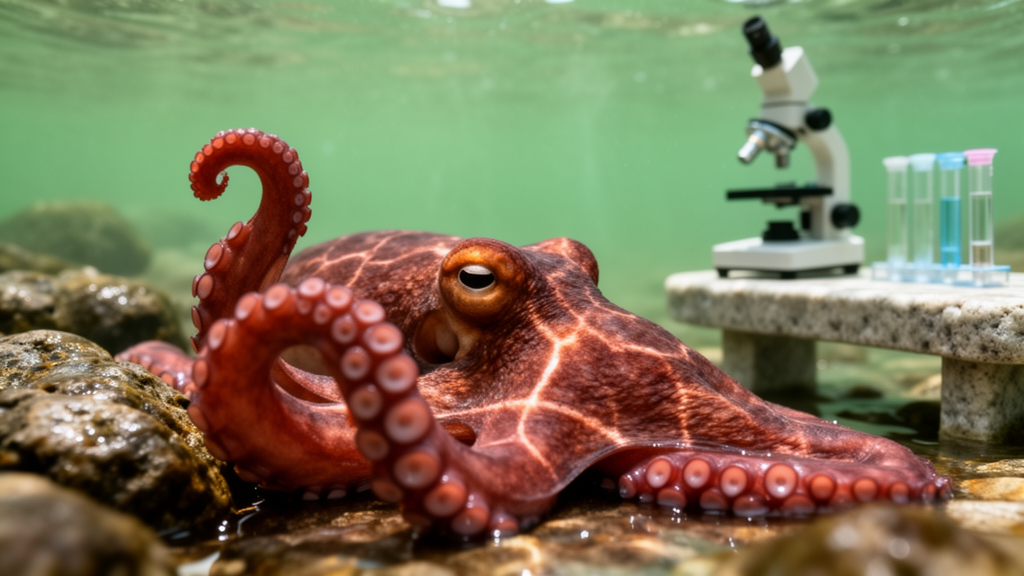
Octopuses, squid and cuttlefish are among the most alien intelligences on Earth. With nervous systems containing hundreds of millions of neurons distributed between the brain and the arms, these coleoid cephalopods can solve puzzles, open jars, vanish into their surroundings within fractions of a second, and display behaviours that suggest genuine problem-solving rather than simple reflex. Yet a new study from scientists at the University of Vienna suggests that the origins of this remarkable neural sophistication may lie not in the genes themselves, but in the way the genome is physically folded inside the cell. The findings, published in Nature Communications, point to the three-dimensional architecture of DNA as an active driver of evolutionary innovation rather than a passive by-product of it.
For decades, evolutionary biologists have tended to treat the genome primarily as a linear string of letters, with innovation arising through mutations that alter or duplicate individual genes. The new research challenges that picture. When the Vienna team reconstructed the 3D organisation of the genome in octopus, squid and cuttlefish, they discovered that an ancient and massive burst of genome reorganisation, occurring hundreds of millions of years ago, dramatically reshuffled the chromosomes of the cephalopod ancestor. That reshuffling brought previously distant stretches of DNA into close physical proximity, creating new opportunities for regulatory interactions that had never existed before.
The genome is not simply a sequence. Within the nucleus, it is folded into a complex three-dimensional structure in which loops and domains bring distant regions into contact, allowing regulatory elements such as enhancers to influence genes located far away along the linear chromosome. Understanding how that folded structure itself evolves, the researchers argue, is becoming increasingly important for understanding how new forms of biological complexity arise. Lead author Dr Thea Rogers emphasised that the genome’s three-dimensional arrangement is a genuine object of study in its own right, one whose evolution can shape the evolution of gene regulation and, ultimately, of traits.
The central concept the researchers propose is what they call regulatory entanglement. When a burst of genome reorganisation throws previously separate regions of DNA into contact, those regions can begin to interact and influence each other’s activity. Over long stretches of evolutionary time, these new interactions can become embedded, forming increasingly interconnected regulatory networks. The result is a genome in which novel patterns of gene expression can be generated while essential functions remain intact. In effect, regulatory entanglement offers a mechanism for balancing innovation against stability, one of the central tensions in genome evolution.
This balancing act may be particularly important for animals like cephalopods, whose nervous systems depend on the precisely timed and tissue-specific expression of enormous numbers of genes during development. Regulatory entanglement provides a way for genomes to experiment with new connections, generating fresh patterns of gene regulation that can be refined by natural selection, without dismantling the regulatory machinery required for basic survival. The researchers suggest that this process may have played a key role in the emergence of the coleoid cephalopods’ unusually complex nervous systems, facilitating the fine-tuned gene activity needed to build and operate such elaborate neural tissue.
One of the most striking findings of the study is that not all levels of genome structure respond to reorganisation in the same way. The team found that large structural units known as chromatin domains, which span substantial sections of chromosomes, remained largely stable across hundreds of millions of years of evolution. Whatever upheavals the cephalopod genome endured, these broad compartments persisted, apparently preserving the coarse-grained organisation required for normal cellular function. This stability implies that there are deep constraints on how far a genome’s architecture can be rearranged before fundamental processes break down.
In sharp contrast, finer-scale structures known as chromatin loops proved far more dynamic. These loops, which physically bring distant regions of DNA into contact so that they can regulate one another, varied widely across species, across different tissues, and across developmental stages. Crucially, the researchers found that these flexible loops were often located near genes involved in key cephalopod traits, including genes linked to the nervous system. That pattern suggests that the finer-scale wiring of the 3D genome is precisely where large-scale changes in DNA organisation have their greatest impact, and where evolutionary innovation is most likely to be concentrated.
Taken together, these results challenge a long-standing assumption in evolutionary biology: that genome architecture is simply a passive consequence of evolution, shaped by selection acting on genes but not itself shaping the course of evolutionary change. The Vienna team’s findings indicate the opposite. The three-dimensional organisation of DNA can actively influence how evolution unfolds, by determining which regulatory combinations become available for selection to act upon. In cephalopods, an ancient reorganisation of the genome may have opened an enormous space of new regulatory possibilities, providing raw material for the evolution of traits as demanding as a distributed, highly capable nervous system.
The implications extend well beyond cephalopods. If regulatory entanglement is a general feature of genome evolution, then the same principles could help explain the emergence of complexity in other lineages where large-scale genome rearrangements have occurred, from the genome duplications that reshaped early vertebrates to the chromosomal reshuffling seen in flowering plants. The study also highlights the growing importance of three-dimensional genomics, a field that combines chromosome-conformation data with measures of gene activity to reveal how the physical folding of DNA governs gene regulation. As such datasets accumulate across the tree of life, researchers will increasingly be able to ask not just which genes an organism possesses, but how the arrangement of those genes in nuclear space constrains and enables evolutionary change.
For the coleoid cephalopods, the study offers a compelling new chapter in the story of how Earth’s most alien minds came to be. Hundreds of millions of years ago, their ancestor’s genome was broken apart and reassembled in a new configuration, entangling regulatory elements that had never before communicated. From that tangled regulatory landscape, capable of producing novel patterns of gene activity while preserving the essentials of life, there eventually emerged animals that can learn by observation, change the texture of their skin, and edit their own RNA in response to the environment. The 3D structure of DNA, long treated as mere packaging, now appears to be one of the reasons such creatures exist at all.
Subject of Research: The role of three-dimensional genome architecture and regulatory entanglement in the evolution of complex cephalopod nervous systems
Article Title: 3D structure of DNA may explain how cephalopods evolved complex brains
Article References: 3D structure of DNA may explain how cephalopods evolved complex brains. (n.d.). Original publication
Image Credits: AI Generated
DOI: Not provided
Keywords: cephalopods, octopus, genome architecture, 3D genome, regulatory entanglement, chromatin loops, chromatin domains, gene regulation, evolutionary innovation, nervous system evolution, Nature Communications, epigenomics
Cite Scienmag News
Juliet Wilcox. (October 9, 2026). Ancient DNA Reorganization May Explain How Octopuses Grew Such Complex Brains. Scienmag. https://scienmag.com/ancient-dna-reorganization-may-explain-how-octopuses-grew-such-complex-brains/
Juliet Wilcox. "Ancient DNA Reorganization May Explain How Octopuses Grew Such Complex Brains." Scienmag, 9 October 2026, https://scienmag.com/ancient-dna-reorganization-may-explain-how-octopuses-grew-such-complex-brains/. Accessed 9 October 2026.
Juliet Wilcox. "Ancient DNA Reorganization May Explain How Octopuses Grew Such Complex Brains." Scienmag. October 9, 2026. https://scienmag.com/ancient-dna-reorganization-may-explain-how-octopuses-grew-such-complex-brains/


