


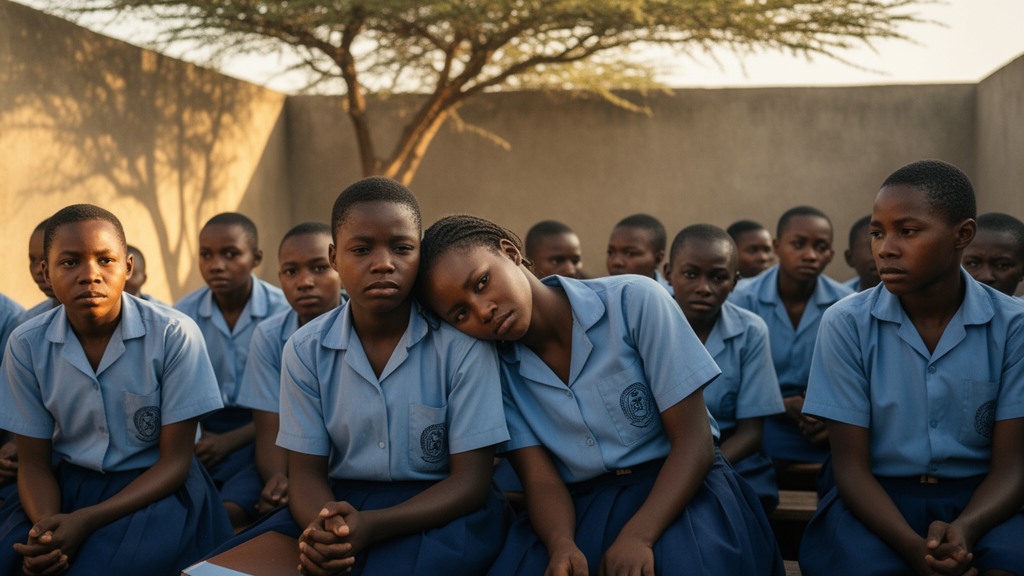
Adolescents in Zimbabwe are carrying a striking burden of trauma symptoms, according to new baseline findings from one of the largest school-based mental health studies conducted in the country. The research, published in PLOS Mental Health, surveyed more than 1,300 young people aged 12 to 18 and found that, on average, they endorsed 7.6 out of 18 possible trauma symptoms. Girls reported significantly higher rates than boys, and the severity of symptoms was consistently linked to lower levels of resilience characteristics such as self-esteem, hope, self-calming ability, and social support. The findings arrive at a moment when adolescent mental health has become an urgent global priority, yet services throughout Southern Africa remain severely inaccessible, and research on young people in the region remains extremely sparse.
The study forms part of a cluster randomized controlled trial evaluating Singing to the Lions, a biopsychosocial workshop designed for trauma-affected youth in Zimbabwe. Rather than randomizing individual children, the researchers randomized by school, assigning 13 schools to either an immediate intervention arm or a waitlist control arm. This cluster design is common in school-based research because it prevents contamination between participants who would otherwise share classrooms and daily routines. The data reported in the new paper come from the baseline phase, before any intervention was delivered, offering a rare snapshot of trauma symptom prevalence and its correlates among Zimbabwean adolescents in both urban and rural settings.
The baseline sample comprised 1,342 adolescents with a mean age of 14.8 years. Just over half of the participants were girls, at 54.6 percent, and a slight majority, 52.4 percent, attended rural schools. This balance between urban and rural youth matters, because much of the existing research on adolescent mental health in Sub-Saharan Africa has focused narrowly on single communities or clinical populations. By drawing from both settings, the study provides a broader picture of how trauma symptoms manifest across different lived environments in a country where young people face a convergence of adversities, from household food insecurity to economic instability and climate-related disasters.
The headline figure, an average of 7.6 trauma symptoms out of 18, points to widespread psychological distress in this population. Girls endorsed significantly more symptoms than boys, a difference the authors report as statistically robust, with a t-statistic of 3.39 on 1,325 degrees of freedom and a p-value of .0007. This gender gap aligns with patterns documented in adolescent mental health research elsewhere, where girls frequently report higher rates of internalizing symptoms following adverse experiences. Notably, however, the study found no statistically significant differences in trauma symptom prevalence based on children’s age, grade level, or whether they lived in rural or urban communities, suggesting that the burden of trauma cuts across demographic lines within this sample.
Perhaps the most analytically rich portion of the findings concerns the relationship between trauma symptoms and resilience characteristics. The researchers measured several dimensions of resilience and examined how each correlated with symptom burden. Self-esteem showed a moderate inverse correlation with trauma symptoms, at r = -.36 with p < .001, meaning adolescents with lower self-esteem tended to report more symptoms. Self-calming ability showed a similar pattern at r = -.30, and social support at r = -.23, both highly significant. Hope, while still statistically significant, showed a much weaker inverse association at r = -.07 with p = .01. These correlations cannot establish causation, since baseline data cannot reveal whether low resilience predisposes young people to trauma symptoms or whether trauma erodes resilience, but they map the psychological terrain on which interventions like Singing to the Lions must operate.
One result stands out as a puzzle: the researchers found no association between trauma symptoms and self-efficacy, the belief in one’s own capacity to act and cope. The absence of this link is intriguing given that every other measured resilience characteristic correlated with symptom burden in the expected direction. The authors do not overinterpret this null finding, but it underscores a methodological point that resonates across the field: resilience is not a single trait but a bundle of distinct psychological resources, and trauma may interact with each of them differently. Interventions that treat resilience as a monolithic quantity may miss the specific levers, such as self-calming skills or social connectedness, that matter most for trauma-affected youth.
The context behind these numbers is sobering. The study’s authors note that Zimbabwean youth are particularly vulnerable to mental health challenges stemming from adverse childhood experiences, including food insecurity, sexual and emotional violence, climate change-induced disasters, and national economic difficulties. Each of these stressors has been documented in the broader literature on adverse childhood experiences as a risk factor for lasting psychological harm, and their co-occurrence in a single generation of young people compounds the risk. Yet, as the researchers emphasize, research on adolescent mental health in Zimbabwe is extremely limited, leaving practitioners and policymakers without the evidence base needed to design appropriate services.
The high prevalence of trauma symptoms and the patterns of trauma expression observed in this study are consistent with the limited previous adolescent mental health research from Sub-Saharan Africa, the authors report. This consistency is important because it suggests the findings are not an artifact of a single sample or measurement approach, but part of an emerging regional picture. At the same time, the scarcity of comparable studies means that each new dataset carries disproportionate weight. Baseline results from a rigorously designed cluster randomized controlled trial, with more than a thousand participants spanning urban and rural schools, represent exactly the kind of evidence the region has lacked.
The trial’s intervention arm adds a practical dimension to the epidemiological findings. Singing to the Lions is described as a biopsychosocial workshop, an approach that addresses biological, psychological, and social dimensions of trauma rather than treating distress as a purely clinical phenomenon. Because adolescents were randomized by school, the trial can compare outcomes between the immediate intervention arm and the waitlist control arm over time, and the baseline data published now will serve as the reference point for that comparison. Whether the workshop reduces trauma symptoms or strengthens resilience characteristics such as self-calming and social support will be answerable only through the follow-up analyses that this baseline prepares.
For now, the baseline results stand on their own as a contribution to a sparse knowledge base. They document a heavy and broadly distributed symptom burden among Zimbabwean adolescents, a consistent inverse relationship between trauma symptoms and most resilience characteristics, and a gender gap in symptom reporting that mirrors global patterns. The authors argue that the findings highlight the need for evidence-based practices that are culturally grounded and contextually specific for the region, rather than imported models untested in local conditions. As adolescent mental health climbs the global public health agenda, studies like this one, rooted in the communities they study and designed to test interventions rather than merely describe problems, offer a template for closing the research gap that has left young people in Southern Africa among the least served in the world.
Subject of Research: Trauma symptoms and resilience among Zimbabwean adolescents in a cluster randomized controlled trial
Article Title: Trauma symptoms and their correlates among Zimbabwean adolescents: Baseline results from a cluster randomized controlled trial
Article References: Fisher, C. M., Gatsi, R., Venables, N., Banda, R., Moore, S., & Hartzes, A. (2026). Trauma symptoms and their correlates among Zimbabwean adolescents: Baseline results from a cluster randomized controlled trial. PLOS Mental Health, 3(9), e0000719. https://doi.org/10.1371/journal.pmen.0000719
Image Credits: AI Generated
DOI: 10.1371/journal.pmen.0000719
Keywords: adolescent mental health, trauma symptoms, Zimbabwe, resilience, cluster randomized controlled trial, Singing to the Lions, school-based intervention, self-esteem, social support, Sub-Saharan Africa, adverse childhood experiences, PLOS Mental Health
Cite Scienmag News
Glenn Wilkins. (October 9, 2026). Zimbabwean Teens Carry Heavy Trauma Burden, Landmark School Study Reveals. Scienmag. https://scienmag.com/zimbabwean-teens-carry-heavy-trauma-burden-landmark-school-study-reveals/
Glenn Wilkins. "Zimbabwean Teens Carry Heavy Trauma Burden, Landmark School Study Reveals." Scienmag, 9 October 2026, https://scienmag.com/zimbabwean-teens-carry-heavy-trauma-burden-landmark-school-study-reveals/. Accessed 9 October 2026.
Glenn Wilkins. "Zimbabwean Teens Carry Heavy Trauma Burden, Landmark School Study Reveals." Scienmag. October 9, 2026. https://scienmag.com/zimbabwean-teens-carry-heavy-trauma-burden-landmark-school-study-reveals/


