


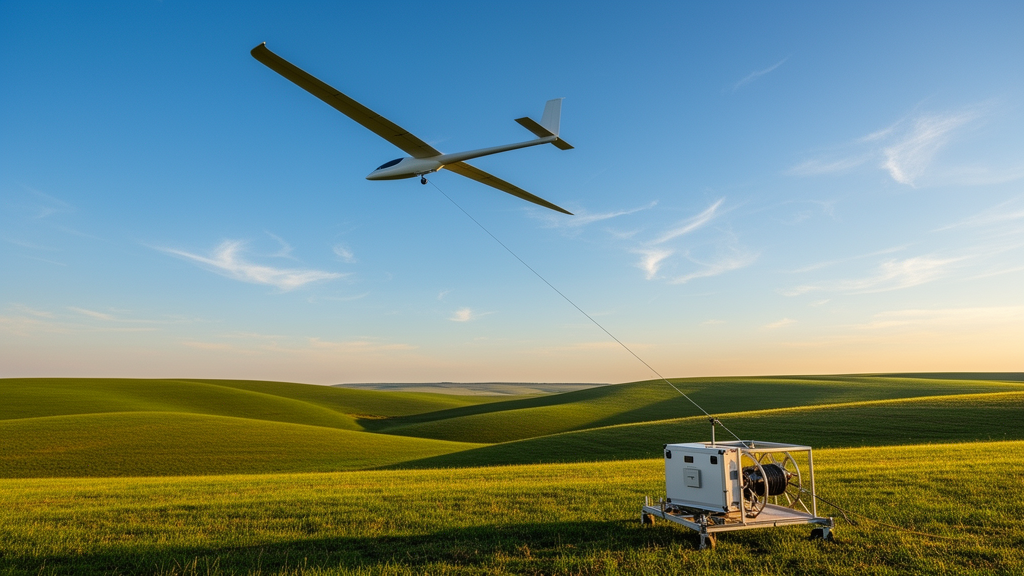
High above the ground, where the wind blows harder and steadier than anywhere near the surface, the atmosphere hides one of the most important and least measured quantities in wind science: turbulence. Meteorological masts simply do not reach the altitudes where modern wind turbines and emerging airborne energy systems operate, and remote-sensing instruments such as lidars lose accuracy as they probe higher into the atmospheric boundary layer. A new study published as a discussion preprint in the journal Wind Energy Science proposes a surprisingly elegant solution to this long-standing measurement gap: use the very machines designed to harvest high-altitude wind energy as turbulence sensors in their own right.
The research, carried out by Agustí Porta Ko, Mark Kelly, Duc H. Nguyen, and Espen Oland, focuses on Airborne Wind Energy Systems, or AWES. These systems fly tethered kites or rigid wings hundreds of meters above the ground, generating electricity either through onboard turbines or by reeling a tether that drives a ground-based generator. Because they routinely operate beyond the surface layer of the atmosphere, the authors realized, these flying platforms occupy exactly the altitude range where conventional turbulence measurements are weakest. Better still, they already carry standard onboard instruments capable of recording their motion and the airflow they encounter.
Characterizing atmospheric turbulence is far more demanding than measuring average wind speed. Scientists need to quantify how gusty the flow is, how large and long-lived its swirling eddies are, and how those eddies are distributed across the three velocity components. The key statistical descriptors include the turbulence intensity, which expresses the magnitude of wind speed fluctuations relative to the mean, and the integral time and length scales, which capture the typical duration and spatial extent of the dominant turbulent structures. Fixed instruments on masts can estimate some of these quantities at low heights, but at upper boundary-layer altitudes the data become sparse, uncertain, or simply unavailable.
The team’s methodology was developed inside UniSimAWE, an in-house simulator framework belonging to the Norwegian AWES developer Kitemill. Within this virtual environment, atmospheric turbulence was generated using the Mann model, a widely adopted spectral turbulence model in wind energy research that produces realistic three-dimensional turbulent wind fields consistent with observed atmospheric spectra. Simulating the kite’s flight through these synthetic turbulent fields allowed the researchers to test, in a controlled setting, whether quantities measured by standard onboard sensors could be translated into meaningful turbulence statistics.
A central insight of the study is that the two operational phases of a ground-generation AWES can be exploited as complementary sampling strategies. During the production phase, the kite flies aggressive crosswind maneuvers, tracing a helical path across the wind to maximize the speed of the tether and the power extracted. During the return phase, by contrast, the kite is reeled back toward its starting position along a nearly streamwise trajectory, meaning it moves roughly parallel to the mean wind. Each phase, the authors show, offers a distinct window onto the turbulent field.
The return phase turns out to be particularly valuable. Because the kite travels nearly along the wind direction during this phase, its onboard measurements effectively sample the turbulence as a streamwise transect, enabling estimation of the turbulence intensity and of the integral time and length scales for all three velocity components. Crucially, the researchers demonstrated that Taylor’s frozen turbulence hypothesis holds for this sampling strategy. This classical assumption, which treats turbulent eddies as frozen patterns advected past a sensor by the mean wind, was verified in two independent ways: through the ratio of integral length scales to integral time scales, and through the ratio of wavenumber-based to frequency-based power spectral densities. Confirming the hypothesis means the kite’s moving measurements can be legitimately converted from the time domain into the spatial domain, a prerequisite for extracting physically meaningful length scales.
The production phase contributes something that conventional fixed-point sensors cannot provide at all. As the kite sweeps through its helical crosswind path, the dominant crosswind component of its motion allows measurement of the integral time and length scales in the crosswind direction, describing how turbulent structures vary laterally to the flow. Fixed masts and single-point instruments, anchored in place, can only sample along the streamwise direction as the wind carries eddies past them. In addition, the geometry of the helical path enables the researchers to measure the streamwise integral time scale even during power production, meaning the kite characterizes turbulence throughout its entire operating cycle rather than only during returns.
Beyond reproducing standard turbulence statistics, the study introduces a genuinely novel quantity: a new time scale designed to characterize the interaction between atmospheric turbulent structures and the AWES trajectory itself. Because a kite in crosswind flight moves rapidly through and around eddies, the turbulence it experiences depends not only on the frozen structures advected by the wind but also on how its own flight path cuts through them. This interaction time scale quantifies that interplay, and the authors highlight its relevance for turbulence-adaptive control, the idea that a kite’s control system could sense incoming turbulence in real time and adjust its trajectory to protect the aircraft, smooth power output, or reduce structural loads.
The implications extend well beyond the AWES community. Wind turbine designers and site assessors depend on accurate turbulence characterizations at hub heights that increasingly exceed the reach of meteorological masts, and the uncertainty in upper-boundary-layer turbulence feeds directly into conservative safety margins and costly over-engineering. A sensing capability that rides along with an operating energy system, requiring no additional infrastructure beyond standard onboard instruments, could provide continuous turbulence data at altitudes that are otherwise poorly observed. It also raises the tantalizing prospect of AWES fleets doubling as distributed atmospheric monitoring networks, mapping turbulence across whole wind farms while simultaneously generating electricity.
The work remains a preprint under open review at Wind Energy Science, meaning the methodology will face scrutiny from the community before final publication, and the results were demonstrated in simulation rather than in field flight tests. Nevertheless, the study makes a compelling case that the instruments and flight patterns of a tethered power kite already contain the raw information needed to characterize upper-atmosphere turbulence, including parameters that conventional techniques cannot deliver. If validated experimentally, the humble kite, humanity’s oldest flying machine, may find a new role as one of the atmosphere’s most agile scientific instruments, sensing the invisible eddies of the high boundary layer while it earns its keep harvesting the wind.
Subject of Research: Using airborne wind energy kites to measure atmospheric turbulence in the upper boundary layer
Article Title: Using an Airborne Wind Energy System as a turbulence sensor
Article References: Porta Ko, A., Kelly, M., Nguyen, D. H., & Oland, E. (2026). Using an Airborne Wind Energy System as a turbulence sensor. https://doi.org/10.5194/wes-2026-150
Image Credits: AI Generated
DOI: 10.5194/wes-2026-150
Keywords: airborne wind energy, atmospheric turbulence, tethered kite, boundary layer, turbulence intensity, integral length scale, Mann model, Taylor frozen turbulence hypothesis, wind energy, lidar limitations, turbulence-adaptive control, Kitemill
Cite Scienmag News
Faith Mcneil. (October 9, 2026). Tethered Kites Could Double as High-Altitude Turbulence Sensors. Scienmag. https://scienmag.com/tethered-kites-could-double-as-high-altitude-turbulence-sensors/
Faith Mcneil. "Tethered Kites Could Double as High-Altitude Turbulence Sensors." Scienmag, 9 October 2026, https://scienmag.com/tethered-kites-could-double-as-high-altitude-turbulence-sensors/. Accessed 9 October 2026.
Faith Mcneil. "Tethered Kites Could Double as High-Altitude Turbulence Sensors." Scienmag. October 9, 2026. https://scienmag.com/tethered-kites-could-double-as-high-altitude-turbulence-sensors/


