


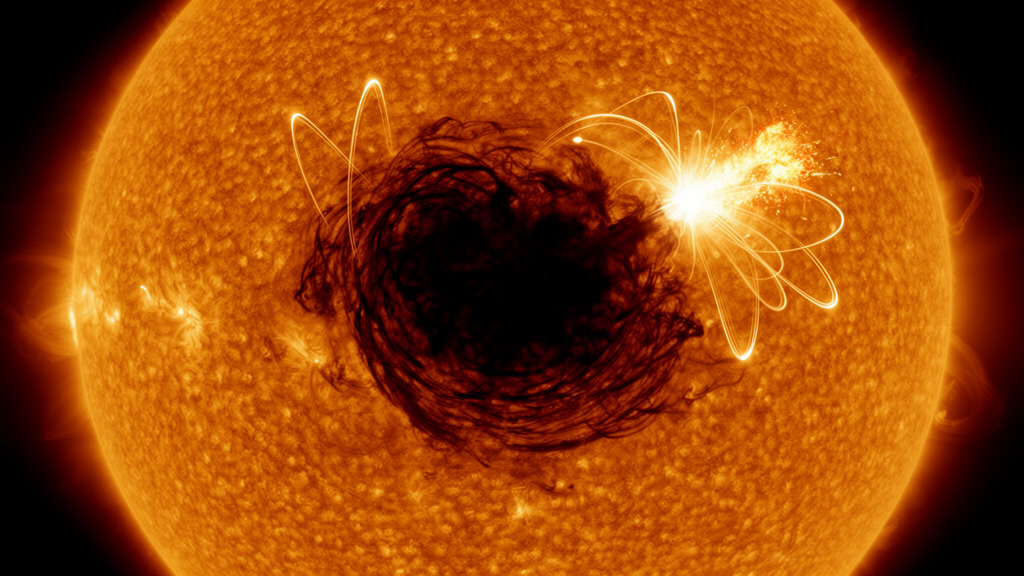
The Sun has a temper, and humanity has seen glimpses of it. In 1859, during the Carrington Event, a colossal solar storm slammed into Earth’s magnetic field with such force that auroras blazed across skies as far south as the Caribbean, and telegraph operators reported sparks jumping from their receiving equipment. Today, a comparable assault of particles and radiation would threaten satellites, navigation systems, radio communications, and the high-voltage transformers that anchor national power grids. But a pressing question has long hovered over solar physics: can our star do even worse? Can it unleash so-called superflares, explosive bursts of radiation carrying energies exceeding those of trillions of hydrogen bombs, events that until now have been observed directly only on distant stars? A new study from researchers at the Max Planck Institute for Solar System Research (MPS) in Germany and the University of Colorado in the United States, published in the journal Philosophical Transactions of the Royal Society A, provides the most compelling evidence yet that the answer may be yes.
The challenge in answering this question lies in the brevity of our observational record. The energy released by a solar flare can be measured directly only from outside Earth’s atmosphere, or determined indirectly from data and images gathered by space probes. Both approaches have been available only since the dawn of the space age roughly seventy years ago. In that entire period, the Sun has produced no superflare. Yet seventy years is a vanishingly small sliver of time for a star that has been burning for 4.6 billion years. As Natalie Krivova, an MPS scientist and lead author of the new study, explained, there is some evidence suggesting that the Sun, too, can produce superflares at great intervals, but there is no direct proof. The new research set out to close that evidentiary gap through an ingenious combination of modern solar observation and historical record-keeping stretching back centuries.
One line of evidence comes from the Sun’s stellar peers. Our galaxy contains many thousands of stars that resemble the Sun in key characteristics such as mass, temperature, and rotation rate. In late 2024, MPS researchers demonstrated that these Sun-like stars produce superflares approximately once every hundred years. If our star behaves like its counterparts, and there is good reason to think it might, then superflares should be a recurring, if rare, feature of solar activity. A second line of evidence comes from natural archives of solar history. Tree trunks preserved for millennia and ice cores extracted from the Arctic’s permafrost contain spikes in the concentrations of radioactive isotopes, isolated, short-lived, and exceptionally strong signals that suggest Earth has repeatedly been exposed to intense bombardment by high-energy solar particles in the distant past. These cosmogenic fingerprints are the only long-term traces such events leave behind, because a flare itself, no matter how powerful, leaves no lasting physical record on the Sun or in its immediate surroundings.
The relationship between these extreme particle eruptions and superflares remains an active area of investigation. According to Valeriy Vasilyev, an MPS scientist and lead author of a companion review article also published in Philosophical Transactions of the Royal Society A, the current state of research indicates that extreme particle eruptions and particularly intense flares often, but not always, occur together. This partial overlap means that isotope spikes in tree rings and ice cores are suggestive but not conclusive evidence of past superflares. What was needed was a way to connect the physics of flare production to measurable quantities that humans have been recording for far longer than the space age. The new study led by Krivova provides exactly that bridge, and it does so by exploiting one of the most carefully maintained observational datasets in all of science.
The first step of the analysis relied on modern instrumentation. The team examined observational data collected by NASA’s Solar Dynamics Observatory between 2010 and 2016, a period of intense solar monitoring during which the spacecraft continuously tracked the Sun’s surface, magnetic field, and atmosphere. From this dataset, the researchers identified the 300 strongest flares of the observation window and correlated the amount of energy each flare released with the size of the corresponding active region on the Sun’s visible surface. Active regions are areas where the magnetic field is particularly strong and structurally complex, and they are intimately associated with sunspots, the dark, cooler patches that dot the solar surface when magnetic fields suppress convection. Active regions are widely considered the potential starting points for eruptions, and quantifying the relationship between their size and flare energy is a cornerstone of modern flare forecasting.
Of course, as Krivova noted, the researchers knew that no superflares had occurred during the observation period. The power of the approach lies in the statistical relationship they uncovered: the link between released energy and active region size should hold true for more powerful events as well, extrapolating the physics observed in ordinary flares into the extreme regime that has never been witnessed on the Sun directly. This empirical scaling allowed the team to convert a measurement of active region area into an estimate of maximum possible flare energy, effectively turning the solar surface into a historical archive of eruptive potential.
The second step reached deep into the observational past. Sunspots have been systematically and regularly recorded for about 400 years, beginning with the telescopic observations of the early seventeenth century. As Theodosios Chatzistergos, an MPS scientist and co-author of the new study, explained, these records offer another way to look into the history of our star. Because sunspots are the visible manifestation of the magnetic complexity in active regions, the size of a sunspot group can be used to infer the size of the associated active region, and from there the strength of a possible eruption. The researchers combed through four centuries of sunspot records with particular interest in the rare outliers, the exceptionally large spots that stood apart from the ordinary run of solar activity and represented the most extreme magnetic configurations the Sun has displayed in the modern era.
One such outlier towers over the historical record: the giant sunspot of April 1947. This behemoth covered approximately 0.6 percent of the visible solar disk, and its diameter was about forty times that of Earth. It remains one of the largest sunspots the Sun has displayed since the beginning of systematic solar observations. Remarkably, no superflare erupted from this region during its transit across the solar disk. The Sun, in other words, loaded the barrel but never fired. Yet the new study demonstrates that a sunspot of this size is statistically capable of triggering a superflare in rare cases. The implication is sobering: the machinery for the most extreme bursts of radiation in the stellar repertoire exists on our own star, and it has assembled itself within living memory.
As Krivova put it, our Sun has superflare potential. It can produce massive sunspots that, in principle, can serve as the starting point for the most extreme bursts of radiation. The finding reframes the question from whether the Sun could ever generate a superflare to whether it has done so, and how often. The statistical frequency suggested by Sun-like stars, roughly once per century, means that a superflare could occur within a human lifetime, and that the absence of one during the space age is not evidence of safety but a matter of timing. Whether a superflare has actually erupted on the Sun in the historical period remains one of our star’s open mysteries, but the new work transforms that mystery from speculation into a quantifiable risk that can be studied, modeled, and prepared for.
The practical stakes are considerable. A Carrington-class event alone would stress twenty-first-century technological infrastructure in ways the nineteenth century never experienced, and a superflare, releasing orders of magnitude more energy, would represent a hazard of a different category entirely. Satellites in orbit, astronauts beyond the protection of Earth’s atmosphere, aviation routes over the poles, and continental power distribution networks would all face exposure. By establishing an empirical link between the largest sunspots in the historical record and the energy scales of superflares, the MPS-led team has given space weather researchers a concrete observational benchmark: when the next giant sunspot rounds the eastern limb of the Sun, scientists will be able to assess its eruptive potential with a rigor that was impossible before this study. The Sun’s most violent capabilities, long hidden in the statistics of distant stars and the chemistry of ancient trees, are now written in its own spotted face, waiting to be read.
Subject of Research: Solar superflare potential inferred from historical sunspot records and flare energy statistics
Article Title: Sun: New evidence of superflares
Article References: Sun: New evidence of superflares. (n.d.). Original publication
Image Credits: AI Generated
DOI: Not provided
Keywords: Sun, superflares, solar flares, sunspots, space weather, Solar Dynamics Observatory, Max Planck Institute for Solar System Research, Carrington Event, active regions, solar activity, stellar flares, Philosophical Transactions of the Royal Society A
Cite Scienmag News
Grant Pearson. (October 9, 2026). The Sun’s Superflare Potential: Giant 1947 Sunspot Reveals Our Star’s Hidden Power. Scienmag. https://scienmag.com/the-suns-superflare-potential-giant-1947-sunspot-reveals-our-stars-hidden-power/
Grant Pearson. "The Sun’s Superflare Potential: Giant 1947 Sunspot Reveals Our Star’s Hidden Power." Scienmag, 9 October 2026, https://scienmag.com/the-suns-superflare-potential-giant-1947-sunspot-reveals-our-stars-hidden-power/. Accessed 9 October 2026.
Grant Pearson. "The Sun’s Superflare Potential: Giant 1947 Sunspot Reveals Our Star’s Hidden Power." Scienmag. October 9, 2026. https://scienmag.com/the-suns-superflare-potential-giant-1947-sunspot-reveals-our-stars-hidden-power/


