


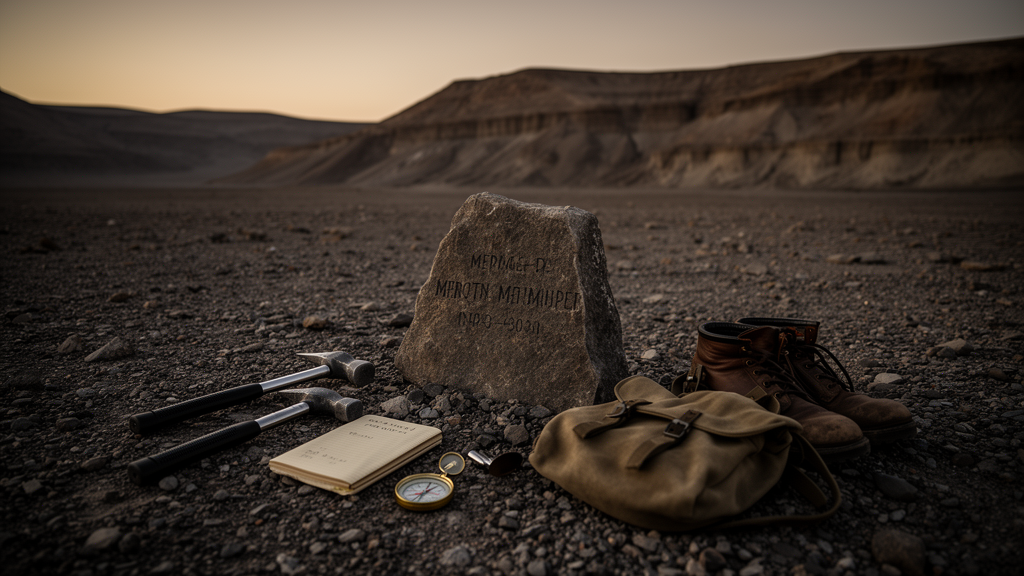
In April 1944, while the Second World War raged across China and Japanese forces occupied most of the country’s eastern and central provinces, three young geologists working in the southwestern interior were killed by bandits in Guizhou Province, on the border with eastern Yunnan. Among them was Y. S. Ma, the only female geologist in China at the time, who died at just 25 years of age. Alongside her fell T. Y. Hsu, aged 36, and K. Chen, aged 28, both described as budding and accomplished geologists whose careers were cut short on the same day. A recent historical study published in the Copernicus journal History of Geo- and Space Sciences by Jian Zhao Yin of Jilin University’s College of Earth Sciences reconstructs their deaths and situates them within the broader, often brutal story of how Chinese geology came of age under conditions of war, poverty, and lawlessness.
The institutional backdrop to this tragedy is the Geological Survey of China, or GSC, which the study characterizes as the country’s first truly scientific education and research institution. Within just a few years of its establishment, the GSC achieved what the author calls tremendous success, creating many firsts in Chinese geological education, research, and mineral exploration, and even some achievements that were world firsts. This rapid ascent is remarkable when set against the conditions of early twentieth-century China, a country with limited industrial infrastructure, few trained scientists, and persistent internal instability. The GSC thus became the cradle of modern Chinese earth science, training generations of geologists who would go on to map the country’s mineral wealth and build its universities and research institutes.
Yet that success, the study emphasizes, came at a heavy price. Many geologists died young for a variety of reasons, reflecting the physical demands of fieldwork in remote and often dangerous terrain, the scarcity of medical care, and the political turmoil that swept China throughout the first half of the twentieth century. Field geology in that era meant long expeditions on foot or by mule through provinces where central authority was weak and banditry was endemic. The risks were not abstract. Fifteen years before the 1944 killings, the brilliant Chinese geologist Y. T. Chao had been murdered by bandits in Zhaotong, in Yunnan Province, in 1929. His death was an early warning of the dangers that field scientists faced in China’s southwestern border regions.
The situation deteriorated dramatically with the outbreak of the War of Resistance against Japan. With the Japanese occupation of most of eastern and central China, almost all universities and research institutions in these developed regions had to relocate to the western rear areas of the war effort. There, under wartime conditions and with severely limited resources, they attempted to continue geological surveys and research. This mass relocation placed scientists directly into some of the most remote and least governed parts of the country. Bandits roamed freely in China during this period, the study notes, especially in the southwestern border regions, posing a significant threat to the developing GSC and causing immense losses to an institution that could ill afford to lose trained personnel.
It was in this environment that the three geologists were killed in April 1944. The study records that Ms. Ma, Mr. Hsu, and Mr. Chen died on the same day at the ages of 25, 36, and 28 respectively. The brevity of those figures is the point of the commemoration: three careers, and with them three contributions to Chinese earth science, ended before they could mature. The author frames the article as a memorial, dedicated to three young scholars who died before achieving their goals, leaving future generations deeply saddened. This year marks the 82nd anniversary of their deaths, a milestone that prompted the historical reconstruction.
Of the three, Ma’s story carries particular historical weight. As the only female geologist in China at the time, she occupied a singular position in a profession that was, like most sciences of the era, overwhelmingly male. The study highlights another striking detail about her: she was fluent in five foreign languages despite never having been abroad. In an age when scientific communication with the outside world often depended on linguistic ability, and when opportunities for Chinese scientists to train overseas were limited by war and poverty, such self-taught multilingualism represented an extraordinary intellectual achievement. It suggests a scientist determined to connect Chinese geology to the international literature and community even as her country was cut off by invasion and internal conflict.
The deaths of Hsu and Chen, though less singular in their historical symbolism, were no less a loss to Chinese science. Both are described in the study as budding and accomplished geologists, meaning that each had already demonstrated real capability while still holding out the promise of much more. In an institution that had created many firsts in geological education and exploration precisely by cultivating young talent, the simultaneous loss of three geologists in a single act of violence was a blow whose full dimensions can only be estimated. The GSC’s achievements had been built on the accumulated expertise of a small community; every death removed knowledge, experience, and teaching capacity that could not quickly be replaced.
The publication history of the study itself offers a window into how history of science research is vetted. The paper appeared as a preprint in History of Geo- and Space Sciences Discuss. on 3 February 2026 and subsequently went through an extended interactive discussion with the journal’s topical editor, Kristian Schlegel. The editor raised a series of suggested revisions, which the author, Jet Yin, addressed in detail, including clarifications of historical context such as the September 18 incident, the 1931 event that marked the beginning of Japanese occupation of Manchuria. The editor later reported that eight referees had been contacted without success, attributing this to the manuscript being too long and incoherent, and recommended that the author withdraw the version and resubmit a shortened one. The author complied, significantly shortening the manuscript and retaining only the essential information closely related to Ms. Ma, and the original preprint was formally withdrawn while a revised version was prepared.
That editorial saga does not diminish the underlying historical record but does underline the care required when reconstructing events from a turbulent period. Wartime China produced fragmentary documentation, and accounts of bandit violence in remote provinces often rest on institutional records, contemporary reports, and later memoirs rather than on systematic archives. Studies like this one, by tracing the careers and deaths of individual scientists, perform a dual function: they recover personal histories that would otherwise be lost, and they quantify, in human terms, the cost at which scientific institutions in developing countries built their foundations. The Geological Survey of China’s many firsts in education, research, and mineral exploration were purchased not only with funding and effort but with lives.
The commemoration of Ma, Hsu, and Chen also speaks to a broader theme in the history of geoscience: fieldwork has always been the discipline’s defining method and its greatest hazard. From the surveyors who mapped mountain belts to the explorers who located the ores that fueled industrialization, geologists have worked where roads end and where state power fades. The story of China’s first female geologist and her two colleagues, murdered on the same day in Guizhou in April 1944, is a stark reminder that the map of modern earth science was drawn by people who risked, and sometimes gave, everything to draw it. Eighty-two years on, their aspirations, born of sacrifice, remain part of the inheritance of Chinese geology and of the international scientific community that remembers them.
Subject of Research: The lives and 1944 murders of China's first female geologist Y. S. Ma and two colleagues during wartime geological fieldwork
Article Title: Lofty aspirations born of sacrifice – In remembrance of Y. S. Ma, China's first female geologist, and her two colleagues who were murdered at the same time
Article References: Yin, J. Z. (2026). Lofty aspirations born of sacrifice – In remembrance of Y. S. Ma, China's first female geologist, and her two colleagues who were murdered at the same time. https://doi.org/10.5194/hgss-2026-3
Image Credits: AI Generated
DOI: 10.5194/hgss-2026-3
Keywords: Y. S. Ma, Geological Survey of China, history of geology, women in science, Guizhou, banditry, War of Resistance against Japan, Y. T. Chao, fieldwork hazards, Chinese geologists, History of Geo- and Space Sciences, wartime science
Cite Scienmag News
Violet Maxwell. (October 9, 2026). Murdered in the Field: Remembering China’s First Female Geologist and Her Lost Colleagues. Scienmag. https://scienmag.com/murdered-in-the-field-remembering-chinas-first-female-geologist-and-her-lost-colleagues/
Violet Maxwell. "Murdered in the Field: Remembering China’s First Female Geologist and Her Lost Colleagues." Scienmag, 9 October 2026, https://scienmag.com/murdered-in-the-field-remembering-chinas-first-female-geologist-and-her-lost-colleagues/. Accessed 9 October 2026.
Violet Maxwell. "Murdered in the Field: Remembering China’s First Female Geologist and Her Lost Colleagues." Scienmag. October 9, 2026. https://scienmag.com/murdered-in-the-field-remembering-chinas-first-female-geologist-and-her-lost-colleagues/


