


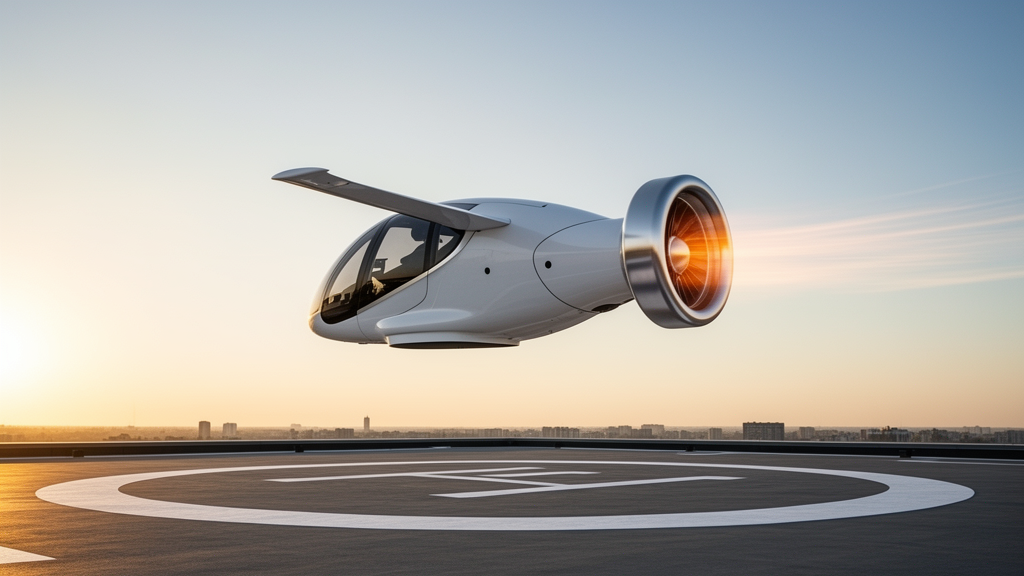
Urban Air Mobility has promised a future in which quiet, electric aircraft glide between rooftops and vertiports, but the engineering reality is that the compact propulsion units at the heart of these vehicles still fight an old aerodynamic enemy: flow separation. When an electric ducted fan sucks air through its surrounding shroud, the sharp curvature at the entrance of the duct can cause the airflow to peel away from the inner wall, forming a low-pressure recirculation bubble right at the duct lip. That bubble steals thrust, destabilizes the fan, and wastes energy. A team of Vietnamese researchers now reports a deceptively simple fix, a ring-shaped device called a Circumferential Intake Flow Deflector, that measurably improves the performance of an electric ducted propulsion fan across a wide operating range.
The study, published in the International Journal of Aeronautical and Space Sciences, was led by Hoang-Quan Chu of Le Quy Don Technical University in Hanoi, together with colleagues from the Viettel Aerospace Institute and Hanoi University of Science and Technology. Electric ducted fans are attractive for urban air vehicles because they combine compact size, low noise, and net-zero emissions in a single package. Yet their efficiency ceiling is set largely by what happens at the intake, where the boundary layer along the duct wall must negotiate a tight turn into the fan face. If the turn is too aggressive for the local flow conditions, the flow separates, and the resulting separation bubble distorts the velocity profile entering the rotor blades, degrading both thrust production and torque efficiency.
The researchers’ proposed solution, the Circumferential Intake Flow Deflector, or CIFD, is a circumferential structure fitted around the intake that reshapes the streamlines approaching the duct lip. Rather than attacking the separation bubble with active blowing or complex variable-geometry mechanisms, the deflector passively guides the incoming air so that the adverse pressure gradient at the lip is softened. The concept joins a family of lip-separation control ideas explored over the past two decades, including double-ducted fans, lip spoilers, articulating leading-edge slats, and anti-stall fins on axial fans, but the CIFD distinguishes itself by being a single, fixed, full-ring device that adds essentially no moving parts to the propulsion system.
Before any claims of improvement could be made, the team anchored their work in experiment. The baseline electric ducted fan, a commercial unit whose performance envelope is documented by the manufacturer, was validated against static aero-propulsion test data that the group had previously published, giving the computational model a firm empirical footing. With the baseline verified, the researchers systematically varied three geometric parameters of the deflector: the opening angle alpha, which controls how steeply the deflector presents itself to the incoming stream; the axial length L, which sets how far the deflector extends along the duct; and the axial distance W, which positions the device relative to the lip. Combinations of these parameters produced a family of candidate designs, each simulated under identical conditions.
The simulations were carried out in ANSYS CFX 2025 R1 using the shear-stress-transport based k-omega turbulence model, a workhorse closure in turbomachinery aerodynamics because it captures both boundary-layer behavior near walls and free-shear turbulence away from them. To ensure that the reported gains were not artifacts of mesh resolution, the team performed grid-independence testing, refining the computational mesh until further refinement no longer changed the key performance metrics. Only after this verification did they compare the candidate deflectors against the baseline fan, evaluating thrust, torque, and drag together with dimensionless performance quantities that allow fair comparison across operating conditions.
One configuration emerged as the clear winner: a design labeled A45L70W0, corresponding to an opening angle of 45 degrees, an axial length of 70 units, and zero axial offset. At a rotational speed of 6000 rpm, the best deflector delivered a 2.32 percent increase in net thrust and a 2.83 percent reduction in torque, while drag rose only marginally, by 0.18 percent. Those percentages may sound modest, but in propulsion engineering they are meaningful. A thrust gain of more than two percent achieved with a passive add-on, accompanied by a torque reduction that directly lowers the power demanded from the electric motor, translates into either longer endurance or heavier payload for an air taxi, and it comes essentially for free in weight and complexity terms.
To confirm that the benefit was not confined to a single operating point, the researchers evaluated both the prototype and the A45L70W0 configuration across a rotational speed range from 2000 to 7000 rpm and benchmarked the results against related studies in the literature. The deflector’s advantages persisted throughout the envelope, indicating that the device does not merely shift the problem to another regime but genuinely stabilizes the intake flow. This robustness matters for urban air vehicles, whose ducted fans must operate efficiently from hover through transition to forward flight, encountering widely varying inflow angles and mass flow demands along the way.
The flow-field diagnostics explain why the device works. By examining contours of total pressure, velocity, turbulence kinetic energy, and static entropy, the team traced how the deflector reshapes the intake flow. Total pressure recovery through the duct improved, meaning more of the energy in the incoming air survives the journey to the fan face. Velocity distributions at the rotor inlet became more uniform, reducing the distortion that the blades must tolerate. Turbulence kinetic energy in the lip region dropped, a signature of the suppressed separation bubble, and static entropy, a direct measure of irreversible energy loss, decreased as well. Together these fields tell a coherent story: the deflector keeps the flow attached where it would otherwise separate, and attached flow wastes less energy.
The implications extend beyond a single fan design. The study was supported by Vietnam’s National Foundation for Science and Technology Development under grant NCUD.02-2023.20, and the authors frame the CIFD as a foundation for future aeroacoustic and structural investigations. That next step is significant for Urban Air Mobility, because noise certification is arguably the binding constraint on where and when air taxis can operate. Flow separation at a duct lip is not only an efficiency problem; the unsteady pressure fluctuations inside a separation bubble are also a noise source. If the deflector’s stabilization of the intake flow carries over to reduced unsteadiness, the same passive device could deliver acoustic benefits alongside the aerodynamic ones, a hypothesis the authors flag as future work.
For now, the result stands as a tidy demonstration of classical aerodynamic thinking applied to a very modern problem. As electric aviation scales from prototypes toward certified passenger vehicles, every percentage point of propulsive efficiency compounds across fleets, battery sizes, and charging infrastructure. A fixed ring of carefully angled metal, validated by experiment, verified by grid-independent simulation, and shown to add thrust while cutting torque and leaving drag nearly untouched, is exactly the kind of incremental engineering that turns a promising concept into a commercially viable aircraft. The ducted fan’s oldest weakness, it turns out, can be blunted by one of its simplest possible modifications.
Subject of Research: Aerodynamic performance improvement of an electric ducted propulsion fan using a circumferential intake flow deflector
Article Title: Aerodynamic Characteristic of an Electric Ducted Propulsion Fan with Circumferential Intake Flow Deflector
Article References: Chu, H.-Q., Nguyen, T.-K., Chu, D.-L., Nguyen, B.-N., Vu, T.-S., & Dinh, C.-T. (2026). Aerodynamic Characteristic of an Electric Ducted Propulsion Fan with Circumferential Intake Flow Deflector. International Journal of Aeronautical and Space Sciences. https://doi.org/10.1007/s42405-026-01270-z
Image Credits: AI Generated
DOI: 10.1007/s42405-026-01270-z
Keywords: electric ducted fan, urban air mobility, circumferential intake flow deflector, flow separation, duct lip, computational fluid dynamics, SST k-omega turbulence model, thrust, torque, turbulence kinetic energy, aerodynamics, eVTOL
Cite Scienmag News
Audrey Campbell. (October 9, 2026). Simple Ring Deflector Boosts Thrust of Electric Ducted Fans for Air Taxis. Scienmag. https://scienmag.com/simple-ring-deflector-boosts-thrust-of-electric-ducted-fans-for-air-taxis/
Audrey Campbell. "Simple Ring Deflector Boosts Thrust of Electric Ducted Fans for Air Taxis." Scienmag, 9 October 2026, https://scienmag.com/simple-ring-deflector-boosts-thrust-of-electric-ducted-fans-for-air-taxis/. Accessed 9 October 2026.
Audrey Campbell. "Simple Ring Deflector Boosts Thrust of Electric Ducted Fans for Air Taxis." Scienmag. October 9, 2026. https://scienmag.com/simple-ring-deflector-boosts-thrust-of-electric-ducted-fans-for-air-taxis/


