


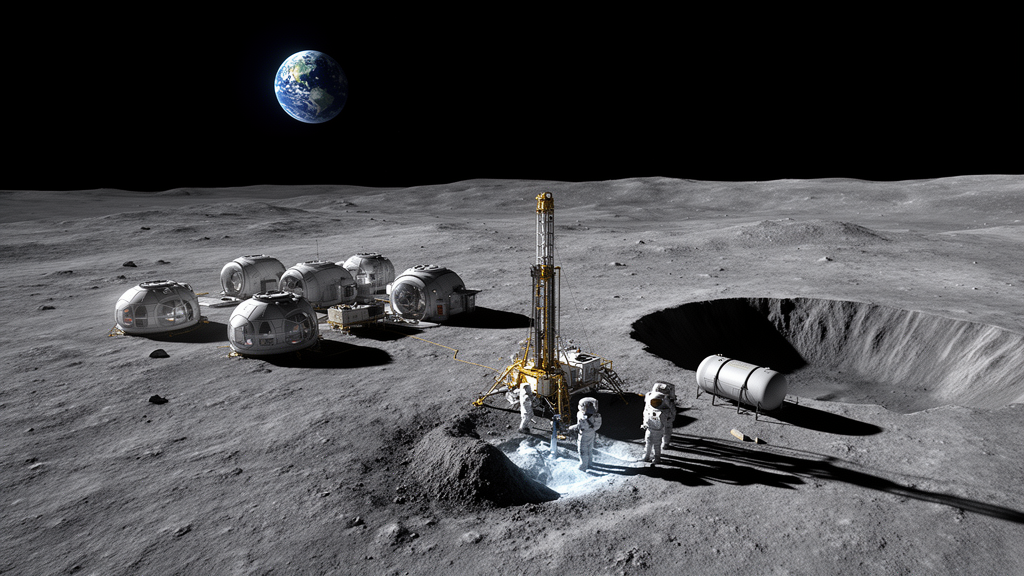
The dream of building glittering cities on the Moon has just collided with a sobering reality check. New research published in the journal Frontiers in Space Technologies argues that even the most optimistic estimates of water locked in ice at the lunar poles fall dramatically short of what a large permanent settlement would need to survive. According to the study, a city of one million people could exhaust the Moon’s entire accessible water supply in roughly a century under the best recycling conditions, and if current, more conservative estimates of lunar water are correct, even a small city could run dry after barely a decade. The findings strike at the heart of the modern ‘moon rush,’ the wave of ambition that has swept up space entrepreneurs, national space agencies, and a growing chorus of visionaries who imagine lunar villages blossoming into self-sustaining metropolises.
The scientific foundation for this lunar optimism is genuine and hard-won. Soon after the Moon formed roughly 4.5 billion years ago, a prolonged bombardment of asteroids pummeled its surface, carving the pockmarked topography we see today and delivering a cargo of volatile compounds, including water. Near the lunar poles, dozens of crater floors have remained in permanent shadow for about four billion years, never touched by direct sunlight. These cryogenically cold recesses, vividly described as ‘pits of eternal darkness,’ sit at temperatures below about 110 kelvin, or minus 163 degrees Celsius. At such extreme cold they function as ‘cold traps,’ environments in which water ice cannot sublimate away by more than a millimeter in a billion years, even in the hard vacuum at the Moon’s surface. In other words, any ice that arrived with those ancient asteroids has been preserved in a deep freeze longer than complex life has existed on Earth.
Confirmation that this water is actually there came through a succession of Moon-orbiting missions. Since 2013, spacecraft have mapped likely ice deposits at the poles in steadily increasing detail, and some analyses have suggested that as much as a billion tons of water could be sequestered in those shadowed craters. That figure, if accurate, would be transformative. Water is not merely something to drink; it can be split into hydrogen and oxygen to make rocket propellant, breathed as oxygen, used to shield against radiation, and employed in countless industrial processes. The presence of water at the lunar poles changes everything about human visits to the Moon, because it suddenly becomes practical to imagine a ‘Moon village’ where people could survive without importing every last necessity from Earth. Settlers could grow their own food and enjoy showers and functional toilets, luxuries that even astronauts aboard the International Space Station cannot fully take for granted.
It is precisely this possibility that has fueled the boldest pronouncements of the private space sector. Jeff Bezos has spoken of moving heavy industry off Earth and onto the Moon, while Elon Musk has set his sights on ‘self-growing cities’ beyond our planet. These are enticing visions, and the new study does not dismiss them outright. Instead, its author, Dr. Martin Elvis, set out to test them with a deceptively simple feasibility analysis: how much power and water would a large lunar population actually consume, and how long could a settlement of 100,000 or one million people plausibly endure before its most critical resource ran out? The method was a data-driven accounting exercise, comparing known or estimated resource inventories against the demands of human habitation at scale.
The good news, according to the analysis, is that electricity is not the bottleneck. The rims of the craters that contain the pits of eternal darkness are bathed in almost permanent sunlight, which is why they are sometimes, slightly inaccurately, called the ‘peaks of eternal light.’ From these highly illuminated vantage points, it would be possible to generate as much as three gigawatts of electricity using towers a kilometer tall and covered with photovoltaic arrays. To put that in perspective, three gigawatts is on the order of the output of several large conventional power plants, enough to light a sizable industrial economy. Crucially, the study notes that solar panels could plausibly be manufactured on the Moon itself, since there is no shortage of silicon in the lunar crust. Abundant local power could even make AI data centers on the Moon feasible, sited near those sunny peaks, and would represent the beginning of a true lunar economy.
Water is where the arithmetic turns brutal. Even assuming a generous inventory of one billion tons of water to start with, a lunar city without recycling would exhaust its supply in only a few years. The best-case scenario is hardly more comforting: with water recycling at 98 percent efficiency, matching the impressive performance achieved aboard the International Space Station, a one-million-person city would still run out of water in just over a century. That may sound like a long time, but on the timescales of civilization-building it is a blink, and it is fundamentally incompatible with the idea of a permanent, growing settlement. Sustainability, the study concludes, is precisely what large-scale lunar habitation currently lacks.
The problem deepens when the billion-ton figure is scrutinized. Today’s best estimates of the water actually present on the Moon are about thirty times lower than that optimistic ceiling, which shortens the time to water exhaustion by the same factor. Under those more realistic assumptions, even a small city would run dry after roughly a decade of operation. The scale of settlement matters enormously: a modest Moon village of a thousand people, or even a town of ten thousand, could remain sustainable for several centuries or more, because its demands stay within the regenerative capacity of careful recycling and modest extraction. The dream of urban scale, however, collapses under the weight of its own water bill. The difference between a village and a city on the Moon is, quite literally, the difference between centuries of habitability and a single human generation.
Are there ways out of this hydrological dead end? The study outlines several potential solutions, each with its own challenges. Recycling efficiency could be improved by a factor of five or more beyond current spaceflight standards, pushing recovery rates toward theoretical limits. Per-capita water consumption could be lowered through new techniques such as vertical farming, which grows crops in controlled, water-frugal environments. Water could be imported, most plausibly from accessible near-Earth asteroids, some of which are known to carry substantial volatile inventories and are easier to reach than the lunar surface itself in terms of energy requirements. Or, most simply, humanity could find more water on the Moon.
That last hope may be the most promising of all, and it points toward a clear research priority. Current water-surveying techniques, relying on orbital spectrometers and neutron measurements, cannot probe more than a few meters below the lunar surface. Yet the rubble-like layer of broken rock and dust known as the regolith typically extends tens of meters deep, and those unexplored depths within the cold traps may hold substantial additional ice. If the ambitious plans of the space billionaires are ever to be realized, the study argues, finding that deeper water will be the essential first step. Until then, the verdict stands: the Moon has enough water for outposts, villages, and perhaps small towns, but not, on present evidence, for cities. The next great lunar discovery may not be made by a lander or a rover, but by a drill.
For now, the research reframes the conversation around lunar settlement in terms that engineers and policymakers can act upon. Power abundance and water scarcity coexist at the poles, a paradox created by the Moon’s violent history and its airless, frozen geography. Any credible roadmap for human expansion beyond Earth must therefore begin with rigorous resource prospecting, honest accounting of consumption, and technologies that close every possible loop. The pits of eternal darkness have guarded their ice for four billion years; whether they can sustain a civilization is no longer a matter of imagination, but of measurement.
Subject of Research: Sustainability of lunar cities given limited water ice at the Moon's poles
Article Title: No cities on the Moon — there isn’t enough water, scientists say
Article References: No cities on the Moon — there isn’t enough water, scientists say. (n.d.). Original publication
Image Credits: AI Generated
DOI: Not provided
Keywords: Moon, lunar water ice, cold traps, lunar poles, space settlement, water recycling, solar power, regolith, Moon village, Frontiers in Space Technologies, lunar sustainability, space resources
Cite Scienmag News
Grant Pearson. (October 9, 2026). Moon Cities May Run Dry: Polar Water Too Scarce for Large Lunar Settlements. Scienmag. https://scienmag.com/moon-cities-may-run-dry-polar-water-too-scarce-for-large-lunar-settlements/
Grant Pearson. "Moon Cities May Run Dry: Polar Water Too Scarce for Large Lunar Settlements." Scienmag, 9 October 2026, https://scienmag.com/moon-cities-may-run-dry-polar-water-too-scarce-for-large-lunar-settlements/. Accessed 9 October 2026.
Grant Pearson. "Moon Cities May Run Dry: Polar Water Too Scarce for Large Lunar Settlements." Scienmag. October 9, 2026. https://scienmag.com/moon-cities-may-run-dry-polar-water-too-scarce-for-large-lunar-settlements/


