


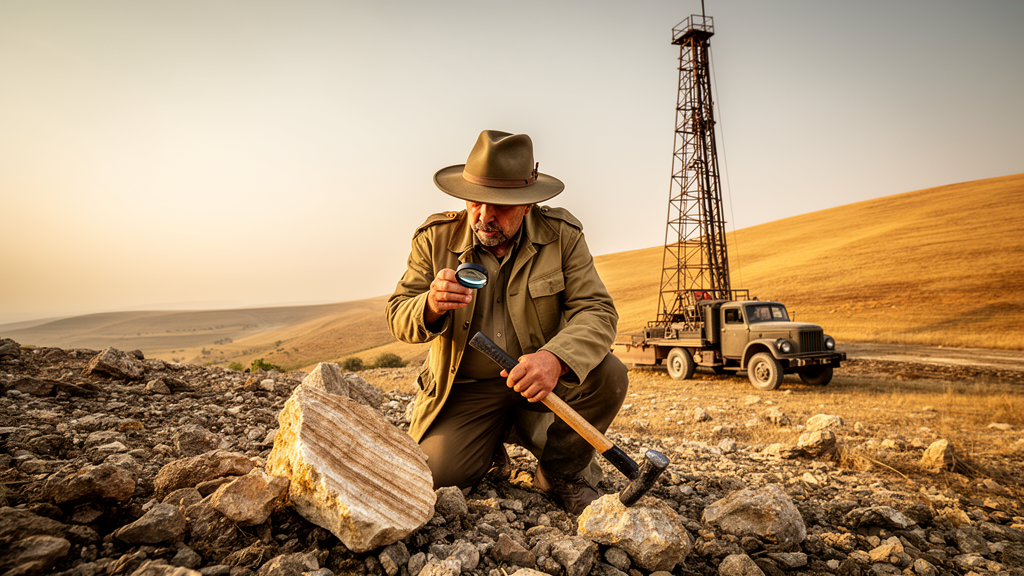
In 1940, as war engulfed Europe and the Ottoman Empire’s successor state scrambled for resources, a drilling rig in a remote gorge in southeastern Anatolia struck oil at a depth of 1,048 meters. The Raman-1 well delivered Türkiye’s first major petroleum discovery, and behind it stood a single figure whose story has remained largely untold outside specialist circles: Cevat Eyüp Taşman, the country’s first petroleum geologist. A new archival study published in the History of Geo- and Space Sciences now reconstructs his career in unprecedented detail, portraying him not merely as a technical expert but as the architect of an entire national energy enterprise.
The research, conducted by Oğuz Mülayim of the Turkish Petroleum Corporation, draws on Prime Ministry Republican Archives, Ottoman Archives, parliamentary records, contemporary newspapers, and the memoirs of Taşman’s colleagues. It organizes his legacy around four pillars: a technical-scientific contribution that transformed oil exploration from guesswork into a rigorous science, an institutional achievement in building state exploration bodies from scratch, a legal-regulatory role in drafting the modern Turkish petroleum law, and an intellectual-public role as an educator who took petroleum geology to the radio airwaves decades before universities taught it.
Taşman’s formation was extraordinary for its time. Born in 1893 in the final decades of the Ottoman Empire, he received his elite secondary education at Robert College in Istanbul, the first American institution of higher education founded outside the United States. In 1911, he was selected as one of the first Ottoman students dispatched by the state for advanced technical training in America. He enrolled at Columbia University’s School of Mines, where he completed a Bachelor of Science in Mining Engineering in 1915, funded by a Carnegie Foundation grant after the First World War interrupted his original state stipend. He went on to pursue a Master of Science in Geology at Columbia, serving as a research assistant and absorbing deep theoretical grounding in stratigraphy and structural geology.
What set him apart, however, was the decade of hands-on industry experience that followed. Taşman worked for the Phelps Dodge Corporation from 1918 to 1920 and then for the Empire Gas & Fuel Company from 1920 to 1930, conducting geological surveys and managing drilling operations in prolific hydrocarbon regions including Texas, New Mexico, and Mexico’s Tamaulipas region. By the early 1920s he was recognized in professional circles, noted in industry publications such as the Engineering & Mining Journal Press. This immersive apprenticeship in the world’s most advanced oil sector gave him a complete command of the exploration cycle, from basin analysis and prospect generation to drilling technology and well-site geology, a combination unmatched by anyone in Türkiye at the time.
The young Republic’s pursuit of energy independence had exposed a critical vulnerability. The Petroleum Law of 1926 demonstrated the state’s resolve to control its subsurface resources, but it also revealed the absence of trained domestic expertise capable of mastering oil exploration science and technology. The initiative to recruit such expertise was formally launched in 1929 under Minister of Economy Mehmet Şakir Kesebir, and Taşman’s unique profile came to official attention through a personal network: journalist Ahmet Emin Yalman, his former Columbia classmate, brought his experience to the authorities. Taşman returned to Türkiye as a consultant in 1929 and was formally appointed Director of the newly established Petroleum Exploration and Operations Administration in May 1933.
His first years in the field were a crash course in the harsh realities of Anatolian geology. Taşman led extensive geological surveys stretching from Thrace to southeastern Anatolia with an interdisciplinary team that included Turkish geologist Kemal Lokman, Swiss geologist Michel Lucius, and German geophysicist Hoffman. In 1931, writing under the Anglicized name Djevad Eyoub, he published a foundational analysis of Türkiye’s petroleum geology in the Bulletin of the American Association of Petroleum Geologists, the first systematic presentation of the nation’s oil potential by a Turkish geologist to an international audience. The paper served a dual purpose: it provided a strategic document for domestic planning while positioning Türkiye as a credible exploration frontier in the global literature.
As director, Taşman pursued a deliberate strategy of selective international collaboration to accelerate the transfer of advanced methods. He recruited distinguished geologists such as Sidney Paige, whose tectonic work was globally recognized, and Harold Moses, alongside Louis Vonderschmidt, an experienced petroleum geologist with over a decade in Venezuela’s prolific fields. Early failures, including the dry Basbirin-1 well in 1934 and other dry holes around Mardin, served as a practical education in the limits of applying foreign models without robust local data. The team responded by emphasizing foundational geological mapping and targeted paleontological analysis. Their assessments correctly questioned initial shallow targets and recommended drilling deeper into older Mesozoic strata, a strategic shift that culminated in the Raman-1 discovery on 20 April 1940, encountering the first economic reserve in fractured Upper Cretaceous carbonate units.
The methodological modernization Taşman championed went beyond mapping. Recognizing the absence of a reliable national stratigraphic framework, he pioneered the integration of biostratigraphy and micropaleontology into Turkish exploration for precise age dating and subsurface correlation. This led to the recruitment of paleontologist Mehlika İzgi, who began at the Mineral Research and Exploration Institute translating geological reports before her potential was recognized by American micropaleontologist Louise Jordan. İzgi became Türkiye’s first female petroleum geologist, served as well-site paleontologist for critical wells, conducted pioneering quantitative foraminiferal analyses for correlating wells in the Adana Basin, married Taşman in 1950, founded the Turkish Petroleum Corporation’s first micropaleontology laboratory, and authored the foundational handbook Applied Micropaleontology. Their partnership symbolized the intertwined nature of scientific advancement and social modernization in the Republic’s technical cadres.
Taşman’s influence extended into law and public life. Drawing on decades of operational experience, he played a pivotal role on the technical committee that drafted Petroleum Law No. 6326, enacted in 1954 after eighteen months of work. The law’s provisions for transparent licensing and technical committees were institutional mechanisms born from his earlier struggles, designed to attract responsible investment while shielding exploration from short-term political cycles, and it generated immediate international interest. In 1955 he moved to the new regulatory body, the Petrol Dairesi Reisliği, as a technical advisor. He was also a founding member and later president of the Geological Society of Türkiye in 1946, published nearly thirty scientific papers, and delivered a 1944 Ankara Radio broadcast and public lectures that translated specialized knowledge into public understanding, framing energy independence as a national cause and cultivating what the study calls a public petroleum consciousness.
The study argues that Taşman’s model was a distinctive hybrid. Unlike the Soviet Union’s rigidly state-controlled approach under Ivan Gubkin, the Middle Eastern pattern of foreign concessionary domination, or the Latin American nationalization-first path where technical expertise lagged behind political action, Türkiye under Taşman’s architecture first established a core of national technical sovereignty within a state framework, then strategically managed foreign technology and capital on its own terms. Taşman died in 1956, but the self-reinforcing ecosystem he designed, spanning scientific method, durable institutions, legal clarity, and public engagement, set the definitive long-term trajectory for Türkiye’s national hydrocarbon endeavors. His legacy, the author concludes, embodies a sober understanding: energy independence is a long-term pursuit constrained by geological reality, and the most critical resource for any nation’s strategic industries is not merely what lies beneath the ground, but the qualified human capital and the will to develop it.
Subject of Research: The foundational role of Türkiye's first petroleum geologist, Cevat Eyüp Taşman, in national oil exploration and energy policy
Article Title: The founding actor of Türkiye's petroleum geology: Cevat Eyüp Taşman and his legacy in the national energy policies
Article References: Mülayim, O. (2026). The founding actor of Türkiye's petroleum geology: Cevat Eyüp Taşman and his legacy in the national energy policies. History of Geo- and Space Sciences, 17(1), 25-35. https://doi.org/10.5194/hgss-17-25-2026
Image Credits: AI Generated
Keywords: Cevat Eyüp Taşman, petroleum geology, Türkiye, Raman-1 well, energy independence, Petroleum Law 6326, micropaleontology, Columbia University, history of geology, MTA, public intellectual, oil exploration
Cite Scienmag News
Courtney Benton. (October 9, 2026). How One Columbia-Trained Geologist Built Türkiye’s Oil Industry From Nothing. Scienmag. https://scienmag.com/how-one-columbia-trained-geologist-built-turkiyes-oil-industry-from-nothing/
Courtney Benton. "How One Columbia-Trained Geologist Built Türkiye’s Oil Industry From Nothing." Scienmag, 9 October 2026, https://scienmag.com/how-one-columbia-trained-geologist-built-turkiyes-oil-industry-from-nothing/. Accessed 9 October 2026.
Courtney Benton. "How One Columbia-Trained Geologist Built Türkiye’s Oil Industry From Nothing." Scienmag. October 9, 2026. https://scienmag.com/how-one-columbia-trained-geologist-built-turkiyes-oil-industry-from-nothing/


