


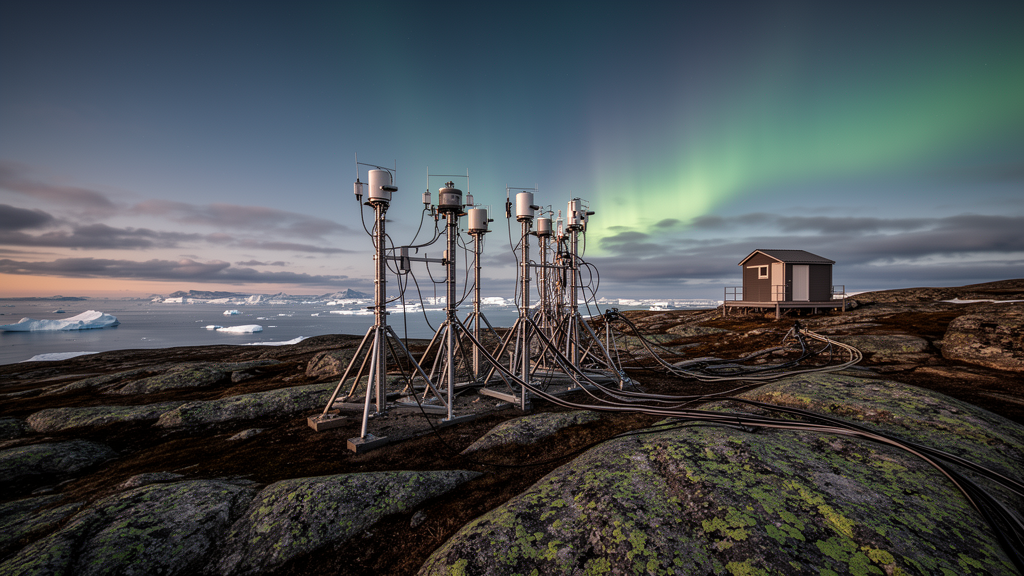
Deep in the Arctic, where the Earth’s magnetic field lines funnel solar wind particles directly into the upper atmosphere, a team of Danish and Norwegian researchers has uncovered a geomagnetic signal that had been hiding in plain sight for decades. By applying four years of one-second magnetometer data from a chain of stations along Greenland’s west coast, Marie Vigger Eldor of DTU Space and her colleagues have isolated a distinct population of rapid geomagnetic variations tied to the magnetospheric cusp, the funnel-shaped region where solar wind plasma gains direct access to the ionosphere. Their statistical study, published in Annales Geophysicae, shows that this cusp-related signal only becomes clearly separable from other magnetic activity during the summer months, a seasonal dependence that explains why earlier investigations, conducted mostly in winter darkness, failed to identify it unambiguously.
The magnetospheric cusp is one of the most dynamic regions of near-Earth space. When the interplanetary magnetic field carried by the solar wind points southward, magnetic reconnection at the subsolar magnetopause opens field lines and allows magnetosheath plasma to penetrate deep into the magnetosphere. This reconnection is pulsed in nature, producing flux transfer events that repeat every few to about fifteen minutes and generate a cascade of ionospheric phenomena: poleward moving auroral forms, reversed flow events, and strong flow channels. Under northward interplanetary conditions, reconnection shifts to the high-latitude lobes, but the cusp remains a site of intense, transient dynamics. All of these processes leave fingerprints in the magnetic field measured on the ground, in the form of rapid fluctuations in the ultra-low frequency, or ULF, band.
To capture these fingerprints, the team processed data from 2020 through 2023 recorded by the West Greenland magnetometer chain, whose stations span magnetic latitudes from the auroral zone deep into the polar cap. They applied a Butterworth bandpass filter to the northward magnetic component, isolating variations with periods between 10 and 600 seconds, a range that encompasses the Pc 3 to Pc 5 pulsation classes as well as Pi 2 irregular pulsations. Rather than trying to classify individual wave events, the researchers computed a broadband metric: they took the absolute value of the filtered signal and smoothed it with a ten-minute boxcar window. This metric, denoted X_ULF, integrates the total variability across the band and therefore responds to transient, impulsive, and wave-like magnetospheric phenomena alike, not just to coherent ULF waves.
The authors are careful about interpretation. Because a bandpass filter preserves the frequency content of any step-like disturbance, a sudden change in the ionospheric current, such as that produced by a flux transfer event, would appear in the metric just as a genuine wave would. Many of the power spectra they examined resemble the spectrum of a Heaviside step function, precisely what an impulsive current change would produce. The team therefore treats their metric as a measure of the ground magnetic response to all rapid dayside dynamics, whether oscillatory or impulsive, rather than as a pure ULF wave proxy. This honesty about what the data can and cannot distinguish strengthens the statistical conclusions that follow.
The results reveal a striking geographic and seasonal structure. At Thule, the northernmost station in the polar cap, enhanced variability appears centred on magnetic local noon during summer, with amplitudes that grow as the F10.7 solar radio flux increases, a clear signature of solar cycle influence. The seasonal variation is anti-correlated with the solar zenith angle, meaning the signal is strongest when the Sun sits highest above the horizon. At Upernavik, slightly further south, a similar but stronger noon-time population appears with a smaller seasonal swing. In contrast, the southern stations in the auroral zone show their dominant activity at night, consistent with substorm processes, and their daytime signals respond strongly to geomagnetic storms as tracked by the ap index.
The pivotal finding emerges when the four years of data are averaged by season and plotted against magnetic latitude and local time. During summer, two separate populations of rapid geomagnetic variation are clearly visible: one poleward of about 75 degrees quasi-dipole latitude, associated with the cusp, and one equatorward of it, associated with auroral oval dynamics on closed field lines. Between them lies a pronounced minimum near 75 degrees, a quiet latitudinal gap that cleanly separates the two source regions. During winter, this minimum vanishes. The poleward population shifts southward, following the cusp as the Earth’s dipole tilt changes, and merges with the equatorward signals, becoming indistinguishable from them.
The physical explanation hinges on solar illumination and the electrical conductivity of the ionosphere. Ground magnetic signals in this frequency band are produced by horizontal ionospheric currents, which obey Ohm’s law and therefore depend on both the electric field and the conductivity of the ionospheric E-region. In the cusp, the electron precipitation streaming in from the magnetosheath is extremely soft, typically below about 220 electronvolts, so it deposits its energy in the F-region above roughly 200 kilometres rather than enhancing E-region conductivity. That means the conductivity overhead must be supplied by solar extreme-ultraviolet radiation, which is only sufficient during summer when the Sun never sets. The team demonstrated this by computing Hall conductances at each station using empirical formulas, and found plots that closely mirror the measured ULF variability at the two northern stations, year after year as solar activity climbed toward maximum.
The dependence on the interplanetary magnetic field further confirms the cusp origin of the high-latitude signal. The noon-time population poleward of 75 degrees appears for all IMF clock angles, indicating that it does not require either purely subsolar or lobe reconnection, but it shifts toward the morning or afternoon side of magnetic noon depending on the sign of the IMF B_y component. This behaviour matches the well-known Svalgaard-Mansurov effect and the documented response of cusp precipitation, poleward moving auroral forms, and the DPY current system to the east-west interplanetary field. Meanwhile, the equatorward dayside population is most pronounced during southward IMF, consistent with enhanced energy transfer through subsolar reconnection, and shows a local minimum at magnetic noon that the authors attribute to travelling convection vortices generated along the flanks of the magnetosphere, away from the bow-shock nose.
The study also resolves a long-standing puzzle in the literature. Earlier work, including analyses of the MACCS search-coil network and SuperDARN radar observations, had reported dayside ULF signatures occurring several degrees equatorward of the expected cusp boundary, leading some researchers to conclude that no distinct cusp wave signature exists on open field lines. The new analysis suggests those winter-time observations captured a mixture of populations: the weak, sun-dependent cusp signal blended with Alfvénic waves bouncing between hemispheres on closed field lines and with signals from more energetic particle precipitation, as documented in comparable Antarctic studies. Only in summer, when the tilted dipole pushes the cusp to its highest latitudes and solar EUV powers the E-region conductivity, does the cusp population crystallise out of the background as a separate, statistically robust entity.
One frustrating asymmetry remains: the optical observations needed to study cusp auroras require darkness, while the geomagnetic signal identified here requires sunlight, so the two cannot be combined in a single campaign. The authors note, however, that the electric fields driving the summer signals almost certainly persist through winter, and propose that dedicated high-cadence radar and satellite measurements could reveal them. For now, the Greenland chain has delivered something no previous array could: a four-year, high-cadence statistical portrait of the dayside high-latitude ionosphere from the auroral oval to the polar cap, and with it, the first unambiguous isolation of the magnetic signature of the polar cusp itself, written in the flickering of Earth’s field whenever the midnight Sun shines over the Arctic.
Subject of Research: Statistical analysis of rapid dayside geomagnetic variations associated with the magnetospheric cusp using Greenland ground-based magnetometers
Article Title: High latitude, dayside rapid geomagnetic variations observed with ground-based magnetometers in Greenland
Article References: Eldor, M. V., Johnsen, M. G., Olsen, N., & Willer, A. N. (2026). High latitude, dayside rapid geomagnetic variations observed with ground-based magnetometers in Greenland. Annales Geophysicae, 44(2), 811-823. https://doi.org/10.5194/angeo-44-811-2026
Image Credits: AI Generated
DOI: 10.5194/angeo-44-811-2026
Keywords: geomagnetism, polar cusp, ULF waves, magnetometers, Greenland, magnetosphere, solar wind, ionosphere, magnetic reconnection, space weather, auroral oval, ionospheric conductivity
Cite Scienmag News
Violet Maxwell. (October 9, 2026). Greenland Magnetometers Reveal Hidden Summer Signatures of the Polar Cusp. Scienmag. https://scienmag.com/greenland-magnetometers-reveal-hidden-summer-signatures-of-the-polar-cusp/
Violet Maxwell. "Greenland Magnetometers Reveal Hidden Summer Signatures of the Polar Cusp." Scienmag, 9 October 2026, https://scienmag.com/greenland-magnetometers-reveal-hidden-summer-signatures-of-the-polar-cusp/. Accessed 9 October 2026.
Violet Maxwell. "Greenland Magnetometers Reveal Hidden Summer Signatures of the Polar Cusp." Scienmag. October 9, 2026. https://scienmag.com/greenland-magnetometers-reveal-hidden-summer-signatures-of-the-polar-cusp/


