


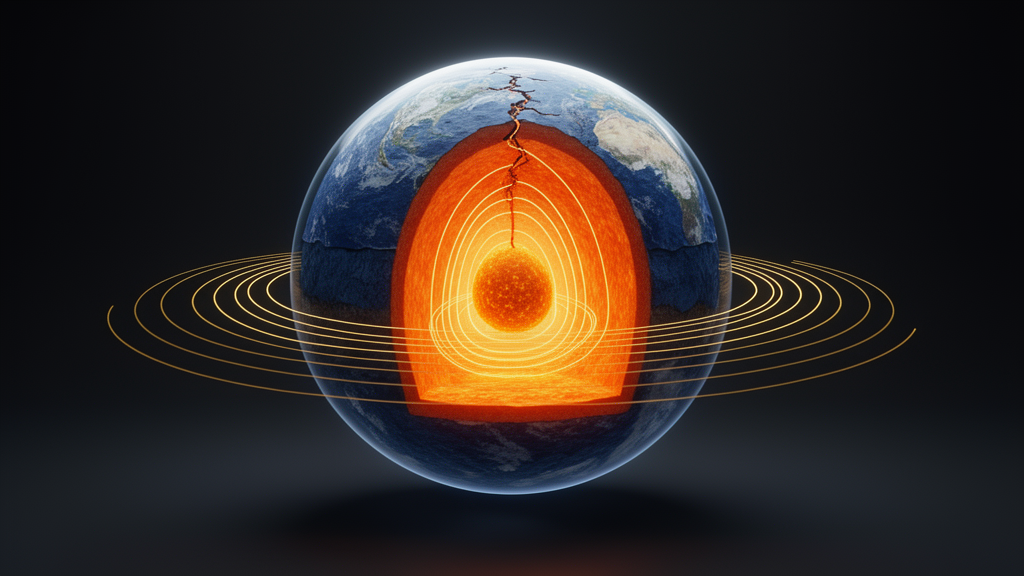
Deep inside our planet, more than 2,900 kilometers beneath our feet, seismic waves bounce off the core-mantle boundary and race through the iron heart of the Earth. For seismologists, these echoes are among the most precious signals in existence, because they carry information about a region no instrument can ever reach directly. Yet some of the most powerful techniques for reading them rest on assumptions that everyone knew were shaky. Now a team of Chinese researchers has delivered the mathematical reassurance the field has been waiting for, showing that one of the most counterintuitive methods in modern seismology is far more trustworthy than its critics feared.
The technique in question is seismic interferometry applied to coda waves, the long, reverberating tail of shaking that follows a large earthquake. When two seismic stations record the same big quake, and researchers cross-correlate the late portions of those recordings, something remarkable emerges: a waveform that looks as if a wave had traveled directly between the two stations, even though no earthquake ever sat at either one. Among the arrivals that appear in these stacked correlations are core phases such as ScS, which reflects off the core-mantle boundary, and PKIKP squared, which passes through the inner core itself. These reconstructed signals have already been used to probe the fine structure of the inner core, including its anisotropy and shear-wave speed.
The trouble is that the classical theory behind interferometry makes demands that coda waves simply do not meet. Cross-correlating noise records converges to the true Green’s function, the complete description of wave propagation between two points, only under idealized conditions, such as a perfectly uniform distribution of noise sources surrounding the stations or a wavefield whose energy is equipartitioned among all directions. Late coda waves violate these conditions. The result has been a persistent unease in the community: reconstructed core phases show anomalously high amplitudes compared with real earthquake data, and their travel times are known to be influenced by earthquake-station geometry, focal mechanisms, and the particular coda time window chosen for correlation. In short, nobody could say with rigor whether the extracted arrival times were true measurements or artifacts.
Yingjie Xia, Xuping Feng, and Xiaofei Chen, of Chengdu University of Technology and the Southern University of Science and Technology, tackled this problem in a study published in Solid Earth in June 2026. Rather than relying on the asymptotic approximations, such as the stationary phase method, that previous theoretical treatments employed, they built a perturbation-based framework. The strategy is elegant: start with a solvable reference model, a bounded homogeneous medium bounded by two discontinuous surfaces that mimics reflections between the Earth’s surface and the core-mantle boundary, and then perturb it to see how much the answer can drift. The reference model allows exact ray-path calculations, with path lengths expressed in closed form for waves that undergo any number of reflections before reaching each station.
From this foundation, the authors derived a strikingly simple and practical result. They introduced a dimensionless parameter defined as the ratio of the seismic wave period to the inter-station travel time, and showed that it establishes a critical angular threshold. For a reconstructed arrival to be free of interference from spurious waves, the incident wavefield must be locally uniform over an angular range at least as large as this threshold, which equals twice the arcsine of half the period-to-travel-time ratio. The perturbation analysis then revealed something even more useful: the error in the reconstructed travel time scales with the cube of this threshold angle. Small thresholds therefore mean tiny errors, and core phases, with their extraordinarily long propagation paths, naturally have very small thresholds.
The numbers make the point vividly. Consider the ScS phase, which has a dominant period of about 50 seconds and a travel time of roughly 1,000 seconds between stations separated by 10 degrees. The threshold angle works out to about 18 degrees. Converting to radians and applying the cubic error formula yields a timing uncertainty on the order of the third derivative of the deviation function divided by 220, which is negligible whenever the wavefield varies smoothly around the inter-station ray path. For PKIKP squared, which takes about 2,500 seconds and has a threshold angle near 11 degrees, the situation is even more favorable. In other words, the very phases that matter most for probing the deep interior are precisely the ones that interferometry reconstructs most accurately.
The framework also resolves a long-standing puzzle about which earthquakes actually contribute to the reconstruction. Intuition might suggest that only quakes lying on the great-circle plane connecting the two stations matter. The theory says otherwise. Because core phases arrive at steep incidence angles, the stable angular range they require encompasses waves arriving from planes that deviate substantially from the inter-station plane. The authors quantify this with a geometric parameter relating the threshold angle to the incidence angle of the target phase. For ScS at 10 degrees of station separation, this parameter reaches about 6; for PKIKP squared it climbs to about 11. When the parameter exceeds one, even coda waves radiated from earthquakes in planes perpendicular to the inter-station plane fall within the stable range and contribute constructively. This explains why a modest, globally scattered set of earthquakes can suffice, relaxing the traditionally assumed requirement for a uniform source distribution.
Numerical simulations confirmed the theory before it faced the real Earth. When the researchers truncated the angular integration at values corresponding to a single pi phase shift, spurious waves interfered with the reconstructed arrival and shifted its phase. At the critical 2-pi threshold, the two wave packets aligned and the true travel time was recovered exactly. Beyond that, at 4 pi, the packets separated entirely and the reconstruction remained clean. A further test with a deliberately non-cosine distribution of travel-time differences, chosen to mimic the complexities of real coda including P-to-S conversions, produced reconstructions nearly identical to the ideal case, validating the perturbation approach.
The decisive test came from real data. The team selected 205 large earthquakes of magnitude 6.8 or greater between 2010 and 2020, downloaded broadband waveforms from stations of the USArray Transportable Array, and cross-correlated coda windows extending from 10,000 to 40,000 seconds after each event’s origin time, bandpass filtered between 15 and 50 seconds of period. The stacked correlograms showed prominent PcP, ScS, and PKIKP squared arrivals at travel times matching the ak135 reference model. A bootstrap analysis, progressively increasing the number of earthquakes in each stack from 10 to 120 across 250 random realizations, showed that mean travel times stabilized and standard deviations shrank as events accumulated. With fewer than roughly 20 earthquakes, deviations exceeded one second; convergence emerged with about 50 to 100 well-distributed events. Crucially, when the data were split by the deviation angle between earthquake and inter-station planes, ScS travel times wandered by up to 3 seconds across different deviation ranges, while PKIKP squared times remained nearly identical, exactly as the high geometric parameter predicted.
The implications reach beyond a single method. The study proposes that a long-running debate, over whether coda-correlation phases represent true inter-station arrivals or a modified wavefield whose timing depends on source distribution, dissolves into a matter of degree. Two conditions jointly determine the outcome: the illumination condition, meaning the incident waves must sample the critical angular range, testable through bootstrap convergence, and a smoothness condition, meaning the velocity structure along the path must yield a smoothly varying deviation function, which ray theory generally guarantees. When both hold, the reconstructed phase is the true arrival; when they fail, the biased measurement appears instead. For researchers mapping the inner core, tracking its rotation, or estimating its shear-wave speed, this framework provides something previously missing: a quantitative, practical criterion for knowing when their measurements can be trusted. The echoes of distant earthquakes, it turns out, were speaking clearly all along; now seismologists finally have the mathematics to prove it.
Subject of Research: Travel-time accuracy of core phases reconstructed by seismic coda-wave interferometry
Article Title: Perturbation analysis of travel-time accuracy for core phases reconstructed from seismic interferometry
Article References: Xia, Y., Feng, X., & Chen, X. (2026). Perturbation analysis of travel-time accuracy for core phases reconstructed from seismic interferometry. Solid Earth, 17(6), 855-866. https://doi.org/10.5194/se-17-855-2026
Image Credits: AI Generated
Keywords: seismology, seismic interferometry, coda waves, core phases, Earth's inner core, travel-time accuracy, perturbation analysis, Green's function retrieval, core-mantle boundary, PKIKP, ScS, deep Earth imaging
Cite Scienmag News
Violet Maxwell. (October 9, 2026). New Math Shows Earth’s Core Can Be Imaged From Earthquake Echoes. Scienmag. https://scienmag.com/new-math-shows-earths-core-can-be-imaged-from-earthquake-echoes/
Violet Maxwell. "New Math Shows Earth’s Core Can Be Imaged From Earthquake Echoes." Scienmag, 9 October 2026, https://scienmag.com/new-math-shows-earths-core-can-be-imaged-from-earthquake-echoes/. Accessed 9 October 2026.
Violet Maxwell. "New Math Shows Earth’s Core Can Be Imaged From Earthquake Echoes." Scienmag. October 9, 2026. https://scienmag.com/new-math-shows-earths-core-can-be-imaged-from-earthquake-echoes/


