


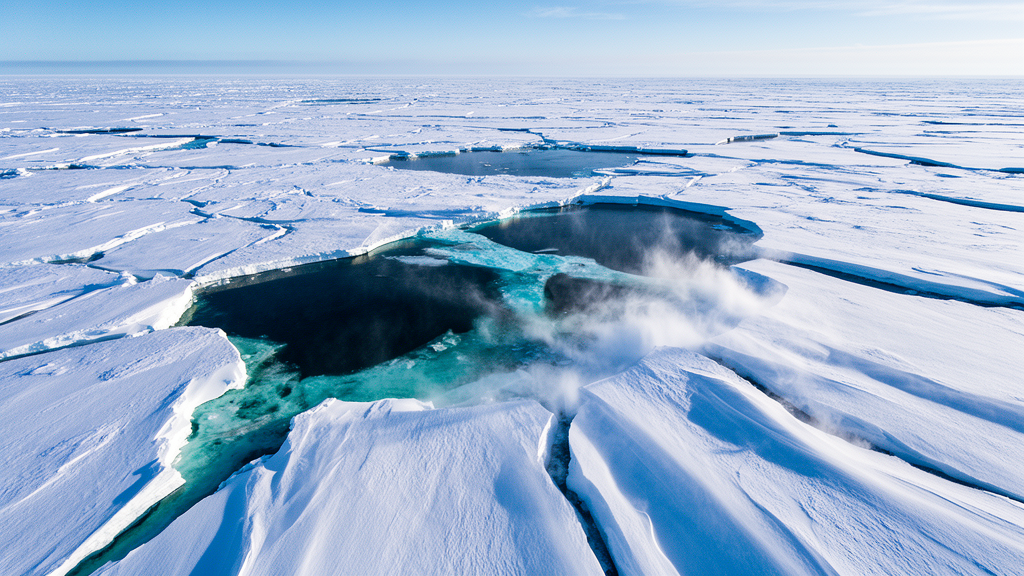
Off the coast of East Antarctica, in a stretch of ocean called Vincennes Bay, the sea ice regularly tears itself open to reveal a pool of churning, freezing water. These recurring openings, known as coastal polynyas, are among the most productive ice factories on the planet: fierce winds strip away the thin skin of new ice almost as fast as it forms, pumping enormous volumes of cold, salty water into the ocean and producing vast quantities of fresh sea ice relative to the fully frozen ocean around them. For decades, scientists have explained the existence and persistence of polynyas almost entirely in terms of wind. A new study published in Nature Communications adds a long-overdue second actor to the story: the waves that those same winds whip up inside the open water.
Using rare in situ measurements from wave buoys deployed in the Vincennes Bay Polynya, a research team led by Joey Voermans of the University of Melbourne, working with colleagues from China, Germany, the United Kingdom, the United States, Norway and Australia, has documented something unexpected. The strong offshore winds that keep the polynya open do more than simply blow newly formed ice away from the coast. They also generate energetic wind waves within the open water itself, and those locally generated waves are powerful enough to fracture the surrounding ice cover. Crucially, the breakup propagates in the opposite direction to the pattern scientists usually associate with wave damage in polar seas.
The conventional picture of wave-induced sea-ice breakup comes from the Southern Ocean, where long-period swells generated by distant storms travel hundreds or even thousands of kilometres before reaching the ice edge. When these swells arrive, they flex and fatigue the ice at its outer boundary, breaking floes apart progressively from the outside in. The fractures radiate inward, and the ice edge erodes over time. This outside-inward mechanism has been studied extensively, both from satellites and in wave tanks, and it underpins most current models of how waves and sea ice interact across the vast marginal ice zones that ring Antarctica.
The Vincennes Bay observations reveal a mirror image of that process. Because the polynya is a region of open water embedded within the ice pack, waves generated inside it by the katabatic and synoptic winds grow across the fetch of the polynya and then strike the surrounding ice from within. The result is an inside-outward breakup pattern: fracturing begins at the polynya’s edge and works its way outward into the surrounding ice field. The team’s buoy records captured energetic wave conditions during strong wind events, providing direct observational evidence that the polynya is not merely a passive hole in the ice but an active wave-generation zone capable of reshaping its own boundaries.
This distinction matters because the two breakup regimes operate on different wave physics. Southern Ocean swells are long, low-frequency waves that can propagate through sea ice over considerable distances, attenuating gradually as their energy is scattered by floes and dissipated by ice deformation. Locally generated wind waves inside a polynya are typically shorter and steeper, having grown only across the limited fetch of open water available to them. Their interaction with the ice edge is correspondingly more abrupt, concentrating flexural stress near the boundary where the ice is thinnest and most vulnerable. The study demonstrates that these shorter, locally born waves are nonetheless energetic enough to fracture the ice cover and expand the region of broken floes around the polynya.
To assess how significant these events are beyond the duration of a single buoy deployment, the researchers turned to two decades of satellite records spanning 2003 to 2022. By examining sea-ice concentration data alongside atmospheric conditions, they identified extreme wave-induced breakup events and traced their consequences across the surrounding ice pack. The satellite analysis showed that these events coincide with substantial reductions in sea-ice concentration, and, strikingly, that the reductions persist for at least a week after the breakup itself. In other words, a single episode of wave-driven fracturing leaves a lasting imprint on the ice landscape, long after the winds that generated the waves have subsided.
The satellite records also revealed a shift in the type of ice present after breakup events. Following wave-induced fracturing, the affected areas showed increased transitions to frazil ice, the loose, slushy crystals that form in supercooled, turbulent water before consolidating into new ice sheets. Frazil ice is the raw material of the polynya’s ice factory, and an increase in frazil production signals that the open, wave-agitated water is actively churning out new ice. The waves, in effect, feed back into the very process that defines the polynya: by breaking the surrounding ice, they enlarge and sustain the open water area, which in turn allows more wind-driven heat loss, more supercooling, and more frazil generation.
This feedback loop has implications that extend well beyond the immediate vicinity of Vincennes Bay. Antarctic coastal polynyas are disproportionately important sites of dense water formation, a key link in the global overturning circulation that ventilates the deep ocean. They are also biological hotspots, where the combination of open water, intense mixing and rapid ice production supports productive marine ecosystems. If waves play a larger role in polynya dynamics than previously recognized, then the models used to simulate sea-ice production, dense water formation and polar ocean circulation may need to account for wave-ice interactions inside polynyas, not just at the open-ocean ice edge where most wave-ice research has traditionally focused.
The findings arrive at a moment when Antarctic sea ice is under scrutiny. After decades of relative stability, Antarctic sea-ice extent has shown pronounced variability and record lows in recent years, prompting intense debate about the role of ocean heat, atmospheric forcing and internal feedbacks. As the climate changes, wind patterns, storm tracks and ocean conditions around Antarctica are all shifting. The authors note that as Antarctic coastal polynyas evolve under a changing climate, wave activity may become increasingly important in shaping their sea-ice conditions and their evolution. A polynya that experiences more frequent or more energetic wave events could break its surrounding ice more often, stay open longer, and produce different ice types than one governed by wind alone.
What makes the study particularly valuable is the rarity of its observations. Deploying and maintaining wave buoys inside an Antarctic polynya is logistically demanding, requiring support from teams at Australia’s Casey Station and instrumentation capable of surviving one of the harshest marine environments on Earth. Direct measurements of waves within polynyas are scarce, which is precisely why polynya dynamics have been framed almost exclusively in terms of wind and thermodynamics. By pairing these hard-won buoy records with a twenty-year satellite perspective, the researchers have transformed a theoretical possibility into a documented mechanism. The Vincennes Bay Polynya, it turns out, does not simply exist because the wind says so. It exists because the wind and the waves work together, with the waves carving the ice from the inside out and leaving fingerprints on the Antarctic ice pack that satellites can still see a week later.
Subject of Research: Wave-driven inside-outward breakup of sea ice in an Antarctic coastal polynya
Article Title: Inside-outward breakup of sea ice by locally generated waves in the Vincennes Bay Polynya
Article References: Voermans, J. J., Liu, Q., Cao, L., Kousal, J., Heil, P., Fraser, A. D., Collins, C. O., Rabault, J., & Babanin, A. V. (2026). Inside-outward breakup of sea ice by locally generated waves in the Vincennes Bay Polynya. Nature Communications. https://doi.org/10.1038/s41467-026-77979-y
Image Credits: AI Generated
DOI: 10.1038/s41467-026-77979-y
Keywords: sea ice, polynya, ocean waves, Antarctica, Vincennes Bay, wave-ice interaction, frazil ice, Southern Ocean, katabatic winds, sea-ice concentration, polar oceanography, climate change
Cite Scienmag News
Violet Maxwell. (October 9, 2026). Winds Blow Holes in Antarctic Ice, Then Waves Shatter It From Within. Scienmag. https://scienmag.com/winds-blow-holes-in-antarctic-ice-then-waves-shatter-it-from-within/
Violet Maxwell. "Winds Blow Holes in Antarctic Ice, Then Waves Shatter It From Within." Scienmag, 9 October 2026, https://scienmag.com/winds-blow-holes-in-antarctic-ice-then-waves-shatter-it-from-within/. Accessed 9 October 2026.
Violet Maxwell. "Winds Blow Holes in Antarctic Ice, Then Waves Shatter It From Within." Scienmag. October 9, 2026. https://scienmag.com/winds-blow-holes-in-antarctic-ice-then-waves-shatter-it-from-within/


