


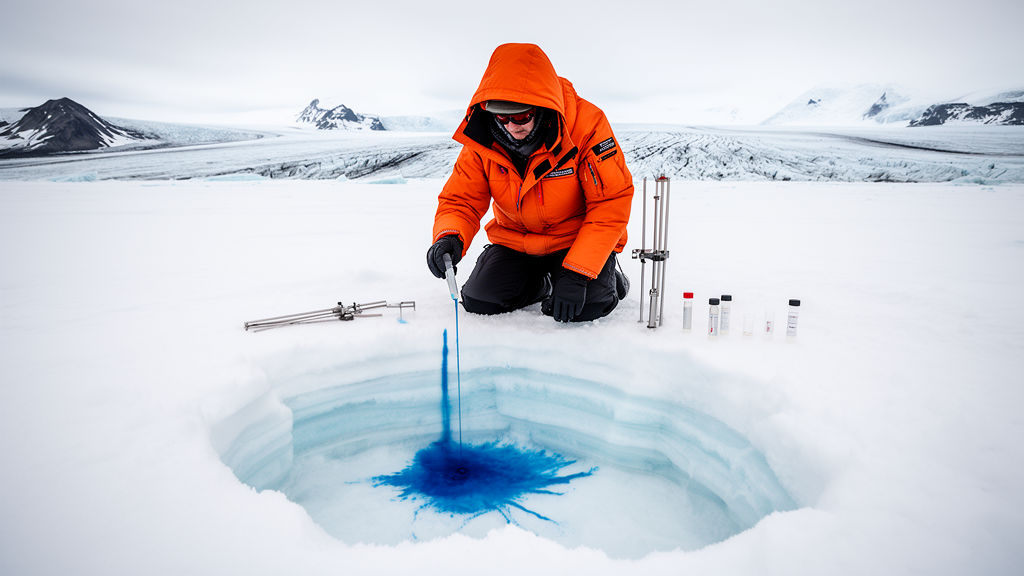
Deep in the Arctic archipelago of Svalbard, where winter temperatures once guaranteed that falling snow stayed frozen until spring, a quiet crisis is unfolding inside the snowpack. Rain now falls on snow in the middle of winter, and each of these rain-on-snow events sends a pulse of meltwater trickling down through layers that have been faithfully recording the climate, layer by layer, for decades. For scientists who drill ice cores from Svalbard’s glaciers to reconstruct past temperatures, storms and pollution, this creeping melt is a threat to the archive itself. A new field study near the research village of Ny-Ålesund has now watched that process happen in real time, dyeing meltwater bright blue and tracking exactly where it goes, what it destroys, and, surprisingly, what it leaves untouched.
The research, published in The Cryosphere, was carried out by Dorothea Elisabeth Baur of the British Antarctic Survey and University of Cambridge, together with Andrea Spolaor and Federico Scoto of Italy’s Institute of Polar Sciences and Elizabeth R. Thomas of the British Antarctic Survey. Over eleven days in March 2023, the team conducted seventeen tracer percolation experiments in nine snow pits on the Gruvebadet slope, roughly a kilometre south of Ny-Ålesund. Their goal was deceptively simple: to simulate a small winter rain event, watch the water move, and then compare the chemical fingerprints of the snow before and after. What they found reshapes how scientists can read melt-affected ice cores, and it offers a measure of hope for archives that many feared were already lost.
The stakes are high because Svalbard is warming faster than almost anywhere on Earth. Mean temperatures on the archipelago rose by three to five degrees Celsius between 1971 and 2017, with winters warming at roughly 1.35 degrees per decade. Glaciers that were once cold throughout are turning temperate, and perennial meltwater aquifers have now been documented on the Holtedahlfonna, Lomonosovfonna and Austfonna ice caps, in some cases at elevations and times of year that would have been unthinkable a generation ago. During a drilling project on Holtedahlfonna in March 2023, researchers encountered liquid water in the firn before spring had even begun. Melt generally enriches snow in the heavy isotope oxygen-18, mixes neighbouring layers and smooths the seasonal cycles that ice-core scientists rely on, a deterioration already documented in nearby Austre Brøggerbreen and Holtedahlfonna and, more dramatically, in the alpine Corbassière glacier in Switzerland.
To catch melt in the act, the team designed an experiment that could work within the strict environmental protections of Brøggerhalvøya, using only harmless natural substances. They prepared a tracer of ultrapure water enriched with deuterium oxide, heavy hydrogen that is chemically identical to water but detectable in isotope measurements, and coloured it with blue food dye. Each experiment poured a known volume, between 250 and 2000 millilitres, equivalent to about 6.25 millimetres of water on the 40 by 20 centimetre test plot, onto a carefully characterised patch of snow. Before each pour, the researchers measured snow temperature profiles at five-centimetre resolution, mapped the full stratigraphy of grain size, shape and hardness, and took density measurements. After the water had drained and refrozen, they cut fresh faces into the pit wall and photographed, measured and sampled the blue-stained structures.
The structural results were strikingly diverse. In colder snow, the meltwater froze into a distinct, bubble-free surface crust, with sharply defined vertical preferential flow paths, fingers of dyed water up to 5.5 centimetres wide, connecting the surface to isolated melt lenses deeper down. In warmer snow, near the end of the campaign, the behaviour changed completely: there was no refrozen surface layer, and instead the water spread in a broad, partly undersaturated wetting front that compacted the snow and lowered the surface by four to eight centimetres. Most remarkably, the team documented internal layering within melt lenses on a millimetre scale, with white remnants of the original snow structure surviving between saturated blue segments. Such fine-scale heterogeneity had been seen in laboratory experiments and computer models before, but never observed forming in the field within a single melt event.
Statistical analysis of the experiments revealed what controlled this behaviour. A multiple linear regression of percolation depth against snow and water properties explained about 63 percent of the variance, and three factors stood out as significant: warmer surface snow allowed deeper infiltration, transitions from fine-grained to coarse-grained layers retarded vertical flow, and larger water volumes pushed the wetting front deeper. Stratigraphy could even override temperature entirely. In one experiment on 29 March, when the snowpack was comparatively warm, the tracer was trapped within the top 1.5 centimetres of fine-grained snow and spread sideways instead of sinking, ponding above the first hard layer. Capillary forces at fine-to-coarse grain transitions, not just dense ice layers, act as barriers to downward flow.
The chemical story, however, is where the study delivers its most consequential message. By sampling stable water isotope ratios, the oxygen-18 to oxygen-16 ratio expressed as δ18O and the deuterium-to-hydrogen ratio expressed as δD, before and after each experiment, the researchers could quantify exactly how much the meltwater had rewritten the snow’s climate record. Melt-affected samples were clearly enriched, with δ18O shifted by about plus 3 per mil and δD by about plus 39 per mil on average. But samples taken just outside the visible blue structures were essentially unchanged, with mean differences of plus 1 per mil for δ18O and plus 7 per mil for δD, within the range of measurement noise. In one vivid example, a dyed flow path carried an enriched δ18O value of minus 15.8 per mil, while samples taken a mere 1.5 centimetres to either side retained their original value of minus 19.5 per mil.
This localisation matters enormously for ice-core interpretation. It means that melt does not homogenise the entire annual layer; it carves enriched channels and lenses through it, leaving the surrounding snow intact. Where enough snow accumulates each year, sub-annual isotope information can still be recovered from the unaffected parts of the profile. The study also suggests a counterintuitive protective effect: refrozen melt layers can act as lids that prevent wind from scouring and mixing the surface, preserving the stratification, and the isotope record, beneath them. Previous work has described melt layers as diffusion-limiting in this way, and the new field observations support that picture. At the same time, the fine-scale heterogeneity that melt introduces is a warning: a single core profile may not capture the true variability of a melt-affected layer, and the number of ice layers in a core will not necessarily equal the number of rain events that occurred.
The experiments also carry a caution about scale. The simulated events, at around 6.25 millimetres of water equivalent, represent small winter rain episodes typical of coastal Svalbard, not the extreme storms the region has seen, such as the 98-millimetre rainfall event of January 2012. The tracer liquid had to be warmed, averaging 11.7 degrees Celsius, to keep it from freezing in the sprinkler during fieldwork at temperatures as low as minus 25 degrees, and the team acknowledges that repeating the experiments through spring and under warmer conditions would broaden the picture. Still, the approach is deliberately simple and cheap, requiring no electricity or wireless equipment, which makes it reproducible at other melt-threatened drilling sites across the polar regions.
For the growing community of scientists racing to extract climate records from warming glaciers, the message is twofold. Melt is not a uniform eraser; it is a sculptor whose work depends on the temperature, texture and layering of the snow it passes through, and whose fingerprints can be read, and partly corrected for, if researchers sample carefully enough. But the study is also a reminder of urgency. Svalbard’s glaciers are among the key Arctic ice-core archives, and the conditions that allow seasonal signals to survive are themselves disappearing. As the authors note, the invaluable firn and ice-core records of melt-prone regions need to be retrieved before the local climate no longer permits their preservation.
Subject of Research: In-situ tracer percolation experiments quantifying how rain-on-snow melt affects snow structure and stable water isotope records in the Svalbard snowpack
Article Title: In-situ tracer percolation experiments to quantify the influence of near-surface melting on Svalbard snow signatures
Article References: Baur, D. E., Spolaor, A., Scoto, F., & Thomas, E. R. (2026). In-situ tracer percolation experiments to quantify the influence of near-surface melting on Svalbard snow signatures. The Cryosphere, 20(9), 5533-5558. https://doi.org/10.5194/tc-20-5533-2026
Image Credits: AI Generated
Keywords: Svalbard, rain-on-snow, meltwater percolation, stable water isotopes, ice cores, snow stratigraphy, Ny-Ålesund, Arctic warming, preferential flow, climate proxies, firn, The Cryosphere
Cite Scienmag News
Sloane Callahan. (October 9, 2026). Blue Dye in Arctic Snow Reveals How Winter Rain Rewrites Glacier Climate Records. Scienmag. https://scienmag.com/blue-dye-in-arctic-snow-reveals-how-winter-rain-rewrites-glacier-climate-records/
Sloane Callahan. "Blue Dye in Arctic Snow Reveals How Winter Rain Rewrites Glacier Climate Records." Scienmag, 9 October 2026, https://scienmag.com/blue-dye-in-arctic-snow-reveals-how-winter-rain-rewrites-glacier-climate-records/. Accessed 9 October 2026.
Sloane Callahan. "Blue Dye in Arctic Snow Reveals How Winter Rain Rewrites Glacier Climate Records." Scienmag. October 9, 2026. https://scienmag.com/blue-dye-in-arctic-snow-reveals-how-winter-rain-rewrites-glacier-climate-records/


