


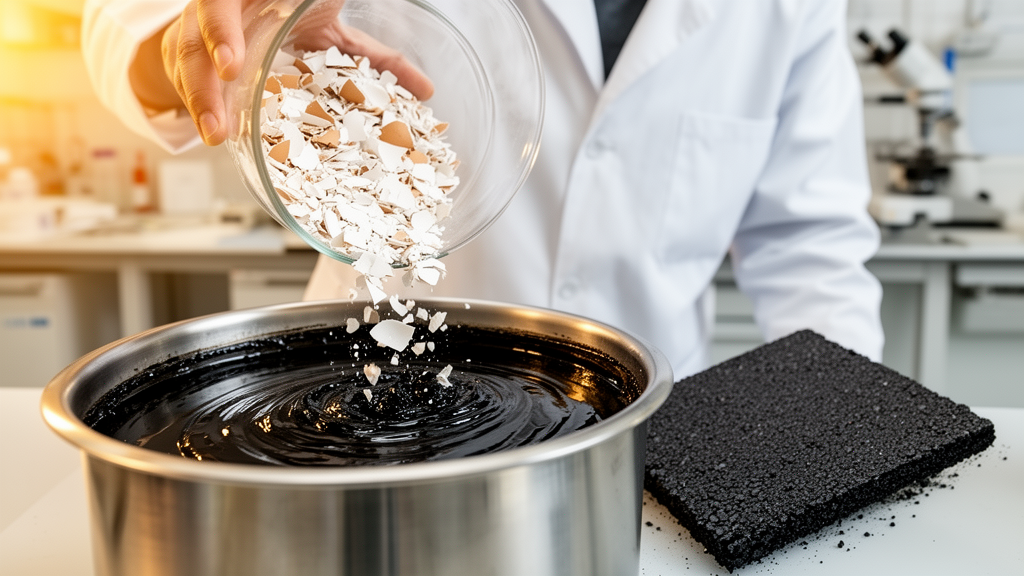
Every year, billions of eggs are cracked open for food production, and the shells are mostly thrown away as low-value waste. A new study from researchers at the National Institute of Technology Silchar and the National Institute of Technology Jamshedpur in India suggests that this humble kitchen byproduct could become a serious player in road engineering. Published in Environmental Science and Pollution Research, the research shows that calcium oxide derived from calcined waste eggshells can dramatically improve the high-temperature performance of bitumen, the sticky black binder that holds asphalt pavements together. Using a statistical optimization technique called response surface methodology, the team identified the precise dose and temperature at which the modified binder performs best, and then validated the prediction with real laboratory mixtures.
The starting material is remarkably simple. Eggshells are composed of more than 94 percent calcium carbonate, the same mineral found in limestone and chalk. When the researchers heated the collected shells to 900 degrees Celsius, the calcium carbonate decomposed into calcium oxide, releasing carbon dioxide in the process. This thermal transformation, known as calcination, produced a high-purity white powder with potent chemical reactivity. The team confirmed the identity and purity of the product using three complementary characterization techniques: X-ray diffraction to verify the crystal structure, Fourier-transform infrared spectroscopy to check chemical bonding, and scanning electron microscopy with energy-dispersive X-ray analysis to examine particle morphology and elemental composition.
With the eggshell-derived calcium oxide in hand, the researchers blended it into a standard 60/70 penetration grade bitumen, a widely used binder class in road construction, at dosages ranging from 1 to 4 percent by weight. They then subjected each blend to a dynamic shear rheometer, an instrument that measures how a binder resists deformation under oscillating loads at controlled temperatures. The results were striking. The complex shear modulus, denoted G*, which describes the overall stiffness of the binder, increased by 540 percent compared with the unmodified control. At the same time, the phase angle, which indicates how much of the binder’s response is elastic rather than viscous, dropped by 14 percent, meaning the material behaved more like a solid and less like a fluid under stress.
Perhaps the most consequential number concerns rutting, the permanent grooves that form in hot asphalt under repeated traffic loading. The rutting resistance parameter, expressed as G* divided by the sine of the phase angle, is the standard Superpave indicator of a binder’s ability to resist permanent deformation. In the eggshell-modified binders, this parameter rose by 574 percent relative to the control. In practical terms, a pavement built with the modified binder would be far better equipped to survive scorching summers and heavy axle loads without developing the wavy, wheel-track depressions that plague highways in hot climates. Because the improvement comes from a waste material rather than an expensive synthetic polymer, the economic implications are considerable.
What sets this study apart from many previous attempts at bitumen modification is its systematic use of response surface methodology, a statistical framework that maps how multiple variables interact simultaneously. Rather than testing one factor at a time, the researchers modeled the combined influence of calcium oxide content and test temperature on the rheological response of the binder. The resulting mathematical models were cubic in form and achieved coefficients of determination above 0.95, indicating that the fitted surfaces explained more than 95 percent of the observed variation in the data. Such high model quality gives engineers confidence that the predictions are statistically reliable rather than artifacts of experimental noise.
The optimization exercise converged on a clear answer: a calcium oxide dosage of 2.3 percent combined with a test temperature of 58 degrees Celsius produced the most effective combination of rheological properties. To verify that the model was not merely a statistical exercise, the team prepared binders at the predicted optimum and measured their actual performance. The experimental values deviated from the model predictions by less than 5 percent, a level of agreement that validates the entire modeling approach. This kind of validated optimization is valuable because it reduces the trial-and-error burden in future formulation work, allowing engineers to target specific performance goals with fewer laboratory iterations.
Rheology alone does not make a road, so the researchers went a step further and built actual asphalt mixtures using the optimized binder. These mixtures were evaluated with standard mechanical tests used in pavement design. Marshall stability, a measure of a compacted specimen’s resistance to load under controlled conditions, increased by 13.76 percent compared with mixtures made from the unmodified binder. Indirect tensile strength, which reflects the mixture’s ability to resist cracking under tension, rose by 16 percent. The tensile strength ratio, a key indicator of moisture susceptibility that compares strength before and after conditioning in water, improved by 5 percent, confirming that the modified mixtures were better able to resist the stripping and weakening that water infiltration causes in asphalt layers.
The mechanisms behind these improvements are consistent with what is known about calcium-based modifiers in bitumen. Calcium oxide particles act as stiff mineral fillers within the binder’s colloidal structure, increasing the effective volume of the solid phase and restricting the mobility of the maltenic matrix that surrounds the asphaltene micelles. In addition, calcium oxide is chemically basic and can interact with acidic components in bitumen, strengthening the binder’s internal network. Hydrated lime, a close chemical relative, has long been used in asphalt for exactly these reasons, along with its ability to reduce moisture damage by altering the surface chemistry of aggregates. The eggshell-derived material offers the same family of benefits while diverting an abundant organic waste stream from landfills.
The environmental logic of the approach is compelling. Poultry processing generates enormous quantities of eggshell waste worldwide, and much of it ends up in landfills where it contributes to odor and leachate problems. Converting that waste into a functional pavement modifier addresses two problems at once: it reduces disposal burdens and it substitutes a renewable, low-cost material for virgin mineral additives or costly synthetic polymers. The calcination step does require significant heat, so a full life-cycle assessment would be needed to quantify the net environmental benefit, but the study establishes the technical feasibility clearly. The authors report that the work was conducted without external funding and that all data and models appear in the published article.
For the road-building industry, the study offers a template for how modern statistical tools can accelerate the adoption of waste-derived additives. Instead of exhaustive factorial testing, response surface methodology compresses the experimental program into a manageable set of runs while still capturing nonlinear interactions between dosage and temperature. The Indian research team, led by Jaba Debnath with Khwairakpam Lakshman Singh and Ambika Kuity as supervisors, demonstrated that the resulting models can be trusted to within a few percent of reality. If follow-up work confirms long-term durability, aging resistance, and field performance, breakfast’s most overlooked byproduct may soon find its way beneath the wheels of millions of vehicles, one resurfaced highway at a time.
Subject of Research: Waste eggshell-derived calcium oxide as a sustainable bitumen modifier optimized by response surface methodology
Article Title: Study on waste eggshell–derived calcium oxide–modified bitumen using response surface methodology
Article References: Study on waste eggshell–derived calcium oxide–modified bitumen using response surface methodology. (n.d.). https://doi.org/10.1007/s11356-026-38208-7
Image Credits: AI Generated
DOI: 10.1007/s11356-026-38208-7
Keywords: bitumen, eggshell waste, calcium oxide, response surface methodology, asphalt pavement, rheology, rutting resistance, Marshall stability, sustainable materials, dynamic shear rheometer, moisture resistance, waste valorization
Cite Scienmag News
Violet Maxwell. (October 9, 2026). Eggshell Waste Transformed Into Powerful Bitumen Booster for Hot-Weather Roads. Scienmag. https://scienmag.com/eggshell-waste-transformed-into-powerful-bitumen-booster-for-hot-weather-roads/
Violet Maxwell. "Eggshell Waste Transformed Into Powerful Bitumen Booster for Hot-Weather Roads." Scienmag, 9 October 2026, https://scienmag.com/eggshell-waste-transformed-into-powerful-bitumen-booster-for-hot-weather-roads/. Accessed 9 October 2026.
Violet Maxwell. "Eggshell Waste Transformed Into Powerful Bitumen Booster for Hot-Weather Roads." Scienmag. October 9, 2026. https://scienmag.com/eggshell-waste-transformed-into-powerful-bitumen-booster-for-hot-weather-roads/


