


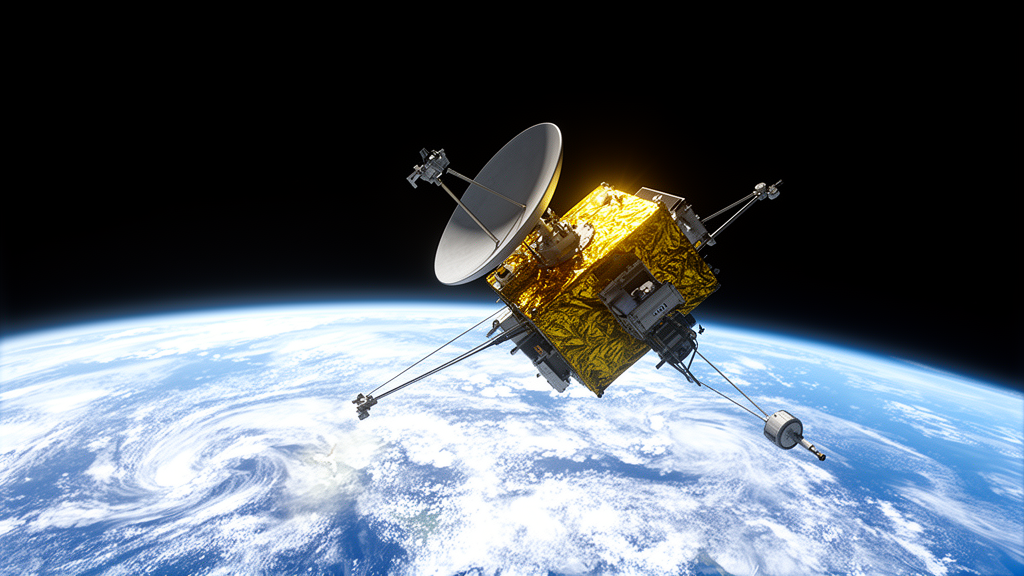
When the European Space Agency’s Jupiter Icy Moons Explorer, better known as Juice, swept past the Moon and Earth in August 2024, mission scientists seized a rare opportunity. The spacecraft’s Submillimetre Wave Instrument, or SWI, a brand-new 29-centimeter radio telescope that had never before been exercised under demanding conditions, pointed at our own planet and used it as a giant, well-characterized calibration lamp hanging in space. The results, published in Annales Geophysicae as the third paper in a four-part series on the flyby, confirm that the instrument works remarkably well, while revealing a few quirks that the team must now untangle before Juice reaches Jupiter in 2031.
SWI is not an ordinary camera or spectrometer. It is a heterodyne instrument operating simultaneously in two frequency bands, 530 to 638 gigahertz and 1066 to 1286 gigahertz, designed to probe the atmospheres of Jupiter and its icy moons by detecting faint spectral fingerprints of water vapor, ozone, oxygen and other molecules. Behind the telescope’s mirrors, a polarizing grid splits the incoming radiation into two independent receivers, each equipped with a chirp transform spectrometer offering 10,000 channels across a 1-gigahertz instantaneous bandwidth and a digital autocorrelation spectrometer covering 4.4 gigahertz. Both receivers are double sideband designs, meaning they are simultaneously sensitive to two sky frequencies symmetric about the local oscillator, a subtlety that shapes how every spectrum must be modeled and interpreted.
The Lunar-Earth Gravity Assist, executed on 19 and 20 August 2024, was the first time since Juice’s launch on 14 April 2023 that such tests were possible. During the Near Earth Commissioning Phase in mid-2023, Earth’s apparent diameter was only a fraction of SWI’s beam width, so the received signal was too weak for many checks. At closest approach, however, the spacecraft passed just 6,800 kilometers above Earth’s surface. The planet filled the entire antenna pattern, its strong continuum radiation flooded the receivers, and spectral lines of water, ozone and oxygen could be detected in mere seconds of integration time. For the first time, the team could test the instrument’s performance across its entire spectral tuning range.
The calibration strategy itself carries a dramatic backstory. Standard total-power calibration requires observing two reference loads of known temperature, typically an internal hot load and the cold sky, to pin down the linear relationship between received power and brightness temperature. But after launch, engineers discovered that SWI’s calibration flip mirror, which redirects the receiver input from the telescope to the internal hot load, has a drastically reduced lifetime. Instead of the required minimum of 54,000 flip cycles, the mechanism is now estimated to survive only about 10,000 cycles before it jams permanently. With years of Jupiter science ahead, every flip counts.
The team’s workaround is elegant. Repeated measurements of the receiver noise temperature across a fixed set of 150 tunings showed that, for each tuning, individual values scatter by only about 4 percent around the median. That stability allowed the scientists to replace the hot-load observation with a lookup table of noise temperatures measured during earlier payload checkout windows, combining it with paired observations of the science target and cold sky. In this position-switching scheme, half the observing time goes to the target and half to empty sky, and the ratio of the two cancels out slow drifts in the instrument’s gain, provided the interval between measurements is short enough, typically on the order of 10 to 30 seconds.
To judge whether the calibrated numbers were trustworthy, the team needed an independent prediction of what Earth should look like. They built a model from two parts: atmospheric profiles of temperature, pressure, water vapor and ozone taken from NASA’s MERRA-2 reanalysis database, averaged over 24 hours, all longitudes and 10-degree latitude bands to match SWI’s footprint of 500 to 800 kilometers, and a line-by-line, layer-by-layer radiative transfer code that propagates radiation through 1-kilometer-thick atmospheric layers using Voigt line shapes and the HITRAN 2008 spectral catalog. Because the strong water vapor transitions block the ground’s thermal emission, SWI effectively sees Earth as a gas planet whose continuum background comes from water vapor between 6 and 16 kilometers altitude.
The comparison delivered a strong verdict. For the 600-gigahertz receiver, 90 percent of the calibrated brightness temperatures deviated by less than 5 percent from the model expectations, consistent with the 4 percent uncertainty inherited from the noise-temperature lookup approach. The 1200-gigahertz receiver matched expectations well between 1080 and 1170 gigahertz, but around 1185 and 1260 gigahertz the observed temperatures ran systematically 5 to 6 percent too high. Because the same data agree with the model elsewhere, the team attributes the discrepancy to the instrument rather than to a flawed Earth model, possibly linked to tuning-dependent receiver power consumption and differing thermal stabilization times. Deviations of 8 to 12 percent appear in the 1170 to 1220 gigahertz local oscillator range and will require further study of the hardware’s drift behavior.
The flyby also enabled a measurement that will never be repeated on this mission: true limb sounding of Earth’s atmosphere. Thirty minutes before closest approach, at 21:20 UTC on 20 August 2024, with the spacecraft 12,020 kilometers above the ground, SWI’s beam began drifting across the atmospheric limb at 6.65 kilometers per second. The beam width at the limb was just 40 kilometers for the 600-gigahertz receiver and 23 kilometers for the 1200-gigahertz receiver, far smaller than the roughly 100-kilometer thickness of the atmosphere, so each 1.5-second spectrum sampled a distinct tangential altitude about 10.8 kilometers below the previous one. The entire traverse of the atmosphere took only 15 seconds, yet the observed spectra of ortho-water at 557 gigahertz and para-water at 1113 gigahertz, along with ozone transitions, matched the model predictions with striking fidelity. Crucially, the spectra showed no periodic baseline ripples from standing waves in the optical path, a tribute to SWI’s off-axis telescope design.
Spectral scan observations, in which the local oscillator steps systematically through the full tuning range of both receivers, served as a shakedown cruise for the instrument’s operating modes. Nearly all tunings were exercised for the first time, and the Earth’s known signal made it possible to grade each one: which work well, which need caution, and which fail outright and must be flagged unusable. The double sideband nature of the receivers proved essential to interpret the data correctly, as transitions from sky frequencies up to 14 gigahertz apart can overlap at the same intermediate frequency. The scans also exposed a subtle artifact: weak narrow peaks spaced 100 megahertz apart, remnants of the frequency comb used to calibrate the chirp transform spectrometers, which linger because the delay between switching the calibration signal off and starting the science acquisition is too short. Lengthening that delay should eliminate the contamination.
Overall, the conclusions are encouraging for the mission’s future at Jupiter. The system temperatures measured in space are valid and can be used directly for calibration; the lookup-table approach successfully mitigates the flip mirror lifetime problem; the spectra are free of severe standing-wave ripples; and the internal scanning mechanisms that raster the beam across targets proved reliable, producing reproducible two-dimensional maps without lost motor steps. Much work remains, including completing the calibration of the autocorrelation spectrometer data and understanding the high-frequency anomalies, but the essential message stands: a spacecraft bound for the icy moons of Jupiter paused briefly at home, stared at the planet that built it, and found its instruments ready for the journey ahead.
Subject of Research: Calibration of the Submillimetre Wave Instrument on ESA's Juice spacecraft using Earth observations during the 2024 lunar-Earth gravity assist
Article Title: Juice/SWI during the Lunar-Earth-Gravity-Assist (LEGA) – Part 3: Observations of the Earth as calibration target
Article References: Jarchow, C., Rezac, L., Hartogh, P., Schulz-Ravanbakhsh, A., Cavalié, T., Herpin, F., Moreno, R., & Murk, A. (2026). Juice/SWI during the Lunar-Earth-Gravity-Assist (LEGA) – Part 3: Observations of the Earth as calibration target. Annales Geophysicae, 44(2), 795-809. https://doi.org/10.5194/angeo-44-795-2026
Image Credits: AI Generated
DOI: 10.5194/angeo-44-795-2026
Keywords: Juice, ESA, Submillimetre Wave Instrument, SWI, lunar-Earth gravity assist, calibration, submillimetre astronomy, heterodyne receiver, Earth atmosphere, spectroscopy, Jupiter Icy Moons Explorer, remote sensing
Cite Scienmag News
Grant Pearson. (October 9, 2026). Jupiter probe turns its instruments on Earth in daring flyby calibration test. Scienmag. https://scienmag.com/jupiter-probe-turns-its-instruments-on-earth-in-daring-flyby-calibration-test/
Grant Pearson. "Jupiter probe turns its instruments on Earth in daring flyby calibration test." Scienmag, 9 October 2026, https://scienmag.com/jupiter-probe-turns-its-instruments-on-earth-in-daring-flyby-calibration-test/. Accessed 9 October 2026.
Grant Pearson. "Jupiter probe turns its instruments on Earth in daring flyby calibration test." Scienmag. October 9, 2026. https://scienmag.com/jupiter-probe-turns-its-instruments-on-earth-in-daring-flyby-calibration-test/


