


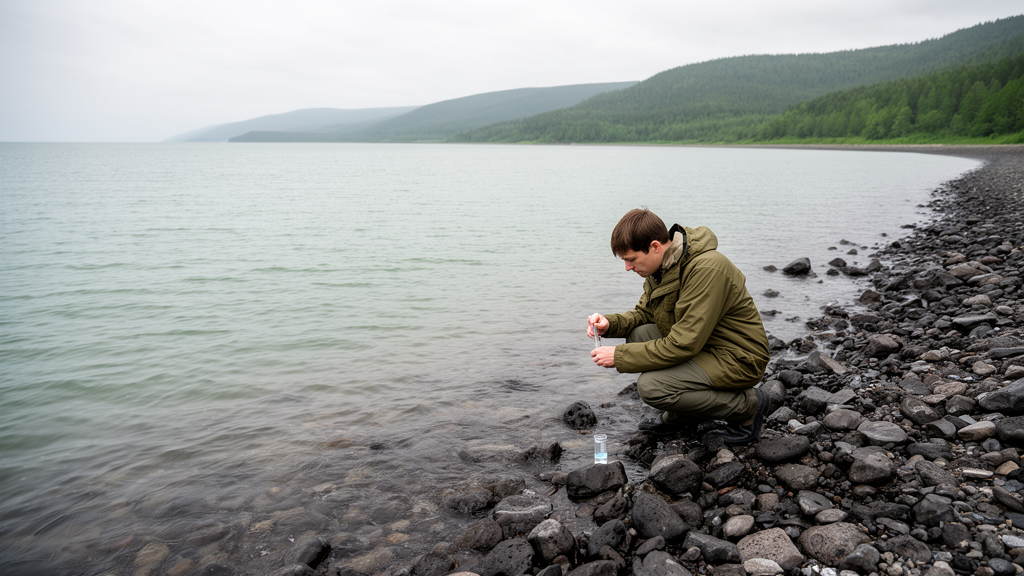
One of the most heavily used stretches of coastline on Sakhalin Island has received its first comprehensive environmental health check, and the results are more reassuring than many residents might have feared. A team of Russian researchers has completed the initial stage of a monitoring program at Lososey Bay, a semi-enclosed water body within Aniva Bay on the island’s southern coast. The bay is among the most urbanized and recreationally significant aquatic areas in the region, which makes it a natural sentinel for the wider environmental condition of Sakhalin’s coastal zone. The study, published in Environmental Science and Pollution Research, combined water chemistry, sediment geochemistry, radiometric dating, and radionuclide tracing to build a multi-layered picture of the bay’s current state.
The headline finding is that there is no evidence of acute anthropogenic pressure on the bay. When the team measured the concentrations of six metals in the water column—vanadium, chromium, manganese, iron, copper, and zinc—not a single value exceeded the maximum permissible concentrations established for water bodies used for household, drinking, and cultural purposes. For a bay that sits close to urban infrastructure and receives inputs from river estuaries, this regulatory clean bill of health is a meaningful baseline. It suggests that, at least at the level of statutory thresholds, the water that swimmers, anglers, and tourists encounter is not carrying dangerous loads of these metals today.
Yet the story is more nuanced than the regulatory numbers alone suggest. While copper and zinc in the water stayed within permissible limits, their concentrations exceeded established background levels many times over. In the bottom sediments, the picture sharpened further: copper concentrations were clearly elevated, and zinc levels sat at the borderline. In many coastal systems around the world, this combination would immediately raise the alarm of industrial contamination, because copper and zinc are classic fingerprints of urban runoff, wastewater, and industrial discharge. The research team therefore faced a central interpretive question: were these metals arriving from human activity, or from somewhere else entirely?
The answer came from the spatial and historical patterns in the data. The elevated metals were distributed homogeneously across the bay rather than concentrated near obvious human sources such as river mouths or the most developed shoreline sectors. More tellingly, sediment cores recovered from the bay floor showed no historical concentration peaks—no buried layers that would mark episodes of past industrial input. In polluted bays, sediment cores typically act like tree rings, preserving spikes of contamination that correspond to industrialization, wartime activity, or waste disposal events. Their absence here pointed the investigators in a different direction: toward the geology beneath the bay itself.
The most likely pathway for metal input, the researchers conclude, is leaching from ophiolites underlying the central part of Lososey Bay. Ophiolites are fragments of oceanic crust and upper mantle thrust onto continental margins, and they are notoriously rich in metals, including nickel and copper. Where these rocks sit beneath a bay, natural weathering and groundwater circulation can steadily release their metallic cargo into overlying waters and sediments. This geological explanation reconciles the apparent paradox of the study: water chemistry that is legally clean, sediment chemistry that looks contaminated, and a spatial pattern that ignores human geography. The metals are real, but they are native to the landscape rather than dumped into it.
Beyond the metal inventory, the study used natural radioisotopes as chronometers and tracers of physical processes, revealing dynamics that have implications for how the bay will respond to future change. By measuring lead-210 in the sediment column, the team reconstructed sedimentation rates and found them temporally heterogeneous—varying through time rather than remaining steady. This variability suggested a shift in the bay’s hydrological regime, one that the authors attribute plausibly to climatic factors. In a warming Arctic-adjacent region, changes in precipitation, river discharge, and coastal circulation can quietly reorganize where and how fast sediment accumulates, with knock-on effects for habitat stability and contaminant burial.
The researchers then compared these long-term sedimentation rates with vertical fluxes of suspended matter, assessed independently using the lead-210–polonium-210 pair, a well-established radiotracer method for quantifying particle flux in seawater. The comparison yielded a subtle but important insight: the contribution of lateral mass transport—the sideways movement of sediment from elsewhere—was negligible in the river estuaries but increased toward the open part of the bay. In other words, near the river mouths, what settles out of the water column largely comes from material settling straight down, while in the open bay, material arriving horizontally becomes a more significant component of the sediment budget. The flux dynamics in the open bay area were also disrupted by local vortex currents, eddies that complicate any simple model of how particles move through the system.
The study also addressed a question that has loomed over the entire North Pacific since 2011: the radiological legacy of the Fukushima-1 nuclear power plant accident. Quantitative assessment of cesium-137 specific activity in the bay confirmed the absence of significant impact from the accident on the local radiological situation. This matters because cesium-137, with its roughly thirty-year half-life, is the radionuclide most often tracked after nuclear incidents, and coastal communities across the Pacific have watched its dispersal with concern. For Lososey Bay, at least, the data provide a concrete, measured reassurance rather than a modeled prediction.
What makes this work notable is its methodological architecture. Rather than relying on a single line of evidence, the team triangulated across regulatory chemistry, sediment geochemistry, radiometric chronology, and particle-flux tracing. Each method covers a blind spot of the others: water sampling captures the present moment, sediment cores capture history, lead-210 dating anchors the timeline, and the lead-210–polonium-210 disequilibrium quantifies the machinery of particle transport. Together they allow the distinction between contamination and natural geochemical background—a distinction that is easy to get wrong and consequential to get right, since misattributing natural metal enrichment to pollution can misdirect remediation resources and unjustly stigmatize a coastline.
As the first stage of a monitoring program, the study establishes a baseline against which all future change can be measured. The bay’s waters currently meet regulatory standards, its sediments carry a geological rather than industrial metal signature, its sedimentation regime appears to be shifting in ways that may reflect a changing climate, and its radiological profile shows no Fukushima fingerprint. Whether these conditions persist as urbanization and climate pressures intensify on Sakhalin is precisely what continued monitoring will reveal. For now, Lososey Bay offers a rare example of a heavily used coastal zone where the rocks, not the residents, are the dominant geochemical force.
Subject of Research: Environmental geochemical and radioisotope monitoring of the Lososey Bay coastal recreational zone on Sakhalin Island
Article Title: Assessment of the current state of the coastal recreational zone of Sakhalin Island (case study of Lososey Bay): initial monitoring stage
Article References: Assessment of the current state of the coastal recreational zone of Sakhalin Island (case study of Lososey Bay): initial monitoring stage. (n.d.). https://doi.org/10.1007/s11356-026-38199-5
Image Credits: AI Generated
DOI: 10.1007/s11356-026-38199-5
Keywords: Sakhalin Island, Lososey Bay, heavy metals, copper, zinc, bottom sediments, lead-210 dating, cesium-137, Fukushima, coastal monitoring, ophiolites, marine pollution
Cite Scienmag News
Violet Maxwell. (October 9, 2026). Sakhalin’s Lososey Bay Shows No Acute Pollution as Rocks, Not Runoff, Drive Metal Levels. Scienmag. https://scienmag.com/sakhalins-lososey-bay-shows-no-acute-pollution-as-rocks-not-runoff-drive-metal-levels/
Violet Maxwell. "Sakhalin’s Lososey Bay Shows No Acute Pollution as Rocks, Not Runoff, Drive Metal Levels." Scienmag, 9 October 2026, https://scienmag.com/sakhalins-lososey-bay-shows-no-acute-pollution-as-rocks-not-runoff-drive-metal-levels/. Accessed 9 October 2026.
Violet Maxwell. "Sakhalin’s Lososey Bay Shows No Acute Pollution as Rocks, Not Runoff, Drive Metal Levels." Scienmag. October 9, 2026. https://scienmag.com/sakhalins-lososey-bay-shows-no-acute-pollution-as-rocks-not-runoff-drive-metal-levels/


