


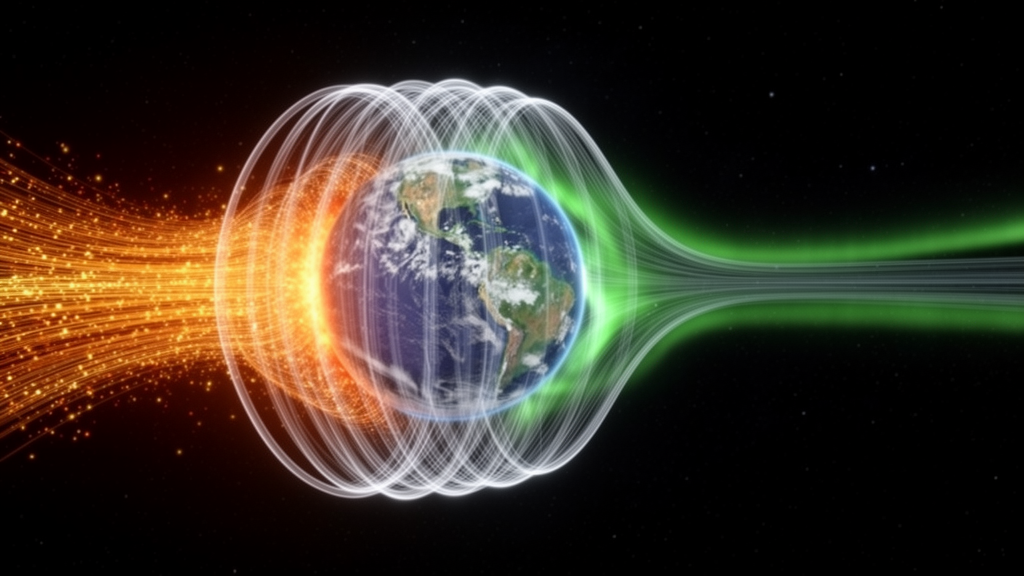
When the strongest geomagnetic storm of Solar Cycle 24 slammed into Earth on St. Patrick’s Day 2015, it did more than paint auroras over unusual latitudes and disrupt GPS signals across the high latitudes. It delivered an enormous, poorly accounted-for pulse of energy into the tenuous air of the upper atmosphere, and scientists are still arguing about exactly where that energy went. A new study published in Annales Geophysicae by Stelios Tourgaidis of the Democritus University of Thrace and colleagues has now put hard numbers on that uncertainty, and the results are sobering: depending on which standard model you use to describe the storm’s electrical driving, the single most important heating process in the upper atmosphere can differ by more than a factor of two.
The region in question is the lower thermosphere–ionosphere, or LTI, a layer spanning roughly 100 to 200 kilometers in altitude where the neutral gas of the atmosphere and the electrically charged plasma of the ionosphere are so intimately intertwined that they effectively share a single energy budget. During quiet conditions, the dominant energy source is sunlight: extreme ultraviolet radiation absorbed by atomic oxygen, molecular oxygen, ozone and nitrogen heats the gas and creates the ionosphere in the first place. But when a coronal mass ejection compresses Earth’s magnetic shield, the picture changes dramatically. Solar wind energy funnels down magnetic field lines into the polar regions, energetic electrons and protons rain into the atmosphere, and a process called Joule heating takes over as the thermodynamic heavyweight of the entire system.
Joule heating is, in essence, frictional heating on a planetary scale. Ions in the ionosphere are dragged across magnetic field lines by electric fields inherited from the solar wind, while the much denser neutral gas below resists being pushed along. The collisions between these two populations convert electromagnetic energy delivered from the magnetosphere directly into heat. Because the heating rate depends on the square of the electric field, any small-scale structure in the field that a model fails to resolve translates into a systematic underestimate of the deposited energy. That quadratic sensitivity is precisely why Joule heating remains, in the words of the research community, among the least quantified of the major processes in the upper atmosphere, despite being the most significant during disturbed times.
To dissect the storm-time energy flow, the team ran the National Center for Atmospheric Research’s Thermosphere Ionosphere Electrodynamics General Circulation Model, version 2.0, a first-principles simulation that solves the momentum, energy and continuity equations for neutrals, ions and electrons from about 100 up to 600 kilometers altitude. They simulated four days around the St. Patrick’s Day storm, which reached a minimum Dst index of roughly minus 223 nanotesla and a minimum SYM-H of minus 234 nanotesla, and they computed every significant heating and cooling term at each grid point before integrating them over the polar cap above 56 degrees latitude. Crucially, they ran the model twice with two different specifications of the high-latitude electric potential: the empirical Weimer 2005 model, which is a statistical average built from satellite measurements, and the Assimilative Mapping of Ionospheric Electrodynamics technique, known as AMIE, which blends real ground-based and space-based observations into a time-dependent map of the electrodynamics.
The comparison between the two runs is the heart of the study. Before the storm, the two drivers produced reasonably similar energy budgets, with the AMIE run showing only modestly larger Joule heating. At the peak of the storm, however, the AMIE-driven simulation produced more than twice as much Joule heating and more than twice as much associated ion-to-neutral heat transfer as the Weimer-driven run. The authors attribute this gap to several compounding factors. The Weimer model resolves features only down to about 2 to 3 degrees of magnetic latitude and roughly an hour of magnetic local time, while AMIE can typically achieve 1 to 2 degrees and 15 to 30 minutes, capturing more of the small-scale electric field variability that the quadratic heating law converts into heat. Moreover, AMIE incorporates actual observations during the event, whereas Weimer represents a climatological average response that the real storm departed from substantially at its height.
Viewed from the perspective of the neutral gas, the energy ledger shifts dramatically between quiet and storm conditions. One day before the storm peak, the largest heating source was solar extreme ultraviolet radiation combined with energetic particle precipitation, followed by heating from the recombination of molecular oxygen. Joule heating was split roughly evenly between energy deposited promptly into the neutrals and energy first given to the ions and then handed over to the neutrals through collisions. At the storm peak, Joule heating and ion-neutral heating became the dominant sources by a wide margin, while the solar contribution rose only slightly. On the cooling side, carbon dioxide emission at 15 micrometers dominated before the storm, but during the disturbance nitric oxide cooling at 5.3 micrometers surged far past it, behaving as the natural thermostat that helps the thermosphere shed the storm’s excess heat over the following two to three days.
The ion and electron perspectives complete the picture. Ions receive a fraction of the Joule heating directly and a small additional contribution from hotter electrons, then cool almost entirely by transferring heat to the far denser neutral gas; at the storm peak both their heating and their cooling rose sharply in tandem. Electrons, by contrast, are heated mainly by solar radiation and by the thermalization of secondary electrons created when energetic particles ionize the neutral gas, and they cool through elastic and inelastic collisions with neutrals and ions. Notably, the electron energy budget showed only small differences between the two model runs, both before and during the storm, indicating that the driver-dependent uncertainty is concentrated almost entirely in the Joule heating pathway and its ion-mediated branch.
These discrepancies matter far beyond academic bookkeeping. The amount of Joule heating deposited during a storm determines how much the upper atmosphere swells, and a puffier thermosphere means increased drag on the thousands of satellites in low Earth orbit, degrading orbit predictions and collision-avoidance margins. The study also highlights a deeper data problem: the entire archive of simultaneous ion, neutral and electron temperature measurements in the 100 to 200 kilometer altitude range amounts to only about 60 hours of observations, most of it from the Atmosphere Explorer C and E satellites of the late 1970s and early 1980s. Recent re-analyses of that legacy data have even shown that the textbook ordering of temperatures, in which electrons are hotter than ions and ions hotter than neutrals, does not always hold, a fact that current models, including TIE-GCM, are forced to assume away.
The authors argue that closing these gaps requires new, systematic, co-located and co-temporal measurements of all the parameters that enter the Joule heating calculation, ideally from an in situ platform flying through the region where the heating peaks. Mission concepts of exactly this kind are actively being pursued at both ESA and NASA, including the proposed Daedalus low-perigee spacecraft. Meanwhile, the recently released TIE-GCM version 3.0 offers higher spatial resolution that may capture more of the sub-grid electric field variability responsible for the largest uncertainties. Until such measurements and models mature, the study stands as a vivid demonstration that our forecasts of storm-time upper atmospheric response rest on driver choices that can swing the energy budget by a factor of two, a humbling reminder of how much remains unknown about the interface between Earth and space.
Subject of Research: Storm-time energy budget and Joule heating uncertainty in the high-latitude lower thermosphere–ionosphere
Article Title: Storm-time energy budget in the high latitude lower thermosphere–ionosphere: quantification of energy exchange and comparison of different drivers in TIE-GCM
Article References: Tourgaidis, S., Sarris, T., Baloukidis, D., Buchert, S., Pirnaris, P., Papadakis, K., & Balafoutis, A. (2026). Storm-time energy budget in the high latitude lower thermosphere–ionosphere: quantification of energy exchange and comparison of different drivers in TIE-GCM. Annales Geophysicae, 44(2), 773-793. https://doi.org/10.5194/angeo-44-773-2026
Image Credits: AI Generated
DOI: 10.5194/angeo-44-773-2026
Keywords: geomagnetic storm, Joule heating, lower thermosphere, ionosphere, TIE-GCM, space weather, St. Patrick's Day storm 2015, AMIE, Weimer model, nitric oxide cooling, energetic particle precipitation, satellite drag
Cite Scienmag News
Cameron Wolfe. (October 9, 2026). Two Models, One Storm: The Huge Gap in How We Budget Space Weather Energy. Scienmag. https://scienmag.com/two-models-one-storm-the-huge-gap-in-how-we-budget-space-weather-energy/
Cameron Wolfe. "Two Models, One Storm: The Huge Gap in How We Budget Space Weather Energy." Scienmag, 9 October 2026, https://scienmag.com/two-models-one-storm-the-huge-gap-in-how-we-budget-space-weather-energy/. Accessed 9 October 2026.
Cameron Wolfe. "Two Models, One Storm: The Huge Gap in How We Budget Space Weather Energy." Scienmag. October 9, 2026. https://scienmag.com/two-models-one-storm-the-huge-gap-in-how-we-budget-space-weather-energy/


