


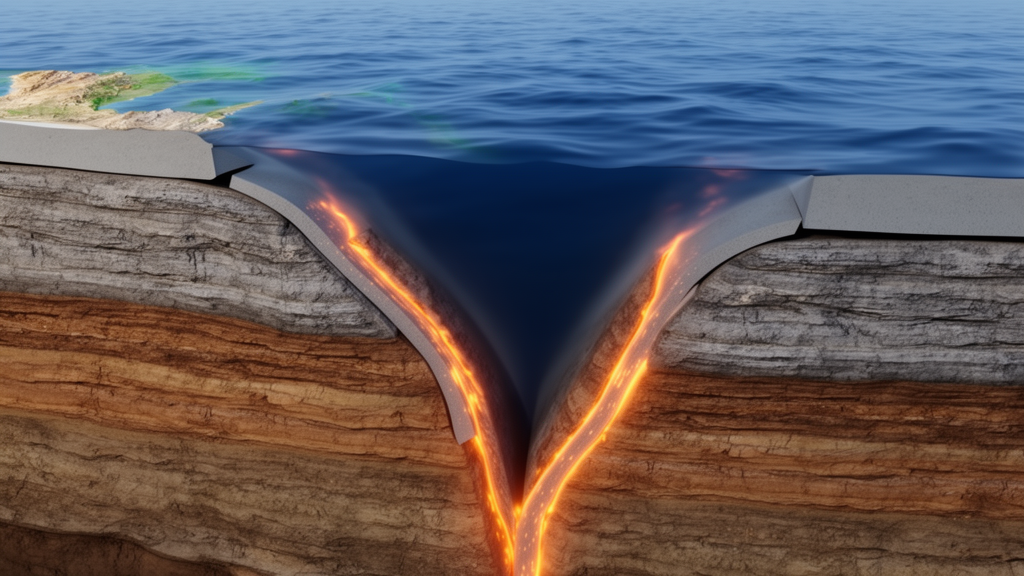
Deep beneath the Pacific coast of Mexico, the Earth emits a kind of whisper. These faint, long-lasting seismic signals, known as non-volcanic tremor, are far too weak to be felt at the surface, yet they carry an extraordinary amount of information about what happens where one tectonic plate grinds beneath another. A new study published in the journal Solid Earth by Quetzalcoatl Rodríguez-Pérez, Víctor Hugo Márquez-Ramírez, and Francisco Ramón Zúñiga of the Universidad Nacional Autónoma de México has now subjected these whispers to some of the most rigorous statistical scrutiny ever applied to them, and the results suggest that tremor behaves in ways that are both strikingly similar to ordinary earthquakes and profoundly strange in its own right.
Non-volcanic tremor was first recognized in Japan in 2002, and since then it has been detected in subduction zones and transform faults around the world, from Cascadia to Taiwan to the San Andreas Fault. Unlike a regular earthquake, which releases energy in a sudden rupture lasting seconds, tremor is an emergent signal of long duration and low amplitude, composed of swarms of tiny low-frequency earthquakes stacked on top of one another. It tends to occur on the plate interface near the edges of locked regions, and it is closely associated with slow slip events, the silent cousins of large earthquakes that can shift the ground by centimeters over days or weeks without producing any shaking people would notice. Fluids released by the dehydration of the sinking plate are widely implicated in generating tremor, and the phenomenon often appears in regions of high pore-fluid pressure where the fault is weakened and slipping is easier.
The Mexican subduction zone is an ideal natural laboratory for studying this behavior. There, the Cocos and Rivera plates dive beneath the North American plate at convergence rates ranging from about 2.0 to 6.8 centimeters per year, and the geometry of the subducted slab changes dramatically along strike, from steep subduction beneath Jalisco to an almost subhorizontal slab beneath Guerrero and Oaxaca. The region also contains the Guerrero seismic gap, a 200-kilometer-long segment that has not produced a significant earthquake since 1911 and is capable of generating an event of magnitude 8.1 to 8.4 if it ruptures in a single blow. Tremor in this zone has been documented in Guerrero, Jalisco-Colima, and Oaxaca, at depths ranging from about 10 to 50 kilometers, both near the trench and far down-dip of the locked interface.
Rodríguez-Pérez and his colleagues assembled catalogs of six tremor sequences recorded between 2005 and 2019, drawing on data from temporary seismic networks such as the Mesoamerican Subduction Experiment, the Mapping the Rivera Subduction Zone project, and the Guerrero Seismic Gap project, as well as ocean-bottom seismometers deployed more recently. The events ranged in magnitude from minus 0.8 to 3.65, far below anything a person could feel, and the team analyzed their sizes and the intervals between them using three complementary statistical frameworks: the classic Gutenberg-Richter relationship, non-extensive statistical mechanics, and multifractal detrended moving average analysis.
The Gutenberg-Richter analysis produced one of the study’s clearest findings. The b-value, which describes the ratio of small events to large ones, ranged from 1.25 to 2.42 across the sequences, and its distribution was not random. The highest values, between 2.22 and 2.42, occurred in the down-dip portion of the plate interface beneath Guerrero, while the lowest values, between 1.25 and 1.41, appeared in the interplate coupling region closer to the trench. High b-values indicate a fault zone dominated by small slips, which may reflect greater fracturing or different stress and fluid conditions at depth. In the coupling region, by contrast, the tremor b-values were not so different from those of ordinary tectonic earthquakes on the Cocos plate, which typically fall between 0.8 and 1.3.
The non-extensive statistical analysis told a complementary story. This framework, developed for complex systems far from equilibrium, uses a parameter called the q-value to quantify the length scale of spatial interactions and the degree of instability in the system. The researchers found q-values ranging from 1.39 to 1.65, and, crucially, the q-value behaved in exactly the opposite way to the b-value: it reached its highest values in the interplate coupling region near the coast and its lowest values down-dip. A Monte Carlo analysis confirmed a strong negative correlation between the two parameters, with a mean Pearson coefficient of minus 0.94. High q-values in the coupling zone suggest greater stress heterogeneity associated with plate locking and asperity distribution, while the lower values down-dip reflect different pressure, temperature, and rock structure conditions in that environment.
Perhaps the most technically ambitious part of the study was the multifractal analysis of both magnitude and interevent-time series. The team found that tremor sequences exhibit multifractal structures remarkably similar to those observed in ordinary tectonic earthquakes, meaning that their fluctuations display a spectrum of scaling behaviors rather than a single one. By shuffling the data and generating surrogate time series that destroy temporal correlations while preserving their statistical distributions, the researchers could distinguish between apparent multifractality, which arises simply from broad probability distributions, and intrinsic multifractality, which reflects genuine nonlinear dynamics. The answer was not uniform: only one sequence showed clear intrinsic multifractality, four displayed apparent multifractality, and five gave inconclusive results, indicating that no single mechanism dominates and that the origin of the complexity varies from place to place.
The Hurst exponent, a measure of long-term memory in a time series, ranged from 0.65 to 1.06, with most sequences showing strong persistence above 0.95. Values above unity suggest a transition toward non-stationary behavior and should be interpreted with caution, but the overall picture is one of strong temporal correlations, meaning that tremor activity in the present is statistically linked to tremor activity far into the future. The authors suggest, cautiously, that these high correlations may reflect localized regions perturbed by fluids, though they emphasize that this interpretation remains speculative. Notably, the measured Hurst exponents are statistically comparable to those reported for regional seismicity and aftershock sequences in southern Italy, Taiwan, Greece, and the San Andreas Fault, hinting that ordinary earthquakes and tremor share a deep common structure in how their timing is organized.
When the team examined the intervals between tremor events, they found that most sequences were best described by a Lognormal distribution, with a Gamma distribution fitting better for two sequences in the coupling region. The Exponential distribution, which would imply purely random timing, fit worst in every case. The authors interpret this mixture as evidence of complex, mixed statistical characteristics, though they caution that a lognormal fit alone does not prove mixed tectonic and volcanic behavior, since it also occurs in purely tectonic settings. Meanwhile, the relationship between tremor duration and magnitude proved disappointingly weak, with coefficients of determination ranging from only 0.03 to 0.34. Unlike regular earthquakes, where duration scales robustly with size, tremor duration appears to be governed by partially independent processes, a finding that may reflect both the complex generation mechanism of tremor and the difficulty of measuring signals that lack clear phase arrivals.
For a region that sits atop one of the world’s most significant seismic gaps, these results carry real weight. Tremor marks the transition between creeping and locked segments of the plate interface, and understanding its statistical fingerprints helps clarify how strain energy accumulates and is released in the quiet intervals between great earthquakes. The work also demonstrates that the tools of modern statistical physics, from non-extensive entropy to multifractal analysis, can extract meaningful structure from signals that are barely above the noise floor. As ocean-bottom seismometers and denser networks continue to expand the tremor record along the Mexican coast, the statistical portrait drawn by this study offers a baseline against which future changes, and perhaps precursors to the next great rupture, may one day be recognized.
Subject of Research: Statistical properties of non-volcanic tremor sequences in the Mexican subduction zone
Article Title: Statistical characteristics of non-volcanic tremor distributions along the Mexican Subduction Zone
Article References: Statistical characteristics of non-volcanic tremor distributions along the Mexican Subduction Zone. (n.d.). https://doi.org/10.5194/se-17-803-2026
Image Credits: AI Generated
Keywords: non-volcanic tremor, Mexican subduction zone, Guerrero seismic gap, b-value, Gutenberg-Richter law, non-extensive statistics, multifractal analysis, Hurst exponent, slow slip events, plate interface, seismic hazard, Cocos plate
Cite Scienmag News
Violet Maxwell. (October 9, 2026). Faint Tremors Beneath Mexico Reveal Earthquake-Like Patterns Deep in a Subduction Zone. Scienmag. https://scienmag.com/faint-tremors-beneath-mexico-reveal-earthquake-like-patterns-deep-in-a-subduction-zone/
Violet Maxwell. "Faint Tremors Beneath Mexico Reveal Earthquake-Like Patterns Deep in a Subduction Zone." Scienmag, 9 October 2026, https://scienmag.com/faint-tremors-beneath-mexico-reveal-earthquake-like-patterns-deep-in-a-subduction-zone/. Accessed 9 October 2026.
Violet Maxwell. "Faint Tremors Beneath Mexico Reveal Earthquake-Like Patterns Deep in a Subduction Zone." Scienmag. October 9, 2026. https://scienmag.com/faint-tremors-beneath-mexico-reveal-earthquake-like-patterns-deep-in-a-subduction-zone/


