


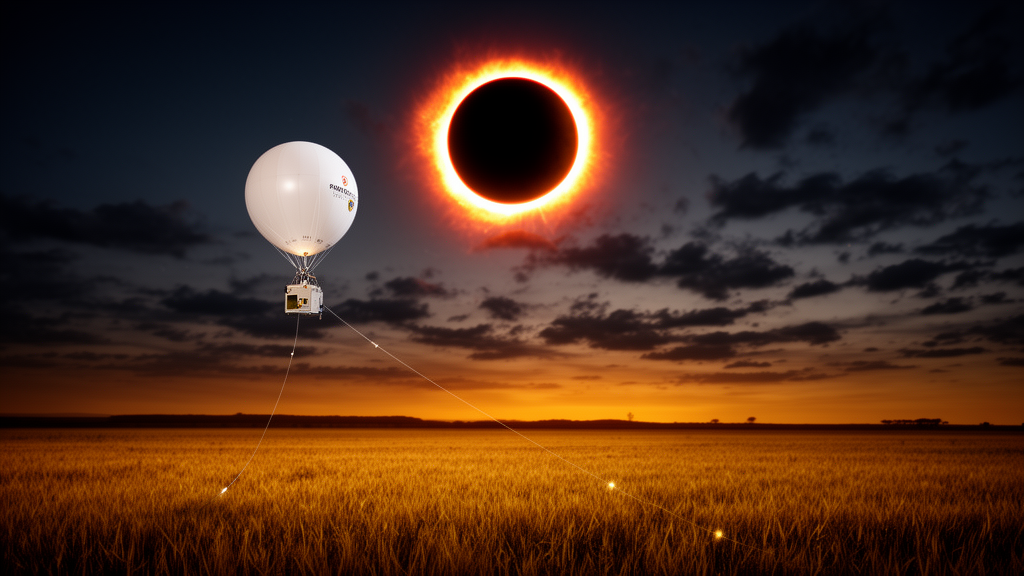
When the Moon slid across the face of the Sun on 14 October 2023, it carved a narrow ribbon of shadow that swept across the Americas at supersonic speed. For most people along the path, the annular eclipse was a spectacle: a blazing ring of fire hanging in the late-afternoon sky. For a small team of Brazilian atmospheric scientists, it was a rare natural experiment. As the umbra approached the coastal city of Natal, in northeastern Brazil, they launched a stratospheric balloon straight into the fading light, capturing one of the most unusual vertical soundings of the atmosphere ever taken during an eclipse. The results, published in Annales Geophysicae, reveal that even a partial dimming of the Sun near sunset can ripple through the atmosphere from the surface to the lower stratosphere.
The experiment was remarkable for its timing as much as its location. Natal sits at 5.79 degrees south latitude and 35.2 degrees west longitude, right on the transition between land and ocean, and the eclipse reached its maximum obscuration of about 88.5 percent there very close to sunset. That combination, a near-total annular eclipse at the edge of dusk over a coastline, has almost no precedent in the observational record. The balloon lifted off at 18:29:44 UTC, just as the penumbra, the lighter outer shadow, had begun to shade the city. Its flight lasted roughly 1.45 hours, and the umbra itself overtook the balloon at 19:50:16 UTC, when the instrument package was ascending at an altitude of about 22.35 kilometers.
For 3 minutes and 36 seconds, the balloon floated inside the Moon’s shadow, climbing more than 1.4 kilometers while the ring of fire burned overhead. During that window the sensors logged roughly 216 individual measurements. The payload, part of the long-running Southern Hemisphere ADditional OZonesondes project, recorded temperature, pressure, relative humidity, wind speed and direction, and ozone concentration. Ozone was measured with an electrochemical concentration cell, a sensor that relies on an iodine-iodide reaction in a potassium iodide solution to detect the gas. With the balloon rising at about 5 meters per second and the sensor responding within 20 to 30 seconds, the vertical resolution of the profiles reached approximately 100 to 150 meters, fine enough to resolve small-scale structures that satellites would blur.
To judge whether the eclipse-day profiles were truly unusual, the team compared them against a rich baseline: every October sounding from Natal between 1999 and 2023, excluding the eclipse day itself, a total of 62 flights. They also drew on the NRLMSISE-00 empirical model of the atmosphere and the ERA5 reanalysis from the European Centre for Medium-Range Weather Forecasts. Statistical significance was assessed with a hypothesis test at the 90 percent confidence level, treating the climatological October profiles as a normally distributed population. A sounding from 13 October, the day before the eclipse, provided an additional control for day-to-day variability.
The temperature results were striking. In the tropopause region near 14 kilometers altitude, the eclipse-day profile showed a cooling of 4 to 5 kelvin relative to both the October climatology and the model, a difference that extended well beyond the natural variability of the record and remained statistically significant around 18 kilometers. The tropopause itself appeared to rise by about a kilometer compared with the climatological mean. Higher up, in the lower stratosphere, the profile oscillated with unusually large amplitude, and above 24 kilometers the measurements revealed a cooling of roughly 8 kelvin. Notably, these stratospheric fluctuations were almost perfectly anti-correlated with the profile from the day before, mirroring it in reverse, a pattern the authors interpret as strong evidence that the eclipse, not ordinary weather, drove the perturbation.
Pressure told a complementary story. Above about 12 kilometers, the eclipse-day pressure ran 0.2 to 0.7 hectopascals below the climatological profile, a deficit that shrank with altitude and was significant at the 99 percent confidence level. Surface pressure drops during eclipses have been documented before, including during the 21 August 2017 total eclipse over the United States, but capturing the vertical structure of that pressure deficit from a balloon is far rarer. The physics is intuitive: when the shadow cools a column of air, the air contracts and the horizontal pressure gradients that result can launch atmospheric gravity waves, a mechanism long proposed to explain the traveling pressure waves recorded during past eclipses.
Ozone, perhaps the most chemically sensitive of the measured variables, behaved in a way that will excite atmospheric chemists. Below 20 kilometers, where ozone concentrations are typically less than 1 part per million, the profile showed a significant decrease between about 4 and 9 kilometers and an increase between 10 and 14 kilometers. Above 20 kilometers, and especially after the umbra passed the balloon, ozone concentrations climbed persistently above the October average, reaching an enhancement of up to 1.7 parts per million near 29 kilometers, a rise that fell within the 90 percent confidence region. The enhancement is consistent with eclipse photochemistry: when sunlight is blocked, the photodissociation reactions that normally destroy ozone slow down faster than the slower chemical loss processes, so ozone accumulates within the shadowed column.
That said, the ozone story is not settled science. Theoretical work dating back to the 1960s predicted ozone enhancements during eclipses, but later analyses revised the expected photochemical change downward, and a 2025 study concluded that the true column change may be too small to measure confidently. Earlier ground-based observations with Dobson spectrophotometers reported total column increases of about 4 percent, and satellite-era studies found changes of roughly 30 Dobson units attributable to shifts in diffuse radiation. The Natal sounding, being a local, in situ measurement with fine vertical resolution, avoids some of the averaging problems that plague remote sensing, and its agreement with balloon observations from the 26 December 2019 eclipse over Gadanki, India, where tropospheric ozone rose by a few parts per billion, lends weight to the result.
Relative humidity added a final layer of complexity. From about 5 to 18 kilometers, humidity on eclipse day was almost always higher than in the control profiles, with statistically significant enhancements around 5 to 7 kilometers and again near 13 to 14 kilometers. Above 21 kilometers, coincident with the umbra’s passage, humidity dropped below the other measurements, though the absolute values there are tiny, under 1 percent, and within the spread of the climatology. The pattern matches expectations: blocking sunlight suppresses evaporation and cooling reduces the air’s capacity to hold water vapor, raising relative humidity. Similar increases were reported across eight Indian cities during the 21 June 2020 eclipse and over the United States during the 8 April 2024 eclipse, although a 1966 eclipse over Brazil famously produced a humidity drop, a reminder that each eclipse writes its own signature on the atmosphere.
Taken together, the Natal sounding demonstrates that an annular eclipse, which preserves nearly 12 percent of sunlight, is still a powerful enough perturbation to leave coherent fingerprints across the vertical structure of the atmosphere, from a cooled and lifted tropopause to pressure deficits, ozone enhancements, and humidity anomalies. Because the Moon’s shadow is only about 270 kilometers wide and races along at roughly 470 meters per second, catching it with a balloon requires precise forecasting and a dose of nerve; satellites, by contrast, can only help when their orbits happen to cross the shadow path. The authors argue that their near-sunset, coastal observation confirms annular eclipses as significant drivers of localized atmospheric dynamics, and it offers a template for future campaigns: when the next ring of fire crosses a well-instrumented coastline, a balloon in the right place at the right minute can turn a celestial show into a laboratory for the whole depth of the lower atmosphere.
Subject of Research: Vertical atmospheric response to the 14 October 2023 annular solar eclipse measured by balloon sounding over Natal, Brazil
Article Title: A near-sunset atmospheric sounding during the 14 October 2023 annular solar eclipse over Natal
Article References: Paulino, I., da Silva, F. R., Paulino, A. R., & Borba, G. (2026). A near-sunset atmospheric sounding during the 14 October 2023 annular solar eclipse over Natal. Annales Geophysicae, 44(2), 765-772. https://doi.org/10.5194/angeo-44-765-2026
Image Credits: AI Generated
DOI: 10.5194/angeo-44-765-2026
Keywords: solar eclipse, stratospheric balloon, atmospheric sounding, ozone, tropopause, relative humidity, gravity waves, Natal Brazil, annular eclipse, atmospheric dynamics, SHADOZ, ring of fire
Cite Scienmag News
Russell Cooper. (October 9, 2026). Balloon Chases the Ring of Fire: Eclipse Shadow Stirs the Sky Above Brazil. Scienmag. https://scienmag.com/balloon-chases-the-ring-of-fire-eclipse-shadow-stirs-the-sky-above-brazil/
Russell Cooper. "Balloon Chases the Ring of Fire: Eclipse Shadow Stirs the Sky Above Brazil." Scienmag, 9 October 2026, https://scienmag.com/balloon-chases-the-ring-of-fire-eclipse-shadow-stirs-the-sky-above-brazil/. Accessed 9 October 2026.
Russell Cooper. "Balloon Chases the Ring of Fire: Eclipse Shadow Stirs the Sky Above Brazil." Scienmag. October 9, 2026. https://scienmag.com/balloon-chases-the-ring-of-fire-eclipse-shadow-stirs-the-sky-above-brazil/


