


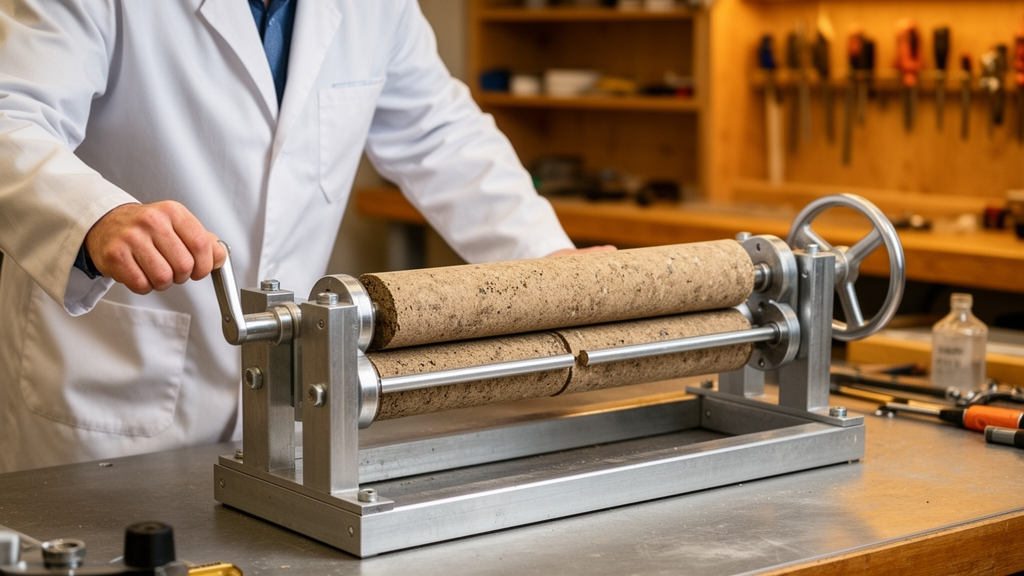
Every year, thousands of scientific papers rely on sediment cores, the long cylinders of mud and silt pulled from lake beds, ocean floors, and wetlands that hold archives of past climates, ecosystems, and environments. Before any of that science can happen, the core has to be opened. The plastic liner that protects the sediment during recovery and transport must be sliced cleanly along its length so researchers can photograph, log, and sample the stratigraphy inside. It sounds mundane, but it is a step so foundational that a single poorly executed cut can compromise months of fieldwork and an archive that took centuries to accumulate. In 2024 alone, the Web of Science database contained at least 1587 articles with the term sediment core in the title or abstract, and each of those studies depended on a clean opening somewhere along the line.
Yet despite its ubiquity, the technology of core opening has remained oddly invisible. Researchers at the EDYTEM laboratory, a joint unit of CNRS and Université Savoie Mont-Blanc in Chambéry, France, found that only two scientific publications describing a core opening device have appeared since 1969. Most laboratories either buy commercial models adapted from craft machinery or bolt together homemade devices whose designs live in workshops rather than journals. The result is a strange gap in the scientific record: a procedure used across thousands of studies is almost never described, validated, or shared, even though the cutting method directly affects the quality of the sediment surface and every sample taken from it.
Now, Raphaël Gallet and Fabien Arnaud of EDYTEM have published a complete, buildable answer in the journal Scientific Drilling: the EDYTEM Manual Core Opening Bench, or MCOB, a hand-operated device that slices sediment cores open with a static blade mounted on a sliding sled. The design targets the most common core formats, cutting polyvinyl chloride liners up to 1.5 meters long with walls up to 3 millimeters thick and external diameters of 63 and 90 millimeters, and every drawing, parts list, and assembly guide is available online at no charge under a Creative Commons license, meaning any laboratory with basic workshop access can reproduce the entire machine.
The engineering logic behind the MCOB starts with the failure modes it is designed to eliminate. Historically, cores were often opened with circular rotating blades, a technique that is fast and efficient but produces a shower of plastic shards and micro-debris that can contaminate the very sediment researchers are trying to study. Vibrating blades mitigate that problem but introduce their own issues. A static blade, the authors argue, mounted on a sled that glides along a rigid frame, offers the best of both worlds: a regular, symmetric longitudinal cut without the plastic contamination. Their design builds on an earlier static blade approach described in the literature in 2011, refined through months of trial and error into a fully documented open-source machine.
Structurally, the bench breaks down into six subsystems, each documented with computer-aided design files created in FreeCAD. The frame is built from 40 by 40 millimeter aluminium slot profiles with 8 millimeter channels, joined with screwed T-nuts and reinforced with aluminium brackets for rigidity. The guiding system uses a commercial SBR20 linear rail shaft two meters long, carrying four square ball-bearing blocks that keep the cutting tool on a perfectly straight 180-centimeter path. On this rail rides the tool carrier sled, an assembly of eighteen machined parts bolted together, which hosts the interchangeable cutting tools. Everything is deliberately mechanical: no motors, no electronics, just steel, aluminium, and hand power.
That hand power is delivered through the driving system, which the authors identify as the component under the greatest mechanical stress. Turning the crank handle requires a torque of 6.5 newton meters, so the team chose a gear-reduced double-chain transmission using standard 06B1 roller chains running on sprockets mounted to 20 millimeter shafts. A 21-tooth sprocket on the crank drives a 76-tooth sprocket, a gear ratio that multiplies the operator’s input force by roughly 3.6, making the long cutting stroke smooth and controllable with human muscle alone. The sprockets, crank, and shafts are pinned together and all components were sourced from ordinary commercial suppliers, keeping the build within reach of any reasonably equipped laboratory.
Holding the core steady during the cut is its own engineering puzzle, solved by a two-part clamping system. Below, an HDPE half-tube, cut 8 millimeters below its half-diameter and fitted with adjustable wedges, cradles cores of varying diameters on five 3D-printed supports. Above, a matching half-tube assembly presses down on the core to prevent deformation, sliding, or rotation as the blades bite through the liner. Two cylinders at either end, 3D-printed in PLA, maintain the precise gap between the upper and lower half-tubes and block the core from sliding under cutting forces, each machined with wide, deep grooves so the blades can pass unobstructed at the start and end of their stroke. Static stops, centring pins, and two clamping devices complete the fixture.
The cutting head itself reflects the most refined iteration of the design. Two tool carrier assemblies, one on each side of the core, cut both sides of the liner simultaneously. On each side, the first tool to engage is a Sandvik CoroTurn 107 carbide insert of the type used for machining plastic and aluminium, mounted on a custom aluminium holder. It scores a shallow, 0.5-millimeter-deep V-shaped incision into the liner wall. Immediately behind it, a commercial cutting blade follows that groove and completes the cut through the PVC. The V-groove acts as a guide rail for the blade, ensuring a straight, clean, symmetric cut. Two distinct tool sets allow quick switching between 63 and 90 millimeter liners, and a dedicated adjustment tool fine-tunes blade positioning for each setup, with shim adjustments accommodating other diameters.
The payoff, the authors report, has been more than a year of continuous use at EDYTEM by both laboratory staff and external users, during which the bench proved efficient and robust, needing only minor sled alignment adjustments and routine replacement of blades and inserts depending on core diameter. The supplies cost around 3000 euros, a figure the team notes needs re-evaluation after recent inflation and which excludes development and assembly time, but that remains a modest investment for a machine that can anchor an entire core processing workflow. Because the device is hand operated, it also avoids the stricter safety regime that electric motors would demand, and it can be transported to the field when necessary. The team explicitly invites researchers and engineers to adopt, adapt, and improve the design, and to share their enhancements with the community. For a device that quietly underpins thousands of studies a year, bringing core opening out of the workshop closet and into the open-source era may prove one of the more consequential acts of scientific sharing this year.
Subject of Research: Design of a reproducible hand-operated static blade bench for opening sediment core liners
Article Title: Hand-operated fully reproducible static blade core opening bench
Article References: Gallet, R., & Arnaud, F. (2025). Hand-operated fully reproducible static blade core opening bench. Scientific Drilling, 34(1/2), 21-27. https://doi.org/10.5194/sd-34-21-2025
Image Credits: AI Generated
Keywords: sediment cores, core opening, open-source hardware, Scientific Drilling, PVC liners, static blade, paleoclimate, laboratory equipment, EDYTEM, 3D printing, limnology, technical development
Cite Scienmag News
Violet Maxwell. (October 9, 2026). Hand-Cranked Machine Opens Sediment Cores Cleanly and Anyone Can Build It. Scienmag. https://scienmag.com/hand-cranked-machine-opens-sediment-cores-cleanly-and-anyone-can-build-it/
Violet Maxwell. "Hand-Cranked Machine Opens Sediment Cores Cleanly and Anyone Can Build It." Scienmag, 9 October 2026, https://scienmag.com/hand-cranked-machine-opens-sediment-cores-cleanly-and-anyone-can-build-it/. Accessed 9 October 2026.
Violet Maxwell. "Hand-Cranked Machine Opens Sediment Cores Cleanly and Anyone Can Build It." Scienmag. October 9, 2026. https://scienmag.com/hand-cranked-machine-opens-sediment-cores-cleanly-and-anyone-can-build-it/


