


Black holes are famously austere objects. In the simplest scalar-tensor theories of gravity, an isolated, stationary black hole refuses to grow any extra structure: mathematical no-hair results guarantee that the scalar field that generically accompanies these theories must vanish on the horizon. Yet the Universe is messy, and matter around a black hole can change the story. A new theoretical study, published in the journal General Relativity and Gravitation by Masahiro Kaminaga of Tohoku Gakuin University, has now shown in exacting mathematical detail that two thin layers of matter, each far too feeble on its own to destabilize a black hole, can act together and trigger the sudden growth of a scalar field. The finding turns an intuitive picture of environmental influence into a precise, solvable criterion that could reshape how physicists think about black holes embedded in stars, halos, and stratified clouds.
The phenomenon at stake is called spontaneous scalarization, a concept first discovered in the 1990s for compact stars by Thibault Damour and Gilles Esposito-Farèse. In scalar-tensor gravity, matter couples to a scalar field through a function that vanishes in weak fields, so the Solar System looks exactly like general relativity. Near dense objects, however, the coupling can switch on, and the scalar field grows abruptly from an apparently stable, scalar-free configuration. The onset of this growth is a linear instability: the scalar perturbation obeys an equation with a tachyonic effective mass, meaning small disturbances grow exponentially in time. Scalarization has since been studied extensively for neutron stars and for black holes surrounded by smooth distributions of matter such as dark-matter halos, where the trace of the matter stress tensor gives the scalar a position-dependent effective mass.
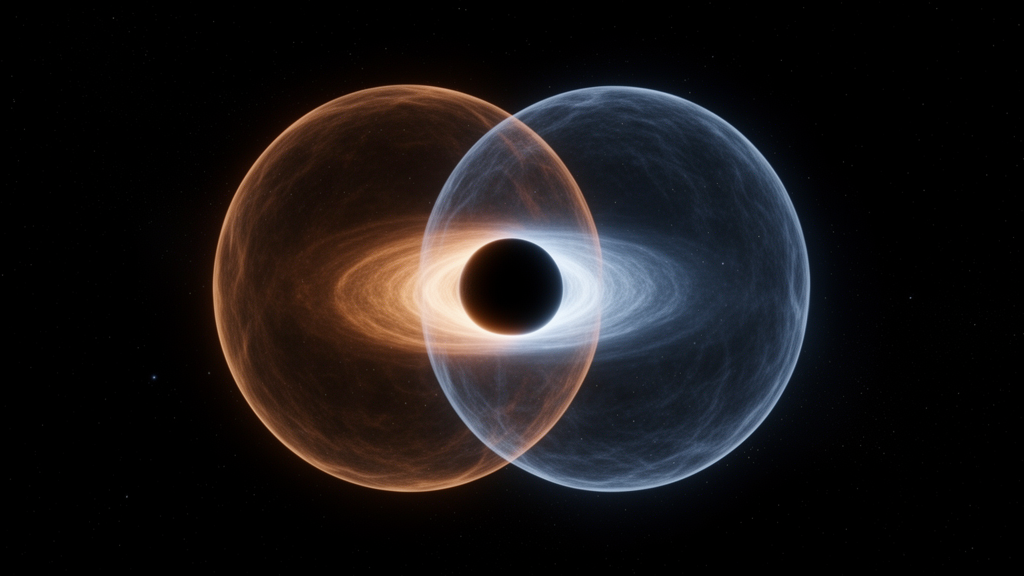
What makes the new work striking is its choice of minimal laboratory. Instead of a smooth halo with an arbitrary density profile, Kaminaga modeled the surrounding matter as two infinitely thin, concentric spherical shells at radii beyond the event horizon. In the thin-layer limit, each shell contributes a delta-function interaction to the radial equation governing the scalar perturbation, with a strength fixed not by hand but by an invariant quantity: the trace of the shell’s surface stress tensor, a combination of its surface energy density and tangential pressure. This choice matters. A trace-free shell, where the surface density equals twice the tangential pressure, does not couple to the scalar field at all, so the instability is controlled by the physics of the matter, not by an adjustable potential parameter.
The central result is a deceptively simple algebraic condition. In the probe limit, where the shells are gravitationally light and the background geometry is exactly Schwarzschild, the onset of instability is determined by the equation 1 minus a1, minus a2, plus one minus chi, times a1 a2, equal to zero. Here a1 and a2 are the attractive strengths of the two shells, each normalized by its own single-shell threshold on the same background, and chi is a purely geometric overlap factor, the ratio of two logarithms of the Schwarzschild metric function at the shell radii. The mathematics behind this formula borrows from the theory of Schrödinger operators with delta interactions supported on spheres, converting the instability question into a two-by-two boundary determinant problem. The determinant’s off-diagonal term represents static scalar exchange between the separated shells, and it is precisely this term that permits collective destabilization.
The consequence is dramatic. There exists an open region of parameter space in which both shells individually lie below their scalarization thresholds, with normalized strengths less than one, yet the pair together produces a growing s-wave mode. For equal normalized strengths, the critical attraction is one divided by one plus the square root of chi, a number that always falls between one half and one. When the two shells are nearly coincident, each needs only about half of its isolated critical strength, exactly as if the two layers had merged into a single double-strength shell. When they are far apart, the overlap factor chi shrinks toward zero and each shell must approach its own separate threshold. For a representative configuration with shells at four and eight Schwarzschild radii, chi equals about 0.415, and the collective threshold drops to roughly 0.61 of the individual critical strength. Notably, an inner shell pushed toward the horizon becomes weakly coupled to an outer layer in these normalized units, a suppression that is a distinctly black-hole effect arising from the horizon boundary condition and the logarithmic stretching of the tortoise coordinate.
The analysis goes further than a threshold. Kaminaga derived the critical scalar cloud at onset in closed form: a static, node-free profile that is regular at the future horizon, changes slope as it crosses each shell, and decays like one over r at infinity. This cloud is a zero-energy resonance rather than a square-integrable bound state, sitting at the edge of the continuous spectrum. When the critical curve is crossed, the resonance descends into a genuine growing mode. A numerical check confirmed the analytic prediction: solving the full frequency-domain determinant with high-precision integration showed no growing mode below threshold, exactly one above it, and a growth rate that vanishes continuously as the threshold is approached from the unstable side. The study also proves that the s-wave sector is always the first to destabilize, and that each angular momentum channel contains at most two radial growth rates, consequences of a comparison principle between angular sectors and a finite-rank structure of the shell interactions.
Crucially, the result survives beyond the probe approximation. Kaminaga constructed an exact scalar-free background consisting of three Schwarzschild regions of different masses, joined across the two shells by the Israel junction conditions that general relativity imposes on surface layers. On this spacetime, the same finite-rank determinant governs the onset, with the shell strengths computed from the exact surface traces and a static scalar resistance function determined by the lapse and curvature factors. A comparison for concrete shell radii showed that the exact critical coupling differs from the probe value by a correction linear in the total shell mass ratio, confirming that the collective effect is not an artifact of neglecting the geometry’s response to the matter. The formal framework is a careful double scaling: the shells are light enough to leave the metric essentially Schwarzschild, while their coupling to the scalar field, multiplied by the scalar-matter coupling constant, remains finite.
The exact Israel calculation also delivered a surprise with geometric flavor. The surface trace of a static shell changes sign as the shell moves radially, and the transition condition, that the geometric mean of the metric factors on the two sides equals one third, reduces in the light-shell limit to the Schwarzschild photon sphere at radius three times the black-hole mass. A shell sitting just inside the photon sphere, between two and a half and three Schwarzschild radii, can satisfy the surface dominant energy condition while carrying a positive trace, which flips the sign of the scalar coupling needed for attraction. This connects the abstract stability analysis to well-known features of black-hole optics, hinting that the geography of strong gravity itself shapes when matter can seed scalar hair.
The authors are careful about physical scope, and so should readers be. The analysis establishes the linear onset only; the nonlinear scalarized branch beyond threshold, the mechanical equation of state of the shells, and their radial stability remain open problems. The model is spherical and static, so accretion disks, rotation, and the superradiant channels of Kerr black holes lie outside it. Moreover, the large coupling constants that light pressureless shells would require to reach the threshold, of order several hundred in the worked examples, are far above the values permitted by binary-pulsar constraints in the standard Damour-Esposito-Farèse model, although the positive-coupling regime associated with pressurized shells near the photon sphere has a different phenomenological status that has not yet been assessed. What the paper delivers instead is a clean, exactly solvable template for a genuinely collective effect: an analytic demonstration that the whole can be unstable when the parts are not, governed by a single geometric overlap number. As physicists increasingly treat black holes as environmental objects, embedded in halos, disks, and stratified clouds, such solvable benchmarks will be essential for deciding when the environment, and its internal cooperation, writes new hair on the horizon.
Subject of Research: Collective matter-induced scalarization instability of a black hole surrounded by two thin shells in scalar-tensor gravity
Article Title: Collective onset of matter-induced scalarization around a black hole with two thin shells
Article References: Kaminaga, M. (2026). Collective onset of matter-induced scalarization around a black hole with two thin shells. General Relativity and Gravitation, 58(10), Article 115. https://doi.org/10.1007/s10714-026-03620-4
Image Credits: AI Generated
DOI: 10.1007/s10714-026-03620-4
Keywords: black holes, scalarization, scalar-tensor gravity, thin shells, Israel junction conditions, tachyonic instability, Schwarzschild spacetime, linear stability, Birman-Schwinger principle, general relativity, no-hair theorem, compact objects
Cite Scienmag News
Grant Pearson. (October 9, 2026). Two Faint Matter Shells Can Team Up to Destabilize a Black Hole. Scienmag. https://scienmag.com/two-faint-matter-shells-can-team-up-to-destabilize-a-black-hole/
Grant Pearson. "Two Faint Matter Shells Can Team Up to Destabilize a Black Hole." Scienmag, 9 October 2026, https://scienmag.com/two-faint-matter-shells-can-team-up-to-destabilize-a-black-hole/. Accessed 9 October 2026.
Grant Pearson. "Two Faint Matter Shells Can Team Up to Destabilize a Black Hole." Scienmag. October 9, 2026. https://scienmag.com/two-faint-matter-shells-can-team-up-to-destabilize-a-black-hole/


