


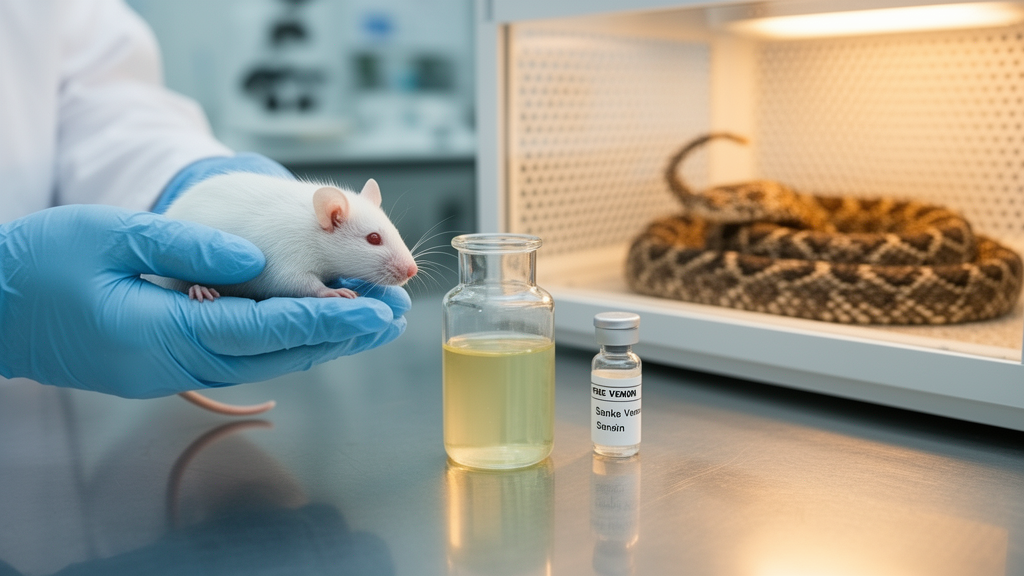
Every year, snakebites from lancehead vipers of the genus Bothrops strike tens of thousands of people across South America, leaving behind a devastating trail of hemorrhage, tissue death, and kidney failure. The gold standard of care remains antivenom, delivered intravenously in hospitals, but this life-saving serum has a well-known weakness: it struggles to counteract the local tissue destruction that venom inflicts at the bite site, particularly when victims reach treatment late. Now, a new study published in PLOS Neglected Tropical Diseases offers a strikingly simple potential ally in this fight — a humble plant flavonoid called rutin, delivered by mouth in a specially engineered nanoparticle form that allowed it to rescue mice from the worst effects of Bothrops jararaca envenomation even when given a full ten minutes after venom injection.
The research, led by Natacha Ferreira de Oliveira, Adrielly Viveiros Torres, and Marcelo Larami Santoro, builds on earlier work showing that rutin and a derivative called rutin succinate could mitigate venom damage when injected directly into the bloodstream before envenomation. That prophylactic approach, however, has little practical value for a farmer bitten in a remote field. The team’s central question was whether rutin could work when given orally, after the venom had already entered the body — a scenario far closer to real-world conditions, where the interval between bite and hospital care can stretch to hours.
Rutin, chemically known as quercetin-3-rutinoside, is a flavonoid abundant in citrus fruits, buckwheat, and onions, long prized in pharmacology for its anti-inflammatory, antioxidant, and vasoprotective properties. Its natural form, however, is poorly absorbed from the gut, which has historically limited its therapeutic ambitions. To overcome this barrier, the researchers formulated what they call nano-rutin, a preparation designed for rapid gastrointestinal absorption. This formulation choice proved critical: it allowed the compound to reach the bloodstream quickly enough to intercept the cascade of venom-induced damage before it spiraled out of control.
The experimental design was deliberately rigorous. In a murine model of Bothrops jararaca envenomation, mice received nano-rutin by gavage just ten minutes after venom injection. One hour later, some of the animals were also treated with the standard anti-Bothrops antivenom, known as SAB, while others received the flavonoid alone. This two-by-two arrangement allowed the team to disentangle what rutin could achieve on its own from what it added to conventional therapy — a distinction with direct implications for remote settings where antivenom may be hours away.
The results paint a vivid picture of what uncontrolled envenomation does to the body. Untreated mice developed severe thrombocytopenia, a dangerous depletion of blood platelets, alongside leukocytosis, an abnormal surge of white blood cells. Their fibrinogen — the essential clotting protein — was consumed by the venom’s relentless enzymatic activity. Levels of interleukin-6, a key inflammatory signaling molecule, climbed sharply, and cell-free DNA spilled into circulation as cells broke apart, while the activity of DNAse, the enzyme that normally clears this debris, dropped. The animals also suffered hypoalbuminemia and, most visibly, marked local hemorrhage and dermonecrosis at the site of venom injection.
Against this grim baseline, oral nano-rutin performed remarkably well. The compound restored most of the evaluated systemic parameters, pulling platelet counts, fibrinogen levels, and inflammatory markers back toward normal. Perhaps most strikingly, it significantly reduced local hemorrhage and dermonecrosis even in the complete absence of antivenom. This finding challenges a long-standing assumption that only neutralizing antibodies can meaningfully blunt the local effects of viper venom, and it suggests that a widely available dietary molecule, properly formulated, could buy precious time for envenomed patients.
The mechanism behind this protection likely reflects rutin’s multifaceted pharmacology. Bothrops venoms are a cocktail of metalloproteinases, serine proteases, and phospholipases that dismantle blood vessels, consume clotting factors, and ignite runaway inflammation. Flavonoids like rutin can inhibit enzymatic activity, stabilize vascular endothelium, scavenge reactive oxygen species, and dampen the inflammatory signaling that amplifies tissue injury. By curbing these processes early, nano-rutin appears to interrupt the self-reinforcing cycle in which hemorrhage, inflammation, and cell death feed one another — a cycle that antivenom, acting primarily on circulating venom toxins, cannot fully arrest once tissue damage has begun.
The clinical implications are considerable. Antivenom remains indispensable and the authors position nano-rutin as a complementary therapy, not a replacement. But the study’s emphasis on oral administration after envenomation speaks directly to one of snakebite medicine’s most stubborn problems: the therapeutic window. In remote regions of the Amazon and rural Brazil, victims may reach a facility with antivenom only after hours of delay, by which time local tissue injury is often irreversible. A cheap, stable, orally available compound that could be administered at health posts — or even as a first-aid measure — could dramatically reshape outcomes in exactly the populations that bear the greatest burden of Bothrops envenomation.
It is worth emphasizing that these results come from a controlled mouse model, and the path from gavage in mice to a tablet in a field clinic runs through the usual gauntlet of toxicology, dosing studies, and human clinical trials. Venom composition varies between Bothrops species, and human envenomation is messier than a standardized injection. Still, the study stands out for its translational logic: it took a compound with known protective properties, solved its absorption problem, and tested it under conditions that mirror the reality of delayed treatment. The combination of nano-rutin with antivenom, in particular, mirrors how an adjunct therapy would actually be deployed.
Snakebite envenomation was recognized by the World Health Organization as a neglected tropical disease, and the search for affordable adjunct therapies has become a global research priority. This study adds a compelling candidate to that effort — one derived not from a laboratory synthesis but from the rind of citrus and the fields of buckwheat. If future studies confirm that nano-rutin can translate its protective effects from mice to humans, a centuries-old folk remedy molecule could become a modern weapon against one of the world’s most underestimated killers, offering victims something they have never had before: a way to fight back against the venom in the critical hours before the antivenom arrives.
Subject of Research: Oral nano-rutin as adjunct therapy for Bothrops jararaca snakebite envenomation
Article Title: Rutin (quercetin-3-rutinoside) administered orally after experimental Bothrops jararaca envenomation prevents hemostatic, inflammatory and hemorrhagic disturbances
Article References: de Oliveira, N. F., Torres, A. V., & Santoro, M. L. (2026). Rutin (quercetin-3-rutinoside) administered orally after experimental Bothrops jararaca envenomation prevents hemostatic, inflammatory and hemorrhagic disturbances. PLOS Neglected Tropical Diseases, 20(10), e0014786. https://doi.org/10.1371/journal.pntd.0014786
Image Credits: AI Generated
DOI: 10.1371/journal.pntd.0014786
Keywords: snakebite, Bothrops jararaca, rutin, flavonoid, antivenom, nano-rutin, hemorrhage, inflammation, thrombocytopenia, neglected tropical diseases, venom, murine model
Cite Scienmag News
Ophelia Keating. (October 9, 2026). Common Plant Compound Rutin Shields Against Deadly Viper Venom Damage in Mice. Scienmag. https://scienmag.com/common-plant-compound-rutin-shields-against-deadly-viper-venom-damage-in-mice/
Ophelia Keating. "Common Plant Compound Rutin Shields Against Deadly Viper Venom Damage in Mice." Scienmag, 9 October 2026, https://scienmag.com/common-plant-compound-rutin-shields-against-deadly-viper-venom-damage-in-mice/. Accessed 9 October 2026.
Ophelia Keating. "Common Plant Compound Rutin Shields Against Deadly Viper Venom Damage in Mice." Scienmag. October 9, 2026. https://scienmag.com/common-plant-compound-rutin-shields-against-deadly-viper-venom-damage-in-mice/


