

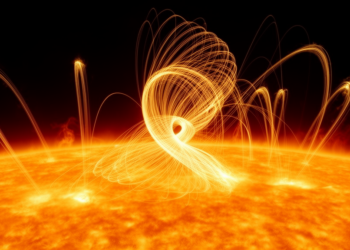
Twisted Solar Null Points Can Become Kink-Unstable, Analytical Study Finds
An analytical Solar Physics study finds that sufficiently twisted torsional spine and fan magnetic null points can develop Alfvénic m=1 ...
An analytical Solar Physics study finds that sufficiently twisted torsional spine and fan magnetic null points can develop Alfvénic m=1 ...

New three-dimensional simulations reveal that the choice of numerical solver and physical dissipative processes fundamentally shapes how solar flares and ...
A new analytical study provides the first closed-form description of how magnetic helicity is created during time-dependent separator reconnection in ...
New research shows the giant sunspot of April 1947 was statistically capable of triggering a superflare, providing the strongest evidence ...
A statistical analysis of eight years of GOES soft X-ray data finds a single power-law exponent of about three linking ...
Kyushu University researchers used high-power lasers to recreate magnetic reconnection in the laboratory and found that its energy-release rate is ...
A new two-stage theoretical model proposes that solar flares begin with a slow global magnetic instability that triggers a multi-scale ...
A new analysis of 38 J- and U-type solar radio bursts shows that these curved spectral signatures trace closed coronal ...
A new Solar Physics study shows that an M2.9 solar flare suppressed and then revived a type I radio noise ...
A new EVE Level 4 Lines data product from NASA's Solar Dynamics Observatory reveals Doppler velocity patterns in solar flares, ...

Embark on a thrilling journey of discovery with Scienmag.com—your ultimate source for cutting-edge breakthroughs. Immerse yourself in a world where curiosity knows no limits and tomorrow’s possibilities become today’s reality!