

Wednesday, October 21, 2026
Science
No Result
View All Result
  • Login
  • HOME
  • SCIENCE NEWS
  • CONTACT US
  • HOME
  • SCIENCE NEWS
  • CONTACT US
No Result
View All Result
Scienmag
No Result
View All Result
Home Science News Space

Twisted Solar Null Points Can Become Kink-Unstable, Analytical Study Finds

October 21, 2026
in Space
Grant Pearson
By Grant Pearson Scienmag Editorial Profile - Observational Astronomy
Reading Time: 2 mins read
0
Twisted Solar Null Points Can Become Kink-Unstable, Analytical Study Finds

Twisted Solar Null Points Can Become Kink-Unstable, Analytical Study Finds

65
SHARES
587
VIEWS
Share on FacebookShare on Twitter
ADVERTISEMENT

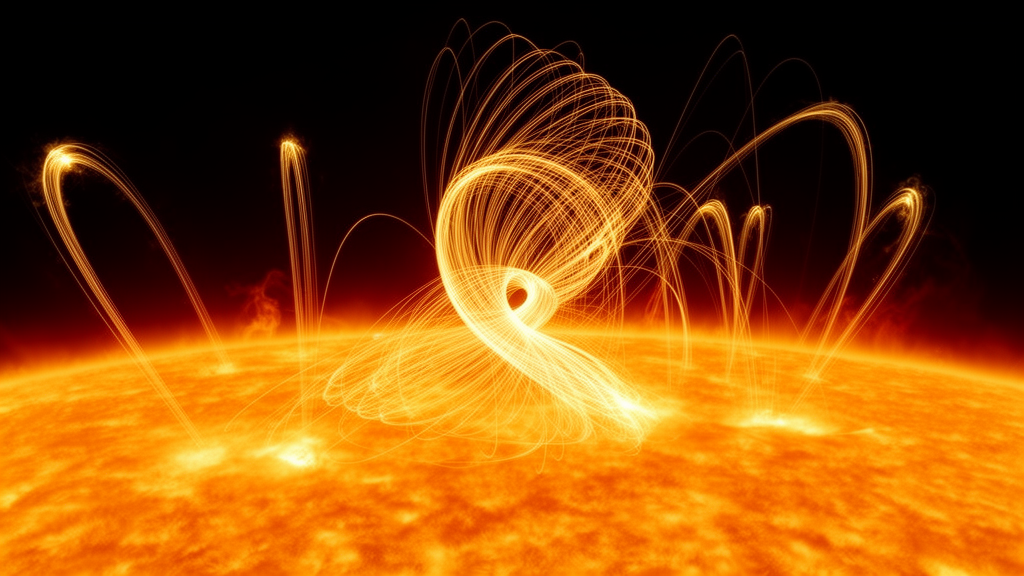
An analytical study of solar magnetic null points finds that sufficiently twisted configurations can become unstable to the m=1 kink mode, growing at Alfvénic rates and strongly deforming the magnetic geometry. The authors report that the deformation can create current sheets where subsequent magnetic reconnection may substantially change the field’s topology. The results appear in Solar Physics as Volume 301, article 160.

The study focuses on three-dimensional magnetic reconnection at null points in the solar corona, a process associated in the research with flares, jets and rapid restructuring of coronal magnetic fields. Two idealized magnetic-field geometries are examined: the torsional spine and the torsional fan. In both models, the central result is the same. Once the azimuthal magnetic-field amplitude is sufficiently large, the total twist exceeds the Kruskal–Shafranov threshold of 2π, and the configuration becomes kink-unstable.

To derive the behavior of these configurations, the researchers use the ideal magnetohydrodynamic energy principle. Their analysis treats line-tied cylindrical flux tubes and takes the static limit of the equilibrium flows. Within this framework, the linear growth rates show that both the torsional spine and torsional fan are susceptible to the m=1 kink mode. The instability develops with Alfvénic growth rates, indicating a rapid evolution in the model rather than a slow static deformation.

The modeled instability sharply distorts the original null-point geometry and produces current sheets. Those sheets provide sites where magnetic reconnection can subsequently occur, potentially causing substantial changes in magnetic topology. The authors therefore interpret the results as a possible natural route by which twisted null-point configurations in the solar corona evolve into kink-unstable states. They propose that this mechanism may help trigger impulsive energy release and topological restructuring associated with solar flares, jets and coronal-heating events.

Because this is an analytical study based on idealized magnetic-field models, the findings establish behavior within the model’s assumptions rather than directly demonstrating the evolution of a particular solar event. The authors’ connection to flares, jets and coronal heating is a model-based implication. The analysis also depends on its treatment of line-tied cylindrical flux tubes, the ideal magnetohydrodynamic framework and the static limit of equilibrium flows, which define the scope of the reported instability and growth rates.

Subject of Research: Analytical modeling of ideal kink instability in twisted solar magnetic null points

Article Title: Kink Instability of Torsional Spine and Fan Magnetic Null Points

Article References: Hosseinpour, M. (2026). Kink Instability of Torsional Spine and Fan Magnetic Null Points. Solar Physics, 301(10), Article 160. https://doi.org/10.1007/s11207-026-02757-4

Image Credits: AI Generated

DOI: 10.1007/s11207-026-02757-4

Keywords: solar corona, magnetic null points, kink instability, magnetic reconnection, torsional spine, torsional fan, magnetohydrodynamics, current sheets, solar flares, coronal jets, Kink, Instability

Cite Scienmag News

Grant Pearson. (October 21, 2026). Twisted Solar Null Points Can Become Kink-Unstable, Analytical Study Finds. Scienmag. https://scienmag.com/twisted-solar-null-points-can-become-kink-unstable-analytical-study-finds/

Grant Pearson. "Twisted Solar Null Points Can Become Kink-Unstable, Analytical Study Finds." Scienmag, 21 October 2026, https://scienmag.com/twisted-solar-null-points-can-become-kink-unstable-analytical-study-finds/. Accessed 21 October 2026.

Grant Pearson. "Twisted Solar Null Points Can Become Kink-Unstable, Analytical Study Finds." Scienmag. October 21, 2026. https://scienmag.com/twisted-solar-null-points-can-become-kink-unstable-analytical-study-finds/


Tags: Alfvénic growth rates in solar plasmascoronal jetscurrent sheetsdeformation of magnetic fields leading to current sheet formationinstabilityKinkkink instabilitykink instability in solar magnetic fieldsKruskal-Shafranov stability thresholdmagnetic null pointsmagnetic reconnectionmagnetic reconnection in the solar coronamagnetohydrodynamic energy principle in solar physicsmagnetohydrodynamicsSolar Coronasolar flare initiation mechanismssolar flaressolar jet and flare dynamicssolar magnetic null pointsthree-dimensional magnetic reconnectiontorsional fantorsional spinetorsional spine and fan magnetic geometriestwisted magnetic flux tubes
Share26Tweet16
Previous Post

Prone surgery in child with Alport syndrome managed with supraglottic airway

Next Post

Longitudinal study finds preparation statistically explains ADHD-linked STEM persistence gap

Related Posts

Taming the Divergent: New Resummation Method Sharpens Heavy Quark Mass Predictions
Space

Renormalon resummation estimates bottom and charm pole masses and HQET parameters

October 21, 2026
Muon g-2 and Forbidden Flavor Transitions Take Center Stage in a New Gauge Model
Space

Theoretical study links flavor-dependent U(1) symmetry to lepton-flavor violation and muon g−2

October 21, 2026
Physicists Trace Gravitational Wave Polarizations to Hidden Spacetime Symmetries
Space

Killing invariants encode plane-wave polarization in linearized general relativity

October 21, 2026
Supernova Map Suggests the Universe May Be More Even Than We Feared
Space

Pantheon+ analysis finds no robust cosmic anisotropy in full Type Ia supernova sample

October 21, 2026
Dark Matter Could Reshape the Silhouettes of Spinning Black Holes, Study Finds
Space

Dark matter could enlarge and circularize spinning black hole shadows, theoretical study finds

October 21, 2026
Flavon fields could explain why matter exists at TeV scales
Space

Flavon-assisted leptogenesis reproduces the baryon asymmetry at TeV scales

October 21, 2026
Next Post
Longitudinal study finds preparation statistically explains ADHD-linked STEM persistence gap

Longitudinal study finds preparation statistically explains ADHD-linked STEM persistence gap

  • Mothers who receive childcare support from maternal grandparents show more optimized

    Mothers who receive childcare support from maternal grandparents show more parental warmth, finds NTU Singapore study

    27656 shares
    Share 11059 Tweet 6912
  • University of Seville Breaks 120-Year-Old Mystery, Revises a Key Einstein Concept

    1061 shares
    Share 424 Tweet 265
  • Bee body mass, pathogens and local climate influence heat tolerance

    682 shares
    Share 273 Tweet 171
  • Researchers record first-ever images and data of a shark experiencing a boat strike

    546 shares
    Share 218 Tweet 137
  • Groundbreaking Clinical Trial Reveals Lubiprostone Enhances Kidney Function

    531 shares
    Share 212 Tweet 133
Science

Embark on a thrilling journey of discovery with Scienmag.com—your ultimate source for cutting-edge breakthroughs. Immerse yourself in a world where curiosity knows no limits and tomorrow’s possibilities become today’s reality!

RECENT NEWS

  • Northern Pine Island Ice Shelf Retreats, Thins and Develops Propagating Rifts
  • Longitudinal study finds preparation statistically explains ADHD-linked STEM persistence gap
  • Twisted Solar Null Points Can Become Kink-Unstable, Analytical Study Finds
  • Prone surgery in child with Alport syndrome managed with supraglottic airway

Categories

  • Agriculture
  • Anthropology
  • Archaeology
  • Athmospheric
  • Biology
  • Biotechnology
  • Blog
  • Bussines
  • Cancer
  • Chemistry
  • Climate
  • Earth Science
  • Editorial Policy
  • Marine
  • Mathematics
  • Medicine
  • Pediatry
  • Policy
  • Psychology & Psychiatry
  • Science Education
  • Science News
  • Social Science
  • Space
  • Technology and Engineering

Subscribe to Blog via Email

Enter your email address to subscribe to this blog and receive notifications of new posts by email.

Join 5,150 other subscribers

© 2025 Scienmag - Science Magazine

Welcome Back!

Login to your account below

Forgotten Password?

Retrieve your password

Please enter your username or email address to reset your password.

Log In
No Result
View All Result
  • HOME
  • SCIENCE NEWS
  • CONTACT US

© 2025 Scienmag - Science Magazine

Discover more from Science

Subscribe now to keep reading and get access to the full archive.

Continue reading