


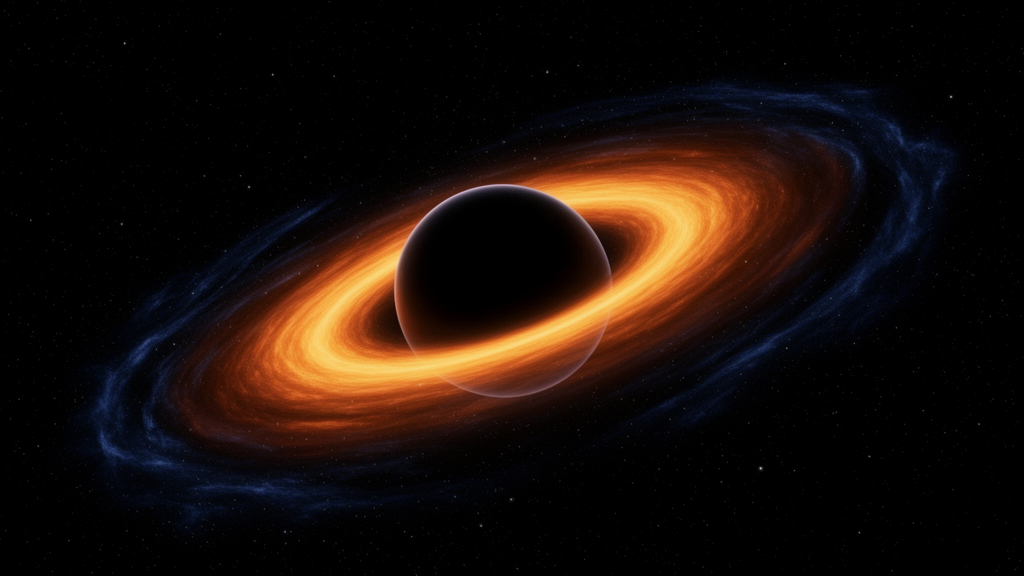
A theoretical study of a rotating black hole embedded in a shell of dark matter predicts that sufficiently massive shells can expand the event horizon, enlarge the shadow and make its outline nearly circular, even for rapidly spinning black holes. The study, published in The European Physical Journal C, also finds that the strongest predictions would exceed shadow measurements from the Event Horizon Telescope (EHT) for M87* and Sagittarius A*.
The authors construct a model in which a piecewise mass function describes a Schwarzschild black hole surrounded by a finite, electromagnetically inert dark-matter distribution. The dark matter is treated as an effective addition to the black hole’s mass, with separate parameters for the mass ratio ΔM/M, the shell’s inner boundary rs and its thickness Δrs. The authors state that the framework can represent dark matter bound in a galactic halo as well as locally captured objects such as brown dwarfs, stellar-mass black holes, primordial black holes and non-radiating dust.
For the non-rotating case, the analysis identifies a critical shell mass beyond which the metric develops an additional pair of horizons. With rs/M = 2 and Δrs/M = 200, the critical values are r*/M = 152 and ΔM/M = 800/9, or about 88.9. Below that threshold, the original event horizon remains in place, although the photon sphere and shadow radius can change slightly. Above it, the outermost root becomes a new event horizon enclosing the central black hole and part of the dark-matter shell, while the photon-sphere and shadow scales increase substantially.
The authors then generalize the static model to an axisymmetric rotating spacetime using the Newman–Janis Algorithm. The resulting metric returns to the Kerr solution when ΔM = 0 and to the static configuration when the spin parameter is zero. They report that the metric satisfies the Einstein field equations and derive corresponding dark-matter density and pressure profiles. The surface stress-energy at the interfaces of the piecewise mass distribution is found to vanish.
In the rotating model, the critical dark-matter mass depends on spin and shell geometry. For an extremal black hole with a/M = 1 and Δrs/M = 200, the reported threshold is ΔM/M = 88.3 at r*/M = 150.5. Models above this threshold develop an enlarged outer horizon and additional roots in the stationary-limit equation, changing the locations and number of ergosphere layers. The reported changes concern the horizon, ergosphere, critical photon-orbit and shadow scales; the study does not establish a general expansion of every physical scale in the system.
Null geodesics are used to locate the unstable circular photon orbits that define the shadow boundary. In the high-mass regime, the critical photon orbits lie outside the dark-matter shell, where the mass function is constant and the geometry has the Kerr form with a much larger total mass. At a fixed spin, rotation and frame-dragging then have less influence relative to the enlarged shadow scale. The calculated distortion parameter consequently approaches zero, producing a nearly circular shadow even at high spin. This circularization is a model prediction rather than an observed black-hole feature.
The study also estimates the high-frequency absorption cross section from the average shadow radius and uses the surface gravity of the outer horizon to calculate Hawking temperature and thermal energy emission. At fixed dark-matter mass, the model predicts a lower emission rate as spin increases. Dark-matter masses below the critical threshold have a marginal effect, whereas above the threshold the calculated Hawking temperature becomes very small and the emission rate is strongly suppressed.
The authors compare predicted shadow diameters with EHT values of dsh/M = 11 ± 1.5 for M87* and dsh/M = 9.77 ± 0.67 for Sagittarius A*. For M87*, all theoretically allowed dark-matter masses in the plotted compatible region satisfy both the 1σ and 2σ observational intervals. For Sagittarius A*, the full allowed region satisfies the 2σ interval, while a 1σ upper limit emerges and decreases as spin rises. At a/M = 0.9, the reported constraint is ΔM/M ≤ 22.3853.
Because the high-mass branch predicts a shadow diameter beyond the EHT-compatible range, the model disfavors dark-matter configurations large enough to trigger the new outer-horizon branch near the two observed black holes. Within the study’s assumptions, the dark matter must either be absent from the immediate vicinity or have a localized mass below the relevant critical value. These limits are conditional on the piecewise, electromagnetically inert shell model, its chosen shell geometry and the adopted horizon and shadow calculations, rather than being general constraints on all possible dark-matter distributions.
Subject of Research: Theoretical modeling of rotating black holes surrounded by finite dark-matter shells and their observable shadows
Article Title: Shadow of rotating black hole surrounded by dark matter
Article References: Feng, H., Cai, Z., Yang, R.-J., & Zhang, J. (2026). Shadow of rotating black hole surrounded by dark matter. The European Physical Journal C, 86(10), Article 1180. https://doi.org/10.1140/epjc/s10052-026-16437-x
Image Credits: AI Generated
DOI: 10.1140/epjc/s10052-026-16437-x
Keywords: black holes, dark matter, black hole shadows, Kerr spacetime, Event Horizon Telescope, null geodesics, Newman–Janis Algorithm, M87*, Sagittarius A*, Hawking radiation, Shadow, rotating
Cite Scienmag News
Grant Pearson. (October 21, 2026). Dark matter could enlarge and circularize spinning black hole shadows, theoretical study finds. Scienmag. https://scienmag.com/dark-matter-could-enlarge-and-circularize-spinning-black-hole-shadows-theoretical-study-finds/
Grant Pearson. "Dark matter could enlarge and circularize spinning black hole shadows, theoretical study finds." Scienmag, 21 October 2026, https://scienmag.com/dark-matter-could-enlarge-and-circularize-spinning-black-hole-shadows-theoretical-study-finds/. Accessed 21 October 2026.
Grant Pearson. "Dark matter could enlarge and circularize spinning black hole shadows, theoretical study finds." Scienmag. October 21, 2026. https://scienmag.com/dark-matter-could-enlarge-and-circularize-spinning-black-hole-shadows-theoretical-study-finds/


