


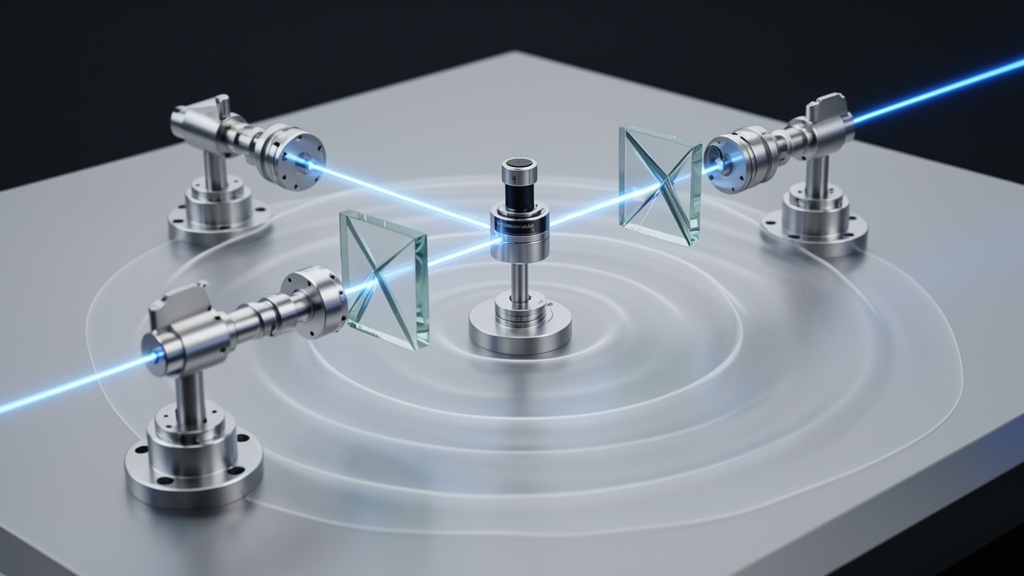
A theoretical analysis of two-particle interferometers shows that a common shortcut can reverse the predicted outcome of experiments designed to probe the quantum nature of gravity. When the gravitational phase accumulated along the particles’ complete trajectories is calculated rather than estimated from horizontal arms alone, the resulting entanglement can be stronger, weaker or even zero. The study identifies geometric ratios that maximize the phase signal and shows that choices of device separation, arm length and deviation angle can determine whether the predicted entanglement survives.
The proposal examined in the analysis involves two massive particles prepared in spatial superpositions and passing through separate interferometers. Gravitational interactions between the particles generate relative phases, and the resulting state can contain entanglement if gravity can mediate coherence between the two quantum systems. The authors consider two arrangements: paired Stern–Gerlach interferometers, where spatial path separation is created through a deviation angle, and paired Mach–Zehnder interferometers, where each particle travels through horizontal and vertical arms. These are theoretical proposals; the study does not report an observation of gravitationally induced entanglement.
Previous analyses have often assumed that the interferometers are much longer than they are wide. Under that condition, the horizontal portions of the trajectories are treated as the dominant source of gravitational phase, while the vertical or inclined segments are neglected. The new calculations show that this approximation is not always safe. When the omitted portions make a substantial contribution, the calculated phase difference can differ markedly from the simplified prediction. In some parameter regimes, the additional contribution cancels the phase difference associated with entanglement, turning an expected signal into a null result. In other regimes, it increases the signal beyond the earlier estimate.
The gravitational phase is obtained by integrating the particle mass multiplied by the gravitational potential acting on it, with the result divided by the reduced Planck constant. In the Stern–Gerlach configuration, the exact expressions combine a horizontal contribution with an integral over the inclined separation segment. They reduce to the usual horizontal-arm approximation when the path separation is small, but logarithmic terms associated with the inclined trajectory become increasingly important as the geometry changes. This means that the full shape of the interferometer enters directly into the phase difference used to predict entanglement, rather than acting only as a minor correction to the long-arm approximation.
Entanglement in the idealized setup is quantified with concurrence, a measure for a two-qubit state. For the state considered in the analysis, concurrence reduces to four times the product of the two beam-splitter amplitudes multiplied by the absolute value of the sine of half the relevant phase difference. Balanced 50:50 beam splitters simplify the expression to the absolute value of that sine. The measure consequently oscillates between zero and one: odd multiples of the phase difference give maximal concurrence, while even multiples give no concurrence. Experimental detection would not require the largest possible value, but geometry that places the phase difference at a zero would erase the entanglement predicted by the model.
With the particles’ total travel distance held fixed, the Stern–Gerlach geometry has a best-performing region rather than one universally optimal shape. The deviation angle should approach a right angle, while the path-separation fraction must be selected according to the normalized distance between the two devices. The rescaled phase first increases as the separation fraction grows, reaches a maximum at an intermediate value and then declines. The optimal fraction also increases with normalized device separation, so a geometry that is optimal at one distance is not necessarily optimal at another. Practical designs are also constrained by non-gravitational forces such as van der Waals interactions, which can dominate when the devices are brought close together.
The Mach–Zehnder analysis reaches the same central conclusion through a different path geometry. Its key parameter is the vertical-arm length divided by the total path length. For a normalized device separation of 0.2, the calculated optimum occurs near a vertical-arm ratio of 0.10 and yields a rescaled phase of approximately 0.20. At a ratio of 0.38, the induced phase becomes effectively negligible. When the normalized separation is 0.5, the preferred vertical-arm ratio shifts to approximately 0.23, with a smaller rescaled phase of around 0.07. As the devices become more widely separated, the optimal design approaches a square configuration in which the vertical and horizontal arms have equal lengths.
The practical implication is that the vertical portions of an interferometer cannot automatically be treated as incidental routing details. They can supply a substantial part of the phase difference on which the proposed entanglement signal depends, and their contribution can either reinforce or cancel the effect attributed to the horizontal arms. Within the assumptions of the analysis, the first design step is to minimize the separation between devices, subject to experimental constraints, and then tune the arm geometry for that particular distance. The rescaled phase also contains the common factor κ = Gm₁m₂/(ℏv), so the analysis isolates geometry while recognizing that particle mass and speed remain relevant to the absolute signal.
The broader experimental obstacles remain formidable. The source estimates that massive quantum systems in the approximate range of 10⁻¹⁴ to 10⁻¹² kilograms, prepared in spatial superpositions at relatively short separations, are required for gravitationally generated phases to become appreciable. Matter-wave interferometry has been demonstrated with complex molecules of approximately 10⁻²¹ kilograms, well below that range. Coherence must also survive throughout the particles’ transit, while the gravitational signal must be distinguished from molecular scattering, thermal photons, thermal vibrations, gravitational-field nonuniformities, nearby masses, Casimir–Polder forces, electrostatic charging and magnetic interactions. The proposed environment would therefore require ultra-high vacuum, cryogenic conditions, electromagnetic shielding and stringent vibration isolation.
The study is a theoretical analysis with no associated experimental dataset or code. It does not demonstrate gravitational quantum entanglement, show that a simplified model has already distorted a completed measurement or establish that an optimized apparatus can meet the required sensitivity. Its narrower result is that exact trajectory geometry can change the predicted phase and concurrence: neglecting non-horizontal path segments can produce incorrect expectations, and particular geometries can remove the predicted entanglement altogether. For experimental programs still working to prepare larger coherent masses and suppress competing interactions, the calculations identify interferometer shape as one controllable factor in estimating whether a measurable gravitationally induced entanglement signal is present.
Subject of Research: Theoretical optimization of dual-interferometer geometry for gravitationally induced quantum entanglement
Article Title: The role of geometric analysis in interferometer design and optimization for gravitational quantum entanglement
Article References: Maleki, A. (2026). The role of geometric analysis in interferometer design and optimization for gravitational quantum entanglement. The European Physical Journal C, 86(10), Article 1189. https://doi.org/10.1140/epjc/s10052-026-16455-9
Image Credits: AI Generated
DOI: 10.1140/epjc/s10052-026-16455-9
Keywords: quantum gravity, gravitational entanglement, interferometer geometry, Stern–Gerlach interferometry, Mach–Zehnder interferometry, gravitational phase, quantum coherence, experimental optimization, role, geometric, analysis, interferometer
Cite Scienmag News
Grant Pearson. (October 20, 2026). Theoretical analysis finds interferometer geometry can erase predicted gravitational entanglement. Scienmag. https://scienmag.com/theoretical-analysis-finds-interferometer-geometry-can-erase-predicted-gravitational-entanglement/
Grant Pearson. "Theoretical analysis finds interferometer geometry can erase predicted gravitational entanglement." Scienmag, 20 October 2026, https://scienmag.com/theoretical-analysis-finds-interferometer-geometry-can-erase-predicted-gravitational-entanglement/. Accessed 20 October 2026.
Grant Pearson. "Theoretical analysis finds interferometer geometry can erase predicted gravitational entanglement." Scienmag. October 20, 2026. https://scienmag.com/theoretical-analysis-finds-interferometer-geometry-can-erase-predicted-gravitational-entanglement/


