


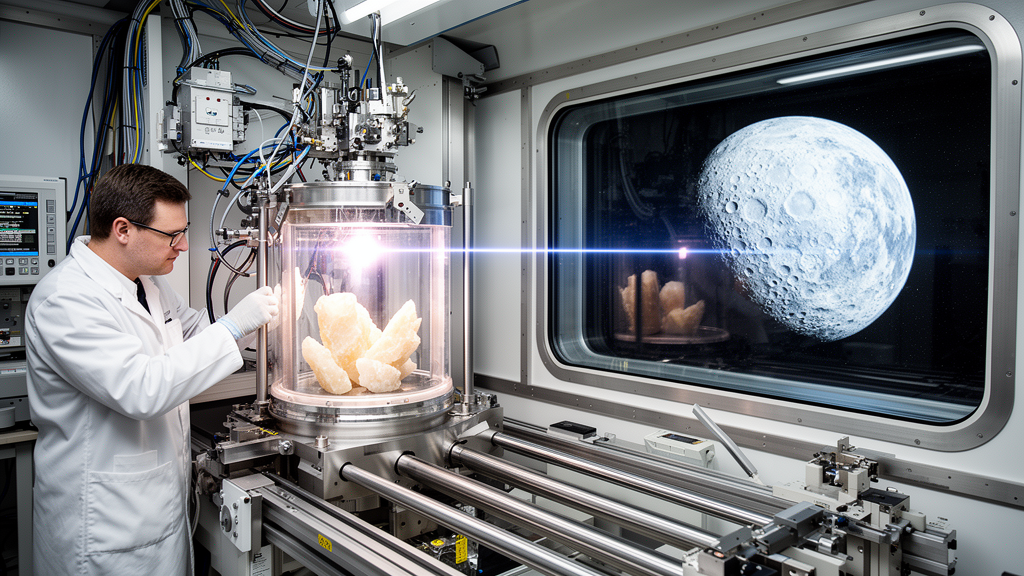
Scientists using the Diamond Light Source synchrotron have observed, for the first time, fluid inclusions preserved inside natron crystals formed when a salty, Enceladus-like solution freezes. Their experiments show that sodium carbonate decahydrate can crystallise around pockets of the original liquid, sealing microscopic samples of it inside the growing mineral. The laboratory result identifies natron as a potential carrier of material from Enceladus’s subsurface ocean and establishes a specific mineral that future spacecraft and landers could seek in surface deposits near the moon’s cryovolcanic plume sources.
The peer-reviewed findings were published in Communications Earth & Environment by a collaboration between Diamond Light Source and the ISIS Neutron and Muon Source. Lead author and Diamond beamline scientist Liam Perera said the inclusions could act as microscopic capsules containing material from the ocean beneath Enceladus’s icy crust. If biological material or other biosignatures are present in that ocean, natron could potentially trap and preserve them, although the experiment did not detect life on Enceladus or demonstrate that preserved material survives under the moon’s surface conditions.
Enceladus is of particular interest because a global subsurface ocean is thought to lie beneath its frozen surface and because material from the interior is ejected through massive cryovolcanic plumes at the moon’s south pole. The ocean is buried beneath about 20 km of ice, making direct drilling impractical. Plumes nevertheless provide a natural route for material to reach the surface.
Perera said planned NASA and ESA flagship missions will need to look for geochemical signatures representing fresh, unprocessed material from the subsurface. To investigate how such material might be incorporated into minerals, the researchers prepared a sodium chloride–sodium carbonate–water solution as an analogue for Enceladus material. They cooled the sample while collecting synchrotron X-ray computed microtomography, or μCT, and X-ray diffraction measurements on Diamond’s DIAD beamline.
Combining these techniques allowed the team to follow the development of ice and salt phases during freezing and relate the mineral phases to their three-dimensional internal structures. The experiment examined mineral formation in a terrestrial laboratory analogue; it did not analyse a sample collected from Enceladus. DIAD has two independently configurable X-ray beams, enabling spatially registered imaging and diffraction measurements.
Tomography provided detailed views of the sample’s internal structure, while diffraction identified its mineral composition. The researchers said this combination was central to distinguishing the trapped fluid pockets in situ. Perera said the method allowed the salts, which are hundreds of micrometres in size and formed within ice at 205 K, to be examined non-destructively as crystallisation progressed.
The bright synchrotron source also enabled the researchers to watch salt crystallisation in real time as the Enceladus-type solution froze. The final frozen sample contained three major phases: hexagonal ice, a eutectic mixture comprising ice, natron and hydrohalite, and individual natron crystals. Natron accounted for around 21% of the imaged volume.
Correlating the diffraction data with the crystals’ three-dimensional microstructures revealed that natron enclosed pockets of fluid from which it crystallised. The study therefore provides direct laboratory evidence for a mechanism through which ocean-derived material could become sealed within a mineral, although the experiment did not establish how frequently such inclusions form on Enceladus or whether they are present there. Fluid inclusions matter because they can preserve fluid at the moment a mineral forms.
On Earth, inclusions in salt minerals have been used to reconstruct the chemistry of ancient environments, and some salt-hosted inclusions have been found to contain organic biological signatures and microorganisms. The Enceladus experiment did not reproduce those terrestrial biological findings. Instead, it showed that an Enceladus-like salty solution can generate natron with enclosed fluid, providing a plausible mechanism by which ocean-derived chemistry, and potentially biological material if present, might be trapped within crystals.
Based on the results, the team suggests that future spacecraft should be equipped to identify crystalline natron and other hydrated carbonate minerals at Enceladus’s surface. The researchers recommend looking for natron in fresh deposits close to plume sources, where larger salt-rich particles may be more likely to contain inclusions. They also identify near-infrared spectroscopy as a possible method for identifying hydrated carbonate deposits and helping select promising sampling locations.
These are proposed mission considerations arising from the laboratory analogue study, not evidence that natron or biologically meaningful inclusions have been detected on Enceladus. Perera said future landers should prioritise sites with signs of natron, while future spacecraft should have the capability to identify the mineral remotely. Understanding how minerals form and preserve fluids at extremely low temperatures may also help scientists interpret observations and samples from icy worlds, subject to confirmation that the proposed minerals and structures exist under Enceladus conditions.
The study highlights the potential value of synchrotron science for planetary research. Its central achievement is a laboratory demonstration that natron can trap fluid when an Enceladus-like solution freezes, together with a non-destructive method for identifying the inclusions inside crystals. The result narrows a possible mineralogical target for future missions without establishing that the ocean contains life, that natron is abundant on Enceladus, or that inclusions preserve biosignatures after material leaves the ocean.
For now, the experiments establish natron as a potential astrobiological target and show how synchrotron imaging can reveal the hidden structure of cold, salty materials that may inform the design and interpretation of future missions.
Subject of Research: Laboratory study of natron fluid inclusions in a frozen Enceladus-like solution
Article Title: Diamond Light Source scientists identify natron as a key target for future Enceladus missions
Article References: Diamond Light Source scientists identify natron as a key target for future Enceladus missions. Original publication (Bibliographic details unavailable.)
Image Credits: AI Generated
DOI: Not provided
Keywords: Enceladus, natron, fluid inclusions, subsurface ocean, synchrotron X-rays, Diamond Light Source, planetary mineralogy, cryovolcanism, astrobiology, icy moons, Diamond, Light
Cite Scienmag News
Grant Pearson. (October 20, 2026). Synchrotron experiments identify natron as potential Enceladus mission target. Scienmag. https://scienmag.com/synchrotron-experiments-identify-natron-as-potential-enceladus-mission-target/
Grant Pearson. "Synchrotron experiments identify natron as potential Enceladus mission target." Scienmag, 20 October 2026, https://scienmag.com/synchrotron-experiments-identify-natron-as-potential-enceladus-mission-target/. Accessed 20 October 2026.
Grant Pearson. "Synchrotron experiments identify natron as potential Enceladus mission target." Scienmag. October 20, 2026. https://scienmag.com/synchrotron-experiments-identify-natron-as-potential-enceladus-mission-target/


