


Ultralight Dark Matter Does Not Influence Gravitational Wave Propagation
A new field-theoretic study finds that ultralight dark matter does not affect gravitational wave propagation, challenging previous classical model predictions.
A new field-theoretic study finds that ultralight dark matter does not affect gravitational wave propagation, challenging previous classical model predictions.

A theoretical study demonstrates that ultra-relativistic bubble collisions produce heavy particles through on-shell scatterings rather than off-shell background decay.

The Hong Kong Institute for Astronomy and Astrophysics celebrated its first anniversary by hosting a symposium uniting over 100 researchers ...

A statistical analysis published in the Journal of Cosmology and Astroparticle Physics uses observations of the Sun, Earth, Jupiter, and ...

Theoretical modeling reveals that surrounding dark matter halos alter spacetime geometry around rotating black holes, expanding characteristic photon orbits and ...

A theoretical study demonstrates how vacuum misalignment induced by quantum chromodynamics can generate gigaelectronvolt-scale dark matter masses, offering a solution ...

COSPAR and IUPAP have signed a Memorandum of Understanding in Beijing to strengthen international cooperation across fundamental physics and space ...

Researchers have developed a fabrication process for copper-polyimide flexible cables that cuts radioactive contamination to roughly 20-31 pg/g of uranium-238 ...

A new study uses near-infrared observations of the inner Galactic Center to rule out large regions of the parameter space ...
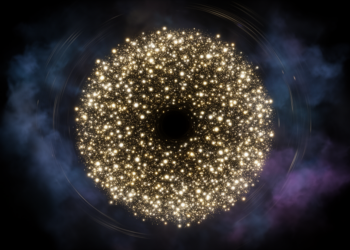
A new theoretical study proposes that globular clusters could have formed around thousand-solar-mass primordial black holes created at the QCD ...


Embark on a thrilling journey of discovery with Scienmag.com—your ultimate source for cutting-edge breakthroughs. Immerse yourself in a world where curiosity knows no limits and tomorrow’s possibilities become today’s reality!