


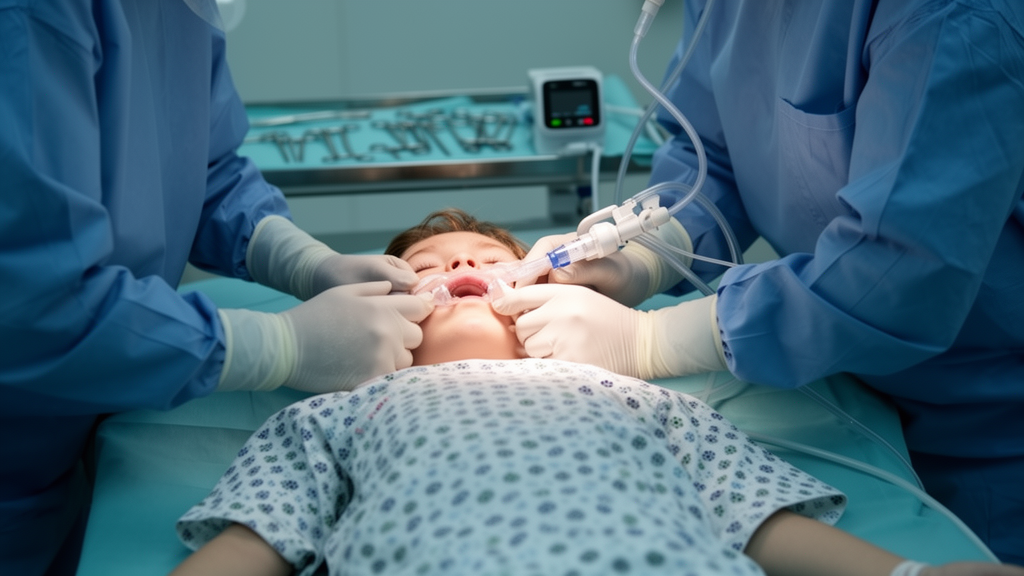
A 12-year-old girl with a mild form of X-linked Alport syndrome underwent elective surgery in the prone position for a recurrent venous malformation of her left lower leg, receiving propofol-based total intravenous anesthesia through a second-generation laryngeal mask airway. The case report describes stable ventilation, preserved blood pressure and oxygenation, an uneventful 100-minute operation, and recovery without postoperative nausea, vomiting, or airway complications. She was discharged home on postoperative day two, with no wound infection evident at follow-up eight days later.
The outcome demonstrates feasibility in this carefully selected patient, but does not establish that the technique is superior to tracheal intubation or that it is equally appropriate in children with advanced kidney disease. Alport syndrome is a hereditary disorder involving abnormalities in type IV collagen, a major structural component of the glomerular basement membrane. The condition is classically associated with progressive kidney disease, sensorineural hearing loss, and ocular abnormalities, although severity varies substantially, even among relatives carrying the same familial variant.
This patient had a clinically mild phenotype, with isolated microscopic hematuria but no renal insufficiency, hearing impairment, or ocular involvement. Her father, however, developed childhood cataracts, progressive hearing loss, end-stage kidney disease at age 25, and ultimately required dialysis and transplantation. That contrast illustrates why perioperative planning based solely on a child’s current organ function may not capture the disorder’s lifelong potential for progression.
The girl’s diagnosis was based on microscopic hematuria detected incidentally after blunt abdominal trauma and her status as an obligate heterozygote for a pathogenic COL4A5 variant carried by her father and grandmother. Direct molecular testing was not performed in the child, but all daughters of an affected male inherit his X chromosome, including the familial variant. Her younger sister carried the same variant and remained asymptomatic.
At preoperative evaluation, the patient was classified as American Society of Anesthesiologists physical status II, had normal exercise tolerance and no predictors of difficult mask ventilation, and was assessed as Mallampati class I. She also had exercise-induced bronchial asthma treated with as-needed salbutamol and continued long-term ramipril as renoprotective therapy rather than for hypertension or heart failure. Laboratory results obtained one month before surgery were within the reference ranges. Serum creatinine was 0.64 mg/dL, urea was 32 mg/dL, and potassium was 4.1 mmol/L. A cystatin C measurement from one year earlier was also within range, at 1.0 mg/L, but an estimated glomerular filtration rate was not calculated, and the perioperative evaluation did not include assessment of proteinuria or albuminuria.
These limitations matter because the case primarily describes management in a child with preserved renal function. It therefore offers little information about anesthetic challenges that may accompany altered drug clearance, electrolyte abnormalities, or hemodynamic instability in advanced Alport syndrome. The authors also did not obtain a patient perspective during documentation of the case.
After preoxygenation and standard monitoring, anesthesia was induced with fentanyl 150 micrograms and propofol 150 mg, both equivalent to 2.38 micrograms per kilogram and 2.38 mg per kilogram, respectively. Mask ventilation was uneventful. A size-4 LMA Supreme, selected under the manufacturer’s weight-based recommendation for patients weighing 50 to 70 kg, was inserted without difficulty, and cuff pressure was adjusted to 55 cmH2O to obtain an effective seal.
A gastric tube was passed through the drainage channel, and residual gastric contents were aspirated. This airway was selected in a patient with no reflux symptoms, a low aspiration risk, normal airway anatomy, and well-controlled exercise-induced asthma; a second-generation supraglottic device was viewed as a way to reduce airway stimulation while avoiding tracheal intubation and neuromuscular blockade. Anesthesia was maintained with a propofol infusion of 6.35 mg/kg/hour and remifentanil at 15.9 micrograms/kg/hour, with propofol titrated against a bispectral index range of 41 to 61.
An additional 50-microgram fentanyl bolus was given intraoperatively, but no neuromuscular blocker or reversal agent was required. The team jointly turned the child from supine to prone while manually stabilizing her head and securing the LMA. Her head and neck were rotated laterally and supported with an open, crescent-shaped gel ring that left the eyes and nose free of pressure.
Care was taken to prevent the airway device from contacting the operating table, and a flexible catheter mount allowed the breathing circuit to remain free of tension. The airway and head position were reassessed repeatedly during surgery. Pressure-controlled ventilation was delivered with positive end-expiratory pressure of 5 cmH2O, inspiratory pressures of 15 to 18 cmH2O, tidal volumes of 6 to 8 mL/kg, and inspired oxygen fractions between 0.41 and 0.48.
Continuous monitoring of inspiratory and expiratory tidal volumes, their difference, airway pressure, and ventilator leak alarms showed that the LMA seal remained effective. Cuff pressure stayed between 50 and 60 cmH2O, with no audible leak. End-tidal carbon dioxide ranged from 38 to 48 mmHg, oxygen saturation remained at 98% to 99%, and sinus rhythm was maintained.
Systolic blood pressure ranged from 95 to 110 mmHg, with mean arterial pressure at or above 65 mmHg and no need for vasoactive medication. A left-leg tourniquet was inflated to 200 mmHg for approximately 45 minutes. Before release, peripheral venous blood gas analysis showed carbon dioxide tension of 45 mmHg, potassium of 3.9 mmol/L, and lactate of 0.7 mmol/L, establishing the pre-reperfusion baseline.
Approximately 300 mL of Ringer’s acetate solution was administered, blood loss was minimal, and no urinary catheter was placed, so urine output was not measured. Nasal temperature remained between 36.9 and 37.3°C with forced-air warming. Ampicillin-sulbactam was given for perioperative antibiotic prophylaxis.
Because a previous anesthetic had produced postoperative nausea and vomiting, dexamethasone and granisetron were administered. Dexmedetomidine and metamizole provided multimodal analgesia, while nonsteroidal anti-inflammatory drugs were avoided in keeping with the authors’ renal-protective rationale. After surgery, the child was returned to the supine position.
The LMA was removed after anesthesia was discontinued, spontaneous ventilation returned with stable end-tidal carbon dioxide, and emergence movements were observed. In the post-anesthesia care unit, vital signs remained stable without supplemental oxygen, and the modified Aldrete score increased from 12 on arrival to 14 at discharge. Postoperative pain reached a visual analogue score of 6 and improved after 3 mg of piritramide.
No postoperative nausea, vomiting, sore throat, or swallowing difficulty occurred. On the pediatric ward, regular numerical pain scores were generally 0 to 1; a transient score of 4 during physiotherapy was controlled after scheduled metamizole. Mobilization with forearm crutches and physiotherapy support was uncomplicated, and she went home on postoperative day two.
The case illustrates an individualized perioperative strategy that combined careful drug selection, stable propofol-based anesthesia, a second-generation supraglottic airway, continuous assessment of seal integrity, and readiness to convert to tracheal intubation. The team kept intubation equipment immediately available and predefined a rescue plan: interrupt surgery, return the child to the supine position, and secure the airway if adequate ventilation could not be maintained. Use of an LMA in the prone position is not standard pediatric practice, and surveys cited in the report indicate that it is an uncommon choice.
Although the authors regarded avoiding neuromuscular blockade as a way to minimize unnecessary medication, the child’s normal renal function meant she would not have faced the same concerns as a patient with advanced kidney impairment. The favorable result supports feasibility in selected children with mild disease and favorable airway and aspiration-risk profiles, while further clinical reports are needed to define safer, more generalizable approaches for pediatric Alport syndrome.
Subject of Research: Peroperative anesthetic management of a child with X-linked Alport syndrome undergoing prone surgery
Article Title: Anesthetic challenges in a child with Alport syndrome undergoing prone surgery with a laryngeal mask airway: a case report
Article References: Gaik, C., Knoth, S., Schmitt, F., & Holzinger, I. (2026). Anesthetic challenges in a child with Alport syndrome undergoing prone surgery with a laryngeal mask airway: a case report. Frontiers in Pediatrics, 14, Article 1950654. https://doi.org/10.3389/fped.2026.1950654
Image Credits: AI Generated
DOI: 10.3389/fped.2026.1950654
Keywords: Alport syndrome, pediatric anesthesia, laryngeal mask airway, prone surgery, propofol TIVA, COL4A5, renal protection, case report, Anesthetic, challenges, child, Alport
Cite Scienmag News
Ophelia Keating. (October 21, 2026). Prone surgery in child with Alport syndrome managed with supraglottic airway. Scienmag. https://scienmag.com/prone-surgery-in-child-with-alport-syndrome-managed-with-supraglottic-airway/
Ophelia Keating. "Prone surgery in child with Alport syndrome managed with supraglottic airway." Scienmag, 21 October 2026, https://scienmag.com/prone-surgery-in-child-with-alport-syndrome-managed-with-supraglottic-airway/. Accessed 21 October 2026.
Ophelia Keating. "Prone surgery in child with Alport syndrome managed with supraglottic airway." Scienmag. October 21, 2026. https://scienmag.com/prone-surgery-in-child-with-alport-syndrome-managed-with-supraglottic-airway/


