


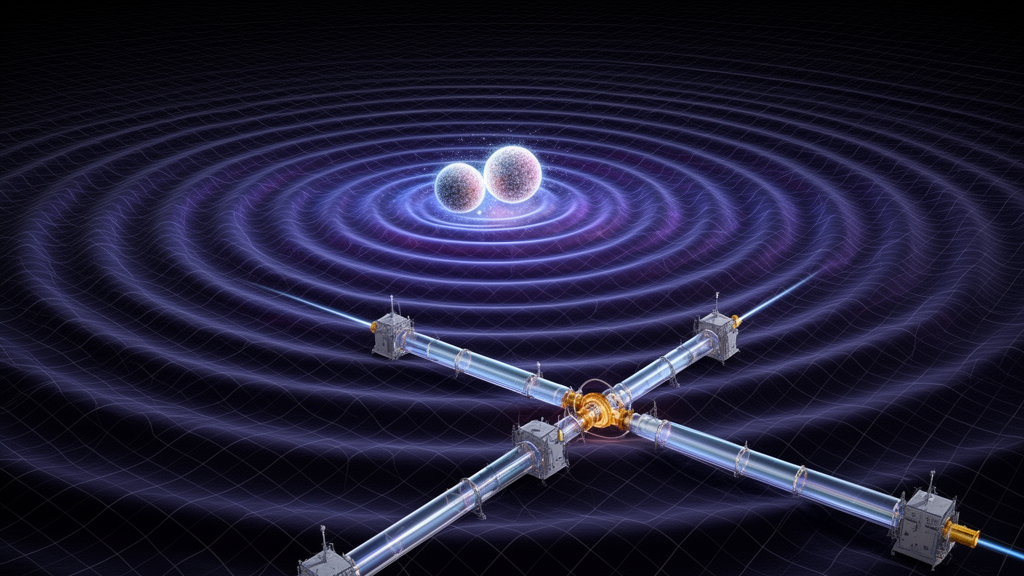
A theoretical study of linearized plane gravitational waves on a Minkowski background found that the plus and cross tensor polarizations are captured by quantities constructed from surviving translational symmetries, but not by the curvature invariants generated by the Cartan–Karlhede algorithm. The analysis was performed entirely within general relativity and was restricted to linearized waves propagating on flat spacetime.
The researchers compared three approaches to identifying physical gravitational-wave degrees of freedom: the gauge-invariant Bardeen formalism, curvature-based Newman–Penrose scalars and the Cartan–Karlhede algorithm, and symmetry-based Killing invariants. Their calculations showed that the Bardeen and Killing methods recover the same two transverse–traceless tensor degrees of freedom, whereas the Cartan–Karlhede quantities do not distinguish the plus and cross polarizations.
The Bardeen decomposition starts from a small metric perturbation around Minkowski spacetime and separates it into scalar, vector and transverse–traceless tensor components. By forming combinations that are unchanged under the relevant gauge transformations, the method removes four non-radiative gauge degrees of freedom. For the plane waves examined here, the authors explicitly evaluated all of the scalar, vector and tensor Bardeen variables.
In transverse–traceless gauge, the scalar variables Φ and Ψ and the vector variable E_i vanished identically for both representative plane-wave polarizations. The only nonzero components were the transverse–traceless metric perturbations. For a wave propagating in the positive z direction, the remaining tensor components were identified with the plus amplitude in the xx and yy entries and the cross amplitude in the xy entry.
The authors then applied a linearized version of the Cartan–Karlhede algorithm, which determines a spacetime classification from components of the curvature tensor and its covariant derivatives. For a monochromatic plane wave with mixed polarization, the Ricci tensor vanished and the Weyl tensor had one nonzero Newman–Penrose scalar, Ψ₄. A boost and spin of the null frame could normalize that scalar to one, removing the information needed to read off the plus and cross amplitudes from its real and imaginary parts.
The algorithm continued to second order, when it found one functionally independent invariant. All resulting invariants depended only on the wave phase, so higher derivatives did not supply additional independent quantities. The calculated Cartan invariants therefore reproduced a known degeneracy of plane-wave classification: the physical polarization choice amounts to a rotation of the spatial frame and is not represented by a distinguishing curvature invariant.
The study found a different encoding in the symmetries retained under linear perturbation. The Minkowski background has ten Killing vector fields, while the plane-wave geometry retains five, including three translational symmetries represented by shifts in the x and y directions and by the combination of a time shift and a z shift. These translational symmetries can be determined from quantities supplied by the Cartan–Karlhede analysis, which makes their identification accessible within a linearized-gauge-invariant framework.
For the relevant symmetries, the Killing invariants are defined by projecting the metric perturbation onto the background translational Killing vectors. In transverse–traceless gauge, the resulting components are Kxx = h⊕, Kyy = −h⊕ and Kxy = h⊗. Equivalently, the inner product of the x-directed vector with itself is 2h⊕, the y-directed inner product is −2h⊕, and the cross inner product is h⊗. These quantities directly reproduce the two physical tensor degrees of freedom identified by the Bardeen variables.
The authors also described a procedure for constructing gauge-invariant quantities in gauge choices where the perturbed Killing vector fields differ from the background symmetry generators. The procedure compares the symmetry generators identified from curvature quantities with the Killing fields solved from the perturbed metric, then uses their Lie-algebra and inner-product data to isolate gauge-dependent contributions. The authors present the algorithm as a possible diagnostic for linearized gravity solutions that admit symmetries, but the reported analysis itself covers only plane waves on a Minkowski background in general relativity. The manuscript contains no associated datasets or code, and it does not experimentally test gravitational-wave signals.
Subject of Research: Gauge-invariant encoding of tensor polarizations in linearized plane gravitational waves on a Minkowski background
Article Title: Where are linearized gauge invariants encoded for plane waves in linearized gravity
Article References: Radhakrishnan, R., McNutt, D., Mirfendereski, D., Davis, E., Julius, W., & Cleaver, G. (2026). Where are linearized gauge invariants encoded for plane waves in linearized gravity. The European Physical Journal C, 86(10), Article 1183. https://doi.org/10.1140/epjc/s10052-026-16355-y
Image Credits: AI Generated
DOI: 10.1140/epjc/s10052-026-16355-y
Keywords: linearized gravity, plane gravitational waves, Killing invariants, Bardeen variables, Cartan–Karlhede algorithm, Newman–Penrose scalars, tensor polarization, Minkowski spacetime, gauge invariance, linearized, gauge, invariants
Cite Scienmag News
Grant Pearson. (October 21, 2026). Killing invariants encode plane-wave polarization in linearized general relativity. Scienmag. https://scienmag.com/killing-invariants-encode-plane-wave-polarization-in-linearized-general-relativity/
Grant Pearson. "Killing invariants encode plane-wave polarization in linearized general relativity." Scienmag, 21 October 2026, https://scienmag.com/killing-invariants-encode-plane-wave-polarization-in-linearized-general-relativity/. Accessed 21 October 2026.
Grant Pearson. "Killing invariants encode plane-wave polarization in linearized general relativity." Scienmag. October 21, 2026. https://scienmag.com/killing-invariants-encode-plane-wave-polarization-in-linearized-general-relativity/


