


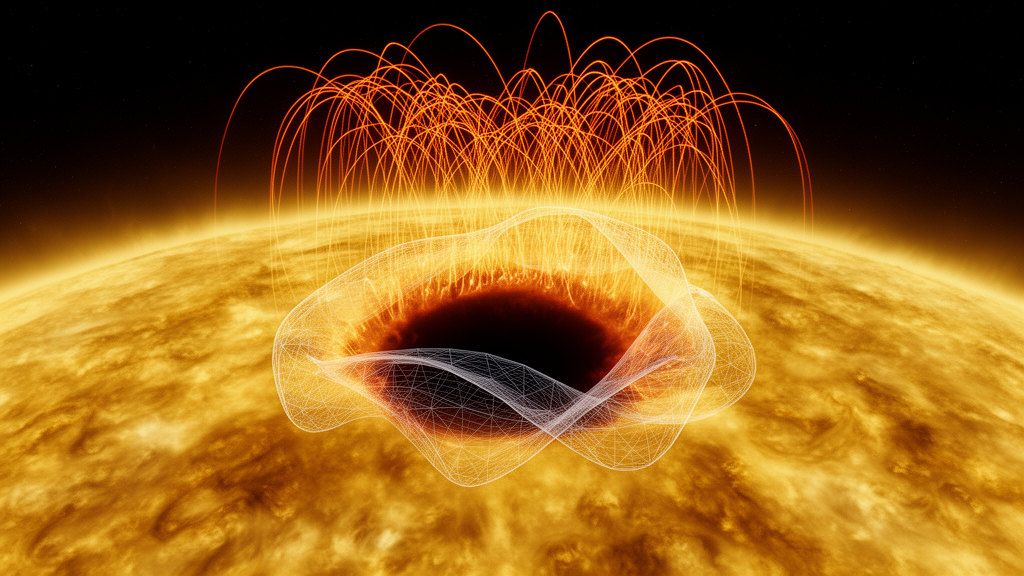
A new study published in Solar Physics argues that this parameterization squeezes the spatial structure of active regions and may discard information relevant to flare initiation. The research shows that deep convolutional neural networks trained directly on the spatial distributions of several active region properties can achieve flare forecasting performance, and that the raw morphology of an active region appears to carry usable flare signatures on its own. The study was carried out by Ashwini Nagaraj Shenoy, Adithya H.N., Deepu Vijayasenan, Sreejith Padinhatteeri, and B. S. Raghavendra.
Instead of relying on parameterized, hand-engineered features derived from active regions, the team trained deep convolutional neural networks on the spatial distributions of several active region physical properties. The researchers hypothesized that the morphology of an active region, in and of itself, encodes meaningful information about its flare potential, and they tested this idea by training separate models on different physical properties and comparing how the models performed. One practical obstacle in training such models is that solar active regions come in different sizes and shapes, while the networks require standardized input dimensions.
To address this, the authors proposed a resizing technique called Pad-crop, which standardizes the dimensions of active region inputs across the dataset so that many different regions can be fed into the same convolutional architecture. The paper presents this as a method for standardizing input dimensions rather than as a validated forecasting improvement in itself. The central result is that models trained on different physical properties achieved comparable forecasting performance.
According to the authors, this indicates that the morphology of active regions in itself may encode meaningful flare signatures, a finding that motivates morphology-based approaches to solar flare forecasting. To examine what the networks were learning, the team applied Gradient-weighted Class Activation Mapping, known as Grad-CAM. The Grad-CAM analysis indicated that the models focused on physically meaningful zones of the active regions, suggesting that relevant features were indeed being captured rather than the networks relying on arbitrary patterns.
The study also examined where the forecasts went wrong. An analysis of false-positive predictions suggested that intermediate C-class flares occurring during the prediction window may contribute to model confusion, meaning that some events counted as false alarms may reflect weaker flaring activity within the window rather than pure model error. The researchers emphasize that spatial structure in active region properties deserves greater attention in future forecasting work, and they note that the source code associated with the study will be made publicly available.
The findings are drawn from the training data and evaluation performed in the study, and the authors frame the results as motivation for further exploration of morphology-based approaches to solar flare forecasting rather than as a completed forecasting solution. Within that scope, the work adds evidence that the two-dimensional arrangement of physical properties across an active region holds flare-relevant information that conventional parameterized features may leave behind, and it offers a reproducible pipeline, from the Pad-crop resizing method to the Grad-CAM diagnostics, for other groups to build on.
Subject of Research: Deep learning-based solar flare forecasting using the spatial distributions of active region properties
Article Title: Solar Flare Forecasting Using the Spatial Distributions of Active Region Properties
Article References: Shenoy, A. N., H.N., A., Vijayasenan, D., Padinhatteeri, S., & Raghavendra, B. S. (2026). Solar Flare Forecasting Using the Spatial Distributions of Active Region Properties. Solar Physics, 301(10), Article 161. https://doi.org/10.1007/s11207-026-02751-w
Image Credits: AI Generated
DOI: 10.1007/s11207-026-02751-w
Keywords: solar flares, space weather, active regions, convolutional neural networks, Pad-crop, Grad-CAM, forecasting, solar physics, machine learning, morphology, Solar, Flare
Cite Scienmag News
Blake Davidson. (October 23, 2026). Deep Learning Reads Active Region Shape to Forecast Solar Flares. Scienmag. https://scienmag.com/deep-learning-reads-active-region-shape-to-forecast-solar-flares/
Blake Davidson. "Deep Learning Reads Active Region Shape to Forecast Solar Flares." Scienmag, 23 October 2026, https://scienmag.com/deep-learning-reads-active-region-shape-to-forecast-solar-flares/. Accessed 23 October 2026.
Blake Davidson. "Deep Learning Reads Active Region Shape to Forecast Solar Flares." Scienmag. October 23, 2026. https://scienmag.com/deep-learning-reads-active-region-shape-to-forecast-solar-flares/


