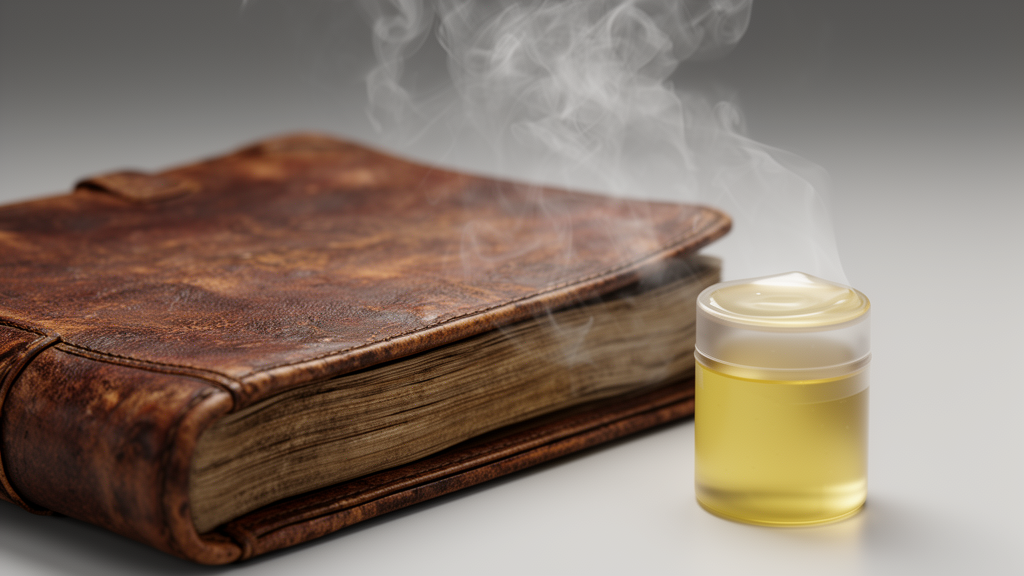
Leather artifacts in museums and archives face a persistent threat from biodeterioration, and the traditional response—applying antimicrobial agents directly onto the surface—can cause secondary contamination or irreversible changes to fragile collagen matrices. A study published in npj Heritage Science reports a non-invasive alternative: rosemary essential oil confined within an oleogel made of candelilla wax, which delivers antimicrobial protection through the air as vapor rather than through direct contact with the object.
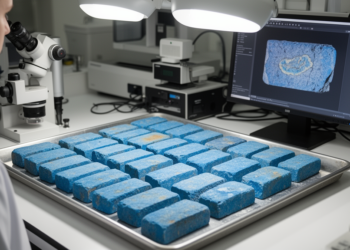
The strategy relies on the physical structure of the gel. Polarized light microscopy and X-ray diffraction confirmed that candelilla wax formed an interpenetrating crystalline network capable of stabilizing the essential oil within it. Rheological and thermal analyses then showed that the wax concentration, varied between 10 and 30 percent by weight, regulated both the structural stability of the gel and the release behavior of the oil. Among the formulations tested, the one containing 20 percent candelilla wax, designated REO-CW-20, provided an optimized balance between stiffness and ductility.
In laboratory testing, the oleogels exhibited strong broad-spectrum antimicrobial activity along with sustained antioxidant capacity. Simulated application tests on leather samples demonstrated effective vapor-phase antimicrobial protection for up to 28 days, with good material compatibility with the leather itself. Because the active compounds travel as vapor, the fragile collagen matrix is never directly exposed to the treatment, addressing a central weakness of conventional contact methods.
The researchers describe the approach as a sustainable vapor-phase strategy for the conservation of leather artifacts and a promising alternative to traditional contact treatments. The findings rest on laboratory simulations rather than trials on actual heritage objects, and the 28-day protection window comes from those controlled tests. Even so, the combination of a plant-derived essential oil, a wax-based carrier, and a delivery method that leaves the artifact untouched offers conservators a template for preservation systems that protect collections without altering the very materials they are meant to save.
Subject of Research: Oleogel-based vapor-phase delivery of rosemary essential oil for antimicrobial preservation of leather artifacts
Article Title: Oleogel-based vapor-phase strategy for sustained antimicrobial preservation of leather artifacts
Article References: Zhang, M., Shao, H., Duan, W., Liu, J., Lei, Y., Albu Kaya, M. G., Han, G., & Tang, K. (2026). Oleogel-based vapor-phase strategy for sustained antimicrobial preservation of leather artifacts. npj Heritage Science. https://doi.org/10.1038/s40494-026-02977-8
Image Credits: AI Generated
DOI: 10.1038/s40494-026-02977-8
Keywords: leather conservation, oleogel, candelilla wax, rosemary essential oil, vapor-phase antimicrobial, biodeterioration, collagen, cultural heritage, npj Heritage Science, sustainable preservation, Oleogel-based, vapor-phase
Cite Scienmag News
Courtney Benton. (October 23, 2026). Wax Oleogel Releases Rosemary Oil Vapor to Shield Leather Artifacts for Weeks. Scienmag. https://scienmag.com/wax-oleogel-releases-rosemary-oil-vapor-to-shield-leather-artifacts-for-weeks/
Courtney Benton. "Wax Oleogel Releases Rosemary Oil Vapor to Shield Leather Artifacts for Weeks." Scienmag, 23 October 2026, https://scienmag.com/wax-oleogel-releases-rosemary-oil-vapor-to-shield-leather-artifacts-for-weeks/. Accessed 23 October 2026.
Courtney Benton. "Wax Oleogel Releases Rosemary Oil Vapor to Shield Leather Artifacts for Weeks." Scienmag. October 23, 2026. https://scienmag.com/wax-oleogel-releases-rosemary-oil-vapor-to-shield-leather-artifacts-for-weeks/