


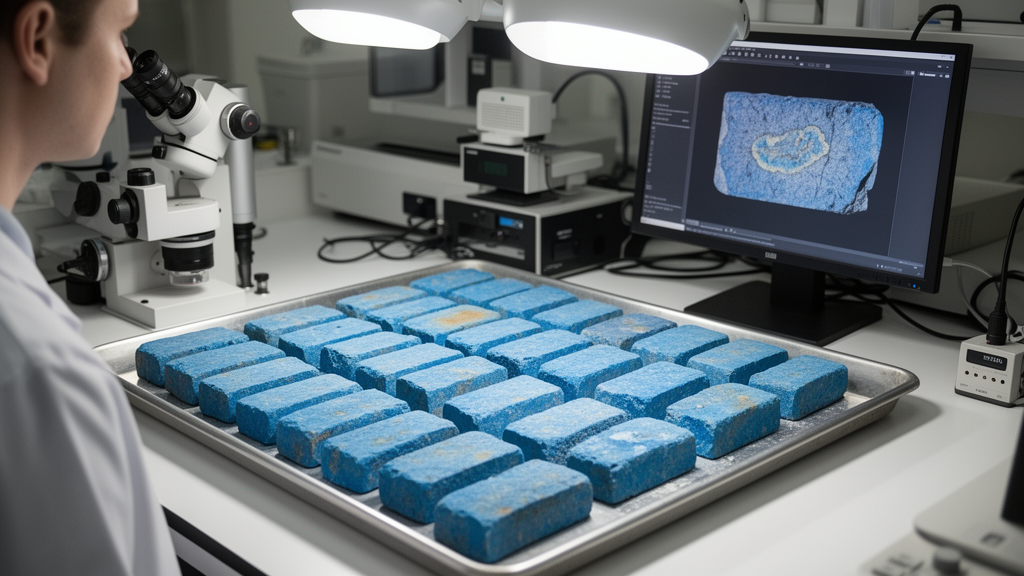
An explainable machine-learning framework classified historic blue bricks among five regional provenance groups with 95% test accuracy in a small conservation study. The researchers analyzed 52 bricks using X-ray diffraction, Raman spectroscopy and X-ray fluorescence data, reporting an area under the receiver operating characteristic curve of 0.973. The results show that the model performed strongly within the tested dataset while providing an account of the variables associated with its classifications.
The project focused on provenance identification, an aspect of architectural conservation where missing inscriptions and incomplete archives can complicate efforts to establish material authenticity. The team combined three forms of analytical information: X-ray diffraction and Raman spectroscopy provided spectral data, while X-ray fluorescence measured elemental concentrations. Those features were used with a random forest classifier to distinguish the five regional groups represented in the dataset.
After this preprocessing, the random forest achieved 95% test accuracy and an area under the receiver operating characteristic curve of 0.973. The researchers also applied Shapley additive explanations, or SHAP, to identify the variables that discriminated most strongly among the provenance groups. Rubidium, aluminum and zirconium emerged as important discriminative variables, making the model’s reasoning less opaque than a prediction based only on its final output.
Interpretation also extended to the autoencoder’s latent representation through decoder-based analysis, which linked encoded features to mineral phases. Together, these analyses support the measured classification performance and the use of explainability tools in examining the information behind the model. The principal limitation is the study’s scale: only 52 bricks from five regions were evaluated.
The reported accuracy therefore does not establish how the framework would perform on larger collections, bricks from additional regions, or materials with different compositions and manufacturing histories. Within that boundary, the study presents a technically interpretable method for using laboratory measurements to support regional provenance identification in architectural conservation.
Subject of Research: Explainable machine learning for tracing the regional provenance of historic blue bricks
Article Title: A sparse autoencoder and explainable machine learning framework for provenance tracing of historic blue bricks in architectural conservation
Article References: Song, Z., Hou, F., Chen, S., Xu, W., & Zhang, L. (2026). A sparse autoencoder and explainable machine learning framework for provenance tracing of historic blue bricks in architectural conservation. npj Heritage Science. https://doi.org/10.1038/s40494-026-03066-6
Image Credits: AI Generated
DOI: 10.1038/s40494-026-03066-6
Keywords: historic blue bricks, provenance tracing, explainable AI, sparse autoencoders, random forests, X-ray fluorescence, Raman spectroscopy, X-ray diffraction, architectural conservation, SHAP explanations, sparse, autoencoder
Cite Scienmag News
Courtney Benton. (October 22, 2026). Explainable AI classifies origins of 52 historic blue bricks. Scienmag. https://scienmag.com/explainable-ai-classifies-origins-of-52-historic-blue-bricks/
Courtney Benton. "Explainable AI classifies origins of 52 historic blue bricks." Scienmag, 22 October 2026, https://scienmag.com/explainable-ai-classifies-origins-of-52-historic-blue-bricks/. Accessed 22 October 2026.
Courtney Benton. "Explainable AI classifies origins of 52 historic blue bricks." Scienmag. October 22, 2026. https://scienmag.com/explainable-ai-classifies-origins-of-52-historic-blue-bricks/


