


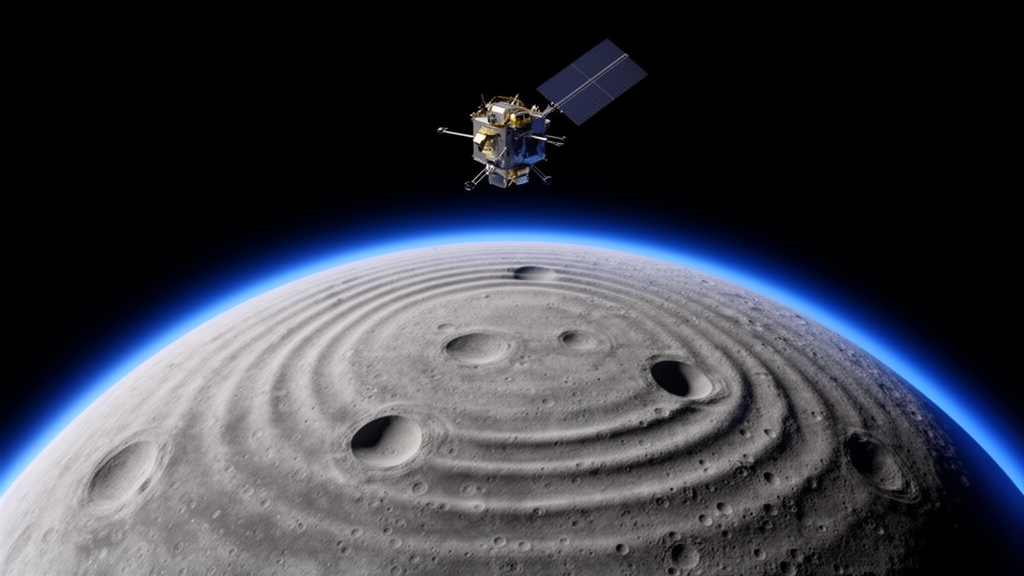
Lunar free oscillations are unlikely to affect the sensitivity of TianQin, a proposed space-based gravitational-wave detector, according to a computational study that incorporated perturbations from the Moon’s normal modes into high-precision orbit simulations. Even under an extreme excitation associated with a moment magnitude 7.0 moonquake, the peak range acceleration noise produced by the modeled oscillations remained at least two orders of magnitude below TianQin’s noise requirement. TianQin is planned as a geocentric mission comprising three satellites in nearly circular, high Earth orbits.
Because the detector would operate in the Earth–Moon environment, the analysis considered whether gravitational perturbations associated with lunar seismic motion could add significantly to that noise. The researchers calculated the perturbations associated with the Moon’s spheroidal normal modes using four seismic velocity models. These lunar seismic models provided the basis for incorporating free-oscillation effects into high-precision simulations of the proposed TianQin constellation.
The study then evaluated the resulting range acceleration noise and compared its peak level with the detector’s noise requirement. In the simulated magnitude 7.0 moonquake scenario, the lunar contribution stayed at least two orders of magnitude below that requirement. The conclusion is bounded to the effects represented by the model: spheroidal normal modes contributing to range acceleration noise within TianQin’s operational frequency band.
It does not establish that every possible perturbation associated with the Moon or the wider Earth–Moon system can be neglected. The research is also a computational assessment of a proposed mission rather than a report based on operating hardware, and its result depends on the normal-mode calculations, the four seismic velocity models and the orbit simulations used in the analysis. Within those limits, the modeled lunar free oscillations are not expected to impair TianQin’s sensitivity in its operational frequency band.
Subject of Research: Modeled effects of lunar free oscillations on TianQin range acceleration noise
Article Title: Effect of lunar free oscillations on TianQin’s range acceleration noise
Article References: Liu, Z., Xu, Y., Liu, K., & Zhang, X. (2026). Effect of lunar free oscillations on TianQin’s range acceleration noise. Astrophysics and Space Science, 371(10), Article 126. https://doi.org/10.1007/s10509-026-04659-0
Image Credits: AI Generated
DOI: 10.1007/s10509-026-04659-0
Keywords: TianQin, lunar free oscillations, gravitational-wave detector, range acceleration noise, lunar seismology, moonquakes, spheroidal normal modes, orbit simulation, Earth–Moon system, Effect, lunar, free
Cite Scienmag News
Iris Watkins. (October 22, 2026). Modeled Lunar Free Oscillations Remain Below TianQin Noise Requirement. Scienmag. https://scienmag.com/modeled-lunar-free-oscillations-remain-below-tianqin-noise-requirement/
Iris Watkins. "Modeled Lunar Free Oscillations Remain Below TianQin Noise Requirement." Scienmag, 22 October 2026, https://scienmag.com/modeled-lunar-free-oscillations-remain-below-tianqin-noise-requirement/. Accessed 22 October 2026.
Iris Watkins. "Modeled Lunar Free Oscillations Remain Below TianQin Noise Requirement." Scienmag. October 22, 2026. https://scienmag.com/modeled-lunar-free-oscillations-remain-below-tianqin-noise-requirement/


