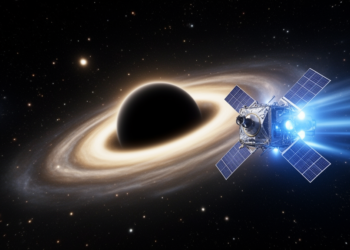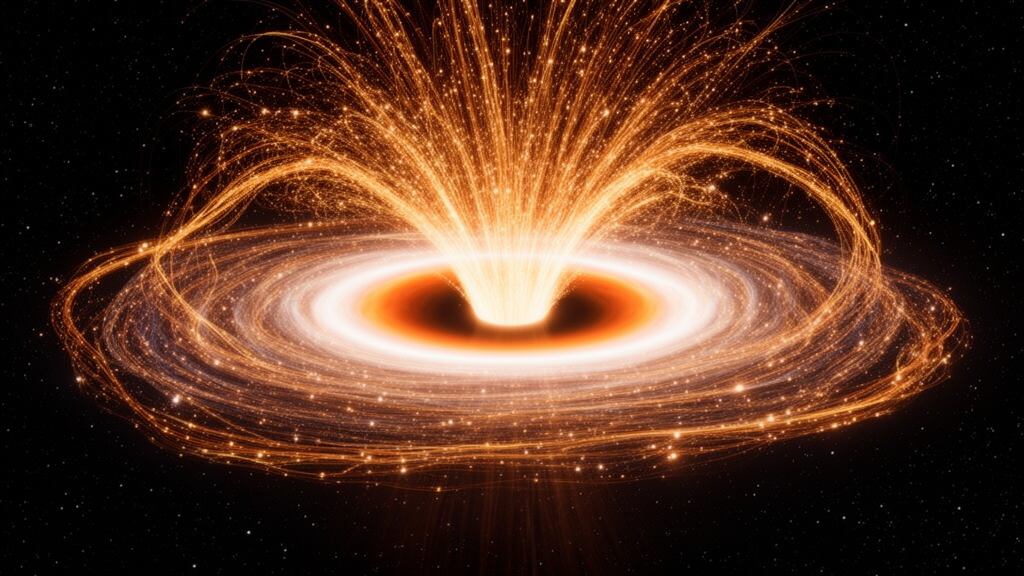
X-ray observations of the supermassive black hole in the galaxy NGC 3783 have revealed evidence of solar-storm-like activity, including a magnetic-reconnection eruption and a coronal mass ejection in its corona. The researchers report that this is the first observation of magnetic reconnection eruptions and a coronal mass ejection in a black hole corona, indicating that the physical processes associated with powerful solar storms can also occur in the environment of a supermassive black hole.
Solar storms are powerful eruptions of X-ray radiation accompanied by winds of charged particles ejected from the Sun’s corona into the solar system. The coronal mass ejections associated with these events form through the conversion of magnetic energy into kinetic energy in a process called magnetic reconnection. In the observed black-hole system, the researchers identified an outburst exhibiting the Neupert effect, a phenomenon first discovered on the Sun in 1968 but never previously observed around a black hole. The presence of this timing pattern, together with other observations, provided evidence that the same broad physical processes underlying solar storms also operate near NGC 3783’s supermassive black hole.
The study was an observational investigation led by Gal Vardi, a doctoral student in the Technion Faculty of Physics, under the supervision of Prof. Ehud Behar. Researchers from Japan, Europe and the United States also participated. The team monitored X-rays emitted from near the black hole with the XRISM space telescope and used observations from ESA’s XMM-Newton space telescope. XRISM is a joint mission of NASA, the Japan Aerospace Exploration Agency and the European Space Agency. Analysis of the eruption’s X-ray behavior and timing supported the interpretation that a solar-like magnetic reconnection event and a coronal mass ejection occurred in the corona of the active galactic nucleus.
NGC 3783 contains a supermassive black hole that can be a million times larger than the Sun or more. The observation extends a familiar type of solar activity to a very different astrophysical setting, but it does not show that a black-hole eruption is identical in scale or consequences to a solar coronal mass ejection. Nor does the study establish how frequently such events occur among supermassive black holes, because the reported evidence comes from a single observed system. The findings offer direct evidence that solar-storm-like dynamics can accompany energetic activity around an active galactic nucleus, while their prevalence across the broader black-hole population remains unconstrained by this study. The peer-reviewed paper, titled “Observation of a Solar-like Magnetic Reconnection Event in an AGN Corona with XRISM,” was published in The Astrophysical Journal Letters on 10 August 2026.
Subject of Research: Observational detection of solar-like magnetic reconnection and coronal mass ejection in a supermassive black-hole corona
Article Title: Solar storms around a black hole
Article References: Solar storms around a black hole. Original publication (Bibliographic details unavailable.)
Image Credits: AI Generated
DOI: Not provided
Keywords: supermassive black holes, NGC 3783, solar storms, magnetic reconnection, coronal mass ejections, XRISM, X-ray astronomy, active galactic nuclei, Neupert effect, Solar, storms, around
Cite Scienmag News
Grant Pearson. (October 22, 2026). Solar-Storm-Like Eruption Observed Near a Supermassive Black Hole. Scienmag. https://scienmag.com/solar-storm-like-eruption-observed-near-a-supermassive-black-hole/
Grant Pearson. "Solar-Storm-Like Eruption Observed Near a Supermassive Black Hole." Scienmag, 22 October 2026, https://scienmag.com/solar-storm-like-eruption-observed-near-a-supermassive-black-hole/. Accessed 22 October 2026.
Grant Pearson. "Solar-Storm-Like Eruption Observed Near a Supermassive Black Hole." Scienmag. October 22, 2026. https://scienmag.com/solar-storm-like-eruption-observed-near-a-supermassive-black-hole/