

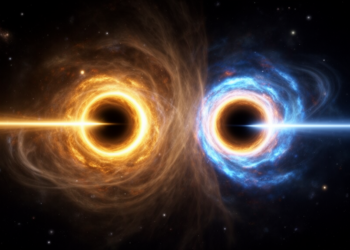
Astronomers Discover the Oldest Compact Quasar Pair in the Early Universe
Astronomers using the James Webb Space Telescope and Gemini North have discovered Nāpōwawāʻenakaulua, the oldest and most compact quasar pair ...
Astronomers using the James Webb Space Telescope and Gemini North have discovered Nāpōwawāʻenakaulua, the oldest and most compact quasar pair ...

JWST and ALMA observations have revealed two actively accreting supermassive black holes separated by about 1.5 kiloparsecs in a gas-rich ...
The Lumina simulation, run on one of the world's most powerful supercomputers, tracks dark matter, galaxies, stars, and radiation across ...
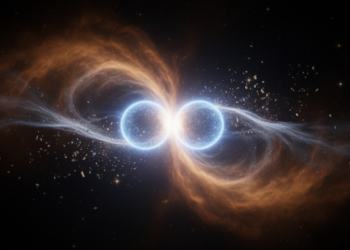
UCLA-led simulations show that extremely dense stellar systems in the early universe may have produced frequent stellar collisions, repeated mergers ...
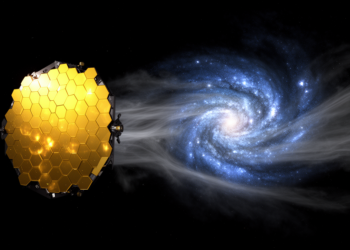
JWST observations of blueshifted sodium absorption reveal that powerful, largely AGN-driven neutral outflows accompany rapid star-formation quenching in massive galaxies ...
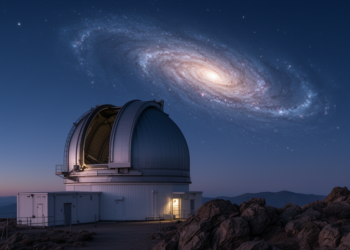
An analysis of approximately 100,000 quasars found a statistically strong velocity–dust relationship consistent with some supermassive black holes having been ...
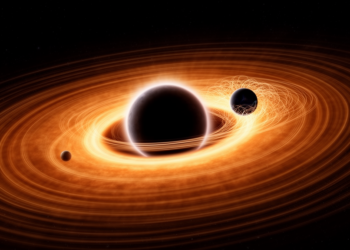
A theoretical analysis of extreme mass-ratio inspirals around a magnetized Ernst black hole shows that an intrinsic magnetic field can ...
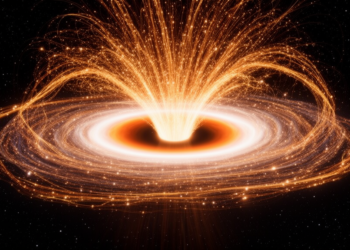
X-ray observations of NGC 3783 revealed a solar-storm-like eruption near its supermassive black hole, supporting evidence for magnetic reconnection and ...
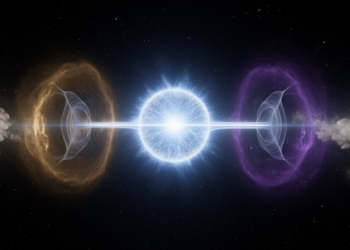
A single-galaxy X-ray and radio study links a truncated accretion disk and hot plasma flow with relativistic jet launching in ...
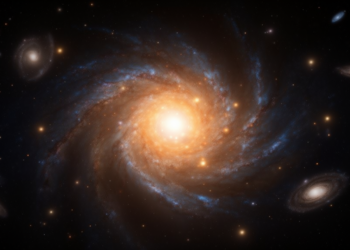
A new comparative study of nearly 5,000 high-redshift Seyfert galaxies shows that narrow-line and broad-line Seyfert 1 galaxies flicker differently ...


Embark on a thrilling journey of discovery with Scienmag.com—your ultimate source for cutting-edge breakthroughs. Immerse yourself in a world where curiosity knows no limits and tomorrow’s possibilities become today’s reality!