


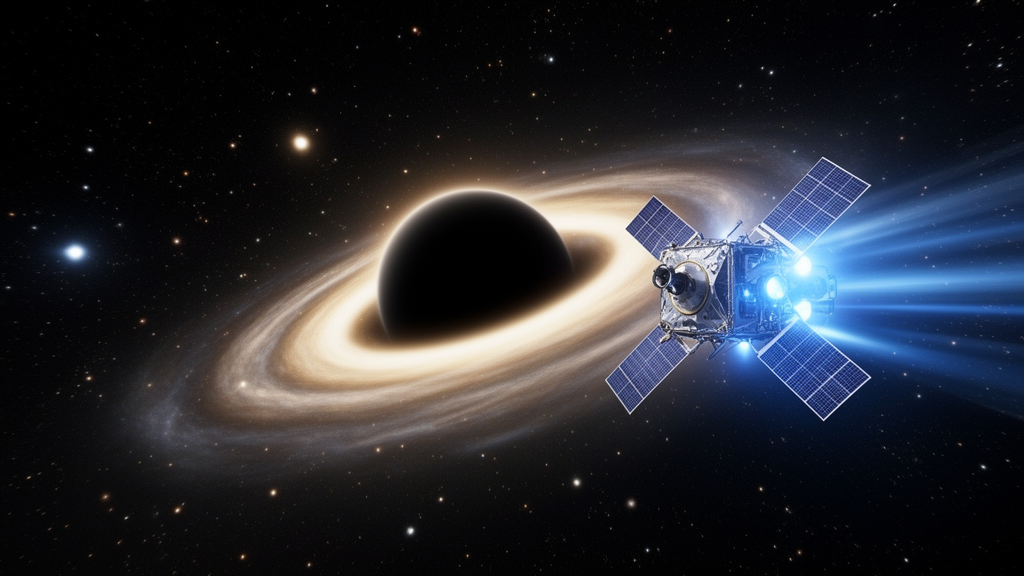
A fleet of lightweight interstellar probes could test the geometry of a black hole without entering orbit or slowing down, according to a theoretical analysis of near-critical flyby trajectories. The study focuses on the “zoom-whirl” effect, in which a probe passes so close to a black hole that it circles the object many times before escaping or falling in. Small changes in the probe’s trajectory could encode departures from the Schwarzschild solution predicted by general relativity. The authors calculate that, for a 10-solar-mass black hole, some departures could shift the capture boundary by centimetres, making the concept a potentially precise—but exceptionally demanding—way to probe strong gravity.
The proposed mission would not require the gram-scale nanocraft used in concepts such as Breakthrough Starshot to brake and settle into an orbit. Instead, a larger nanocraft could serve as a mothership and release much smaller probes, described as sub-gram and sub-centimetre in size, on trajectories that cross the black hole’s vicinity without orbiting it. Those probes would have to withstand extreme tidal forces and communicate their results through the mothership, which could relay the data to Earth. This setup avoids the technically difficult deceleration required by orbiting missions, but it creates a different challenge: determining the capture boundary with extraordinary precision from trajectories that may end either in escape or capture.
For the simplified case of a non-rotating black hole surrounded by vacuum, the investigators model the probes as massive particles following geodesics. A critical impact parameter, written as bcrit, separates trajectories that return to infinity from those captured by the black hole. The impact parameter is the perpendicular distance that the probe would have followed from the black hole in the absence of gravitational deflection. In Schwarzschild spacetime, its value depends on the probe’s asymptotic speed. As that speed approaches the speed of light, the critical impact parameter approaches 3√3 times the black hole’s gravitational radius, the familiar capture threshold for light. For slower probes, the threshold expands, reaching approximately four gravitational radii divided by the probe speed at very low speed.
The remarkable behaviour occurs when a probe passes just outside this boundary. Its radial motion becomes extremely slow near an unstable circular orbit, while it continues moving rapidly in azimuth, accumulating many revolutions around the black hole. The total angle swept out between an inbound and an outbound crossing of a large matching radius grows logarithmically as the trajectory approaches the capture threshold. For a 10-solar-mass black hole, a probe moving at an asymptotic speed of 0.3 times the speed of light and passing only 5 centimetres beyond the Schwarzschild threshold can orbit in this near-separatrix region before escaping. Reducing the impact parameter by roughly a factor of 134 buys one additional whirl. Ten revolutions would therefore require tuning the trajectory to an accuracy smaller than an atomic nucleus, an illustration of both the sensitivity and the extreme difficulty of the proposed technique.
The study also considers a deformed Schwarzschild geometry represented by the Johannsen spacetime. Its parameter α13 measures a departure from the standard non-rotating solution; α13 equal to zero recovers Schwarzschild spacetime. Although this parameter does not describe every possible modification of a black hole, it provides a controlled model for testing whether flyby data could reveal new physics. In the benchmark case of α13 equal to 10⁻⁵ and a black hole with 10 solar masses, the capture boundary moves by 9.733 centimetres at an asymptotic speed of 0.2 and by 6.833 centimetres at a speed of 0.3. A probe launched five centimetres outside the Schwarzschild threshold can consequently be captured in the deformed model, turning a tiny gravitational difference into an unambiguous change in outcome.
That apparent sensitivity comes with a central ambiguity. A single near-critical flyby primarily measures one length scale—the physical critical impact parameter at one speed—and that scale can be altered either by the black hole’s mass or by a deformation of its geometry. In the benchmark example, a Johannsen black hole with a mass of exactly 10 solar masses and α13 equal to 10⁻⁵ can be matched at a reference speed of 0.3 by a Schwarzschild black hole whose mass is 10.0000033333 solar masses. The fractional mass difference is only 3.3 × 10⁻⁷, yet the two models produce nearly overlapping trajectories. Their remaining distinctions include small changes in proper time, but the analysis finds that centimeter-scale offsets at a single speed correspond to timing residuals of only a few nanoseconds.
The degeneracy can be broken, at least in principle, by repeating the experiment at multiple speeds. The ratio of critical impact parameters measured at two velocities removes the overall mass scale to leading order and tests the shape of the boundary as a function of speed. For the benchmark case, however, the residual signal after matching the models at one speed is only about 0.3 to 1 centimetre. The authors therefore describe sensitivity at the 10⁻⁵ level in α13 as an idealized target rather than a demonstrated realistic precision. Achieving it would require not only centimetre-scale boundary localization but equally precise control and measurement of each probe’s asymptotic velocity and impact parameter, along with a probe small enough not to blur those quantities.
The proposed measurement architecture would use two swarms travelling on opposite sides of the black hole, with impact parameters close to the critical value. Their separation, roughly twice the critical impact parameter, could be determined through electromagnetic exchanges far from the black hole. Earth-based Doppler measurements might constrain the probes’ asymptotic speeds, while comparisons of stellar positions in the probes’ comoving frame and in Earth’s frame could provide another route. For escaping probes, the accumulated azimuthal angle would sharpen the location of the capture boundary; captured probes would help bracket it from the other side. The authors estimate that centimetre-scale localization of bcrit could, in principle, determine a black hole’s mass at a precision of roughly 10⁻⁷.
The analysis remains deliberately idealized and does not assess whether the required spacecraft or measurement systems can be built. It assumes a stationary, non-rotating black hole in vacuum, a common flight plane for the probes, and negligible uncertainty in the target’s position and velocity. Real black holes are expected to spin and may be surrounded by dilute accreting matter that could slightly alter probe trajectories through non-geodesic effects. Spin would also shift the critical impact parameter differently for co-rotating and counter-rotating probes, adding further parameters that require independent observables. Even with those caveats, the calculations identify a distinctive possible use for interstellar technology: a flyby swarm could turn repeated close approaches, their escape or capture outcomes, and the angles and times they accumulate into a test of strong gravity without requiring the probes to stop at the black hole.
Subject of Research: Using non-orbiting interstellar flyby probes to test black-hole geometry and departures from the Schwarzschild metric.
Article Title: Testing black holes with interstellar missions: II. Flyby probes
Article References: Fan, Y., Bambi, C., Gao, L., Nosirov, A., & Santangelo, A. (2026). Testing black holes with interstellar missions: II. Flyby probes. The European Physical Journal C, 86(10), Article 1197. https://doi.org/10.1140/epjc/s10052-026-16376-7
Image Credits: AI Generated
DOI: 10.1140/epjc/s10052-026-16376-7
Keywords: black holes, interstellar probes, general relativity, Schwarzschild metric, strong gravity, flyby trajectories, zoom-whirl motion, nanocraft, capture boundary, Johannsen spacetime, Testing, black
Cite Scienmag News
Grant Pearson. (October 21, 2026). Flyby Probes Could Test Black Holes Without Slowing Down. Scienmag. https://scienmag.com/flyby-probes-could-test-black-holes-without-slowing-down/
Grant Pearson. "Flyby Probes Could Test Black Holes Without Slowing Down." Scienmag, 21 October 2026, https://scienmag.com/flyby-probes-could-test-black-holes-without-slowing-down/. Accessed 21 October 2026.
Grant Pearson. "Flyby Probes Could Test Black Holes Without Slowing Down." Scienmag. October 21, 2026. https://scienmag.com/flyby-probes-could-test-black-holes-without-slowing-down/


