


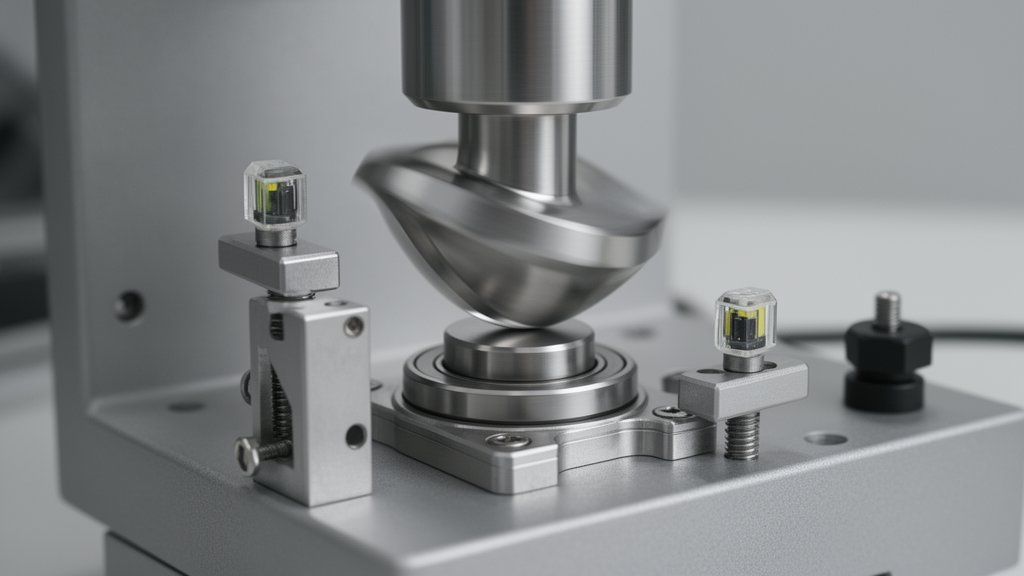
A computational study has shown that reshaping the command sent to a flexible cam-follower mechanism can substantially reduce tracking distortion near resonance, although the best design still leaves an error equal to about 40% of the commanded lift. The researchers modeled the follower as a lightly damped, single-degree-of-freedom system and optimized a periodic cubic-spline cam law against the follower’s calculated steady-state response at 100 radians per second. In a benchmark of six optimization strategies, multi-start bounded gradient optimization produced the lowest objective values and outperformed every alternative across 30 paired random seeds.
The central idea is to treat the cam profile as an input to a dynamic filter rather than as a geometric prescription whose output will automatically match the intended motion. The reduced-order model obeys the equation mx¨ + c(x˙ − y˙) + k(x − y) = 0, where y is imposed cam lift and x is actual follower displacement. With an equivalent mass of 1.2 kilograms, stiffness of 15,000 newtons per meter and damping of 10 newton-seconds per meter, the system has an undamped natural frequency of about 111.80 radians per second, or 17.79 hertz, and a damping ratio of 0.0373. The target speed of 100 radians per second therefore places it in a lightly damped, near-resonant regime, where dynamic filtering can produce substantial phase lag and amplitude distortion.
At that operating point, the uncompensated profile produced severe periodic distortion. Its maximum tracking error was 23.82 millimeters, compared with a commanded lift of 10 millimeters, while its global phase lag was 15.55 degrees. A model-derived inertial surrogate reached a minimum of −299.18 newtons. These values were calculated directly from the fixed point of the one-revolution dynamic map rather than from a simulation begun at rest and stopped after a few cycles. The distinction mattered: a truncated five-revolution calculation generated a larger error and a more negative surrogate, but the researchers identified those figures as finite-transient artifacts rather than properties of the periodic response. A 60-revolution validation across 180 profiles found a maximum objective difference of 1.05 × 10⁻⁶, while step-refinement tests and an analytical harmonic case supported convergence of the fixed-step fourth-order Runge–Kutta implementation.
The desired follower trajectory was a cycloidal rise–dwell–return–dwell program with a 10-millimeter lift. The baseline cam law was represented by 12 independent periodic cubic-spline control points, with a repeated closure point for display, while the final benchmark used 16 independent controls. The composite optimization objective combined periodic tracking error with smoothness, signal bounds, slope, lift-span and mean-offset penalties, plus a penalty on negative values of the inertial surrogate. The span and offset terms were added to prevent an optimizer from appearing successful simply by shrinking or shifting the command. In an 85-run sensitivity study, their adjusted weights kept the resulting cam spans between 9.916 and 9.995 millimeters, although the authors did not claim that this would prevent amplitude collapse for arbitrary settings. A separate parameterization study found that 16 controls provided the best observed compromise under a fixed evaluation budget; it was a budgeted comparison rather than a formal demonstration of discretization independence.
Six methods were compared under a nominal budget of 25,000 objective evaluations: single-start bounded L-BFGS-B, 10-start L-BFGS-B, differential evolution, particle swarm optimization, annealed Langevin search and a hybrid combining Langevin exploration with L-BFGS-B refinement. Multi-start L-BFGS-B achieved a mean objective of 0.2058 with a standard deviation of 0.0035 and beat single-start L-BFGS-B in all 30 paired runs. Particle swarm optimization ranked second with a mean objective of 0.2577, while the hybrid reached 0.2787. Differential evolution averaged 0.4556, and annealed Langevin search performed much worse at 7.3984. The global difference was statistically strong under a Friedman test, with χ²(5) = 143.20, p = 3.74 × 10⁻²⁹ and Kendall’s W = 0.955, and all pairwise advantages of multi-start L-BFGS-B survived Holm correction. Single-start L-BFGS-B was fastest, averaging 2.18 seconds, whereas multi-start provided the best objective quality and repeatability. The results therefore favored multi-start local refinement for this formulation rather than establishing a general advantage for stochastic exploration.
The best periodic profile, found by multi-start L-BFGS-B with seed 2049, lowered the total objective to approximately 0.2038 and reduced the maximum tracking error to 3.96 millimeters. Its minimum inertial-surrogate value improved to −24.03 newtons, and the global phase measure changed from a 15.55-degree delay to a small 1.52-degree lead. The optimized lift span was 9.987 millimeters and its mean lift was 3.750 millimeters, effectively preserving the scale and mean of the target. The much smaller global phase offset did not mean that the follower tracked the trajectory closely, however. Correlation with the target fell from 0.926 for the baseline to 0.868, and interval-specific measurements showed root-mean-square errors of 2.96 millimeters during the rise, 3.74 millimeters during the first dwell, 2.94 millimeters during the return and 1.72 millimeters during the final dwell. The first dwell also carried a nearly uniform mean error of −3.74 millimeters, showing that the result was not simply a uniform angular shift.
Speed continuation improved the hybrid procedure in a controlled comparison. Starting from the same 12-control initialization and using the same budget, a direct optimization at 100 radians per second produced a mean target objective of 0.3749643 ± 6.2 × 10⁻¹⁰. Five repeated stages at the target speed reached 0.26598 ± 0.00933, while a ladder rising through 20, 40, 60, 80 and 100 radians per second reached 0.2121065 ± 2.3 × 10⁻¹⁰ and was better in all 30 paired seeds. Relative to staged direct optimization, the mean reduction was 20.15%, with Wilcoxon and exact sign-test p = 1.86 × 10⁻⁹. When every intermediate profile was reevaluated at the target speed under the same objective, the paired mean declined monotonically from 10.065 to 8.870, 5.518, 1.822 and 0.212. This supported progressive transfer toward a better target-speed solution under the tested protocol, but did not show that continuation is universally necessary or superior.
The optimized profile was nevertheless sensitive to changes in operating conditions. When mass rose to 1.2 times its nominal value, the objective increased from 0.204 to 1.139; reducing stiffness to 0.8 times nominal raised it to 1.469. A sweep from 40 to 140 radians per second revealed large errors near the fundamental resonance, with maximum errors of 8.64–11.19 millimeters around 110–115 radians per second, and additional peaks near half and one-third of the natural frequency. Fourier analysis indicated that the second and third harmonics of the nonsinusoidal input crossed resonance near 55.90 and 37.27 radians per second. At the target speed, the first input harmonic had an amplitude of 0.605 millimeters and was amplified by the single-degree-of-freedom transfer function by a factor of 4.754. Among 1,000 random cases with independent variations of plus or minus 10% in mass, stiffness, damping and speed, the median maximum error was 4.62 millimeters, its 97.5th percentile was 11.05 millimeters, and 73 cases exceeded the full 10-millimeter lift. The compensation was therefore effective at the specified design point but not robust across a broad operating envelope.
Geometric and kinematic audits also showed why the numerical result is not an industrial cam design. The equivalent pitch curve had a maximum absolute pressure angle of 39.67 degrees and a minimum positive curvature radius of 6.35 millimeters. Because 1,747 of 19,200 samples had nonpositive signed curvature, the investigators did not treat the curve as a fully certified cam surface. The optimized input reached a maximum segment-wise jerk of 915,000 meters per cubic second. The periodic cubic spline was C2, meaning that its second derivative was continuous, but its segment-wise jerk was discontinuous at the control knots. Undercutting, Hertzian contact stress and manufacturability could not be certified because roller dimensions, face width, materials, preload and a unilateral contact model were unavailable. The forward model itself was bilateral and linear, excluding gravity, friction, roller inertia, separation, impact and higher structural modes. Its minimum inertial surrogate also remained negative, so the study cannot establish contact preservation. The supported result is narrower: inverse shaping improved periodic tracking in one reduced-order computational model, while physical validation, robustness optimization and explicit geometric constraints remain necessary before the approach can be applied to high-speed machinery.
Subject of Research: Inverse spline-based cam-input optimization for a near-resonant single-degree-of-freedom follower model
Article Title: Inverse input shaping for a near-resonant reduced-order cam-follower model: Periodic-state optimization and algorithmic benchmarking
Article References: Sandoval Flórez, R., Parra Medina, C. P., & Vargas Fonseca, G. L. (2026). Inverse input shaping for a near-resonant reduced-order cam-follower model: Periodic-state optimization and algorithmic benchmarking. Results in Engineering, 32, Article 113520. https://doi.org/10.1016/j.rineng.2026.113520
Image Credits: AI Generated
DOI: 10.1016/j.rineng.2026.113520
Keywords: cam-follower dynamics, inverse input shaping, near resonance, motion tracking, cubic splines, optimization benchmark, mechanical vibration, reduced-order modeling, periodic response, Inverse, input, shaping
Cite Scienmag News
Denise Maddox. (October 21, 2026). Numerical cam shaping reduces near-resonant follower distortion. Scienmag. https://scienmag.com/numerical-cam-shaping-reduces-near-resonant-follower-distortion/
Denise Maddox. "Numerical cam shaping reduces near-resonant follower distortion." Scienmag, 21 October 2026, https://scienmag.com/numerical-cam-shaping-reduces-near-resonant-follower-distortion/. Accessed 21 October 2026.
Denise Maddox. "Numerical cam shaping reduces near-resonant follower distortion." Scienmag. October 21, 2026. https://scienmag.com/numerical-cam-shaping-reduces-near-resonant-follower-distortion/


