

Wednesday, October 21, 2026
Science
No Result
View All Result
  • Login
  • HOME
  • SCIENCE NEWS
  • CONTACT US
  • HOME
  • SCIENCE NEWS
  • CONTACT US
No Result
View All Result
Scienmag
No Result
View All Result
Home Science News Medicine

AI speech model classifies dysarthria severity in real-world recordings

October 21, 2026
in Medicine, Technology and Engineering
Blake Davidson
By Blake Davidson Scienmag Editorial Profile - Data Science
Reading Time: 2 mins read
0
AI speech model classifies dysarthria severity in real-world recordings

AI speech model classifies dysarthria severity in real-world recordings

65
SHARES
587
VIEWS
Share on FacebookShare on Twitter
ADVERTISEMENT

A proof-of-concept artificial intelligence system called Whisper-ST1 achieved 79% per-speaker F1 when classifying dysarthria severity from real-world audio samples. The system also showed strong agreement with ratings from two speech therapists, according to the study. The results support the feasibility of using a pretrained speech-recognition model to assess motor speech impairment under less controlled audio conditions.

Dysarthria is a motor speech disorder affecting people with neurological conditions and is highly prevalent among stroke survivors. Effective treatment requires assessment of severity and speech exercises tailored to the degree of impairment. Traditional speech intervention can face limited access to therapists and low treatment adherence. Whisper-ST1 was developed as a possible component for home-based rehabilitation, with the study focusing on automated severity classification rather than evaluating a complete rehabilitation program.

The researchers built Whisper-ST1 by fine-tuning a pretrained automatic speech recognition model using real-world data alongside traditional research datasets. The model architecture was adapted for the new task, and the researchers used progressive unfreezing to promote flexible adaptation while limiting catastrophic forgetting of relevant speech features. They also applied an ordinal regression loss to reduce the impact of misclassification errors. Ablation experiments examined the contribution of individual pipeline components in isolation.

On real-world samples, Whisper-ST1 produced a per-speaker F1 score of 79% [67%–100%] for dysarthria-severity classification. Its weighted Cohen’s kappa values were 0.814 [0.400–1.000] and 0.878 [0.647–1.000] when compared with the two speech therapists’ ratings, while inter-therapist agreement was 0.851 [0.550–1.000]. Model errors were predominantly between adjacent severity levels, suggesting that the system preserved the ordinal structure of the severity scale. The study therefore demonstrates a proof-of-concept classification approach in heterogeneous audio conditions and provides a foundational step toward AI-assisted tools for remote monitoring and support of dysarthria rehabilitation, but it does not establish the system as a replacement for professional assessment or a complete home rehabilitation intervention.

Subject of Research: Proof-of-concept evaluation of an AI-based audio classification system for dysarthria severity assessment

Article Title: An artificial intelligence-based audio recognition system for dysarthria home-based rehabilitation: A proof-of-concept study

Article References: Sancenon, V., Oh, P. Y. S., Tay, E. K. W., Lee, J. Z. X., Soon, M. L. E., Goh, H. L., Oey, N., & Ta, A. W. A. (2026). An artificial intelligence-based audio recognition system for dysarthria home-based rehabilitation: A proof-of-concept study. PLOS Digital Health, 5(10), e0001794. https://doi.org/10.1371/journal.pdig.0001794

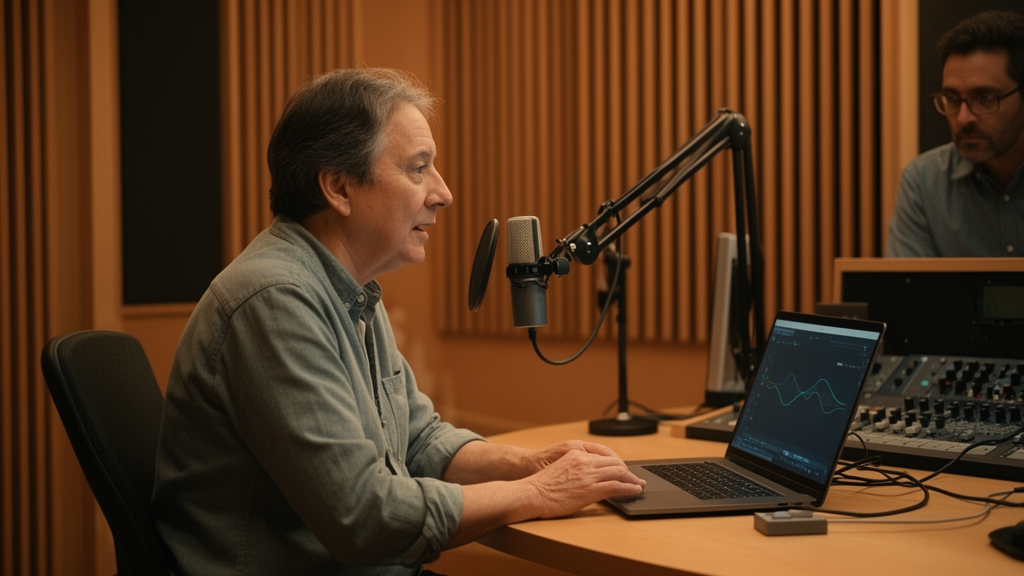
Image Credits: AI Generated

DOI: 10.1371/journal.pdig.0001794

Keywords: dysarthria, artificial intelligence, speech recognition, motor speech disorder, Whisper-ST1, stroke, remote monitoring, ordinal classification, clinical speech assessment, home rehabilitation, artificial, intelligence-based

Cite Scienmag News

Blake Davidson. (October 21, 2026). AI speech model classifies dysarthria severity in real-world recordings. Scienmag. https://scienmag.com/ai-speech-model-classifies-dysarthria-severity-in-real-world-recordings/

Blake Davidson. "AI speech model classifies dysarthria severity in real-world recordings." Scienmag, 21 October 2026, https://scienmag.com/ai-speech-model-classifies-dysarthria-severity-in-real-world-recordings/. Accessed 21 October 2026.

Blake Davidson. "AI speech model classifies dysarthria severity in real-world recordings." Scienmag. October 21, 2026. https://scienmag.com/ai-speech-model-classifies-dysarthria-severity-in-real-world-recordings/


Tags: AI speech disorder classificationArtificialArtificial Intelligenceautomated speech therapy assessmentclinical speech assessmentdysarthriadysarthria severity assessmentfine-tuning speech models with real-world datahome rehabilitationhome-based dysarthria managementIntelligence-basedmachine learning in speech pathologymotor speech disordermotor speech impairment detectionordinal classificationordinal regression in speech disorder classificationpretrained speech recognition modelsreal-world audio analysisremote monitoringspeech impairment severity classificationspeech recognitionstrokestroke rehabilitation toolsWhisper-ST1
Share26Tweet16
Previous Post

Regulatory Evolution Offers Clues to Horn Diversification in Beetles

Next Post

Editorial reviews digital screening for sarcopenia and sarcopenic obesity

Related Posts

Editorial reviews digital screening for sarcopenia and sarcopenic obesity
Medicine

Editorial reviews digital screening for sarcopenia and sarcopenic obesity

October 21, 2026
Wolbachia redirects host ATP metabolism to suppress viruses in mosquito cells
Biology

Wolbachia redirects host ATP metabolism to suppress viruses in mosquito cells

October 21, 2026
Cross-sectional study links social support, fear and health behavior after PCI
Medicine

Cross-sectional study links social support, fear and health behavior after PCI

October 21, 2026
Retrospective Spanish study links COPD triple therapy to lower costs and emissions
Medicine

Retrospective Spanish study links COPD triple therapy to lower costs and emissions

October 21, 2026
Environmental volatility is associated with adaptive caution in visual search
Biology

Environmental volatility is associated with adaptive caution in visual search

October 21, 2026
Pilot trial finds combined dementia rehabilitation and caregiver support feasible
Medicine

Pilot trial finds combined dementia rehabilitation and caregiver support feasible

October 21, 2026
Next Post
Editorial reviews digital screening for sarcopenia and sarcopenic obesity

Editorial reviews digital screening for sarcopenia and sarcopenic obesity

  • Mothers who receive childcare support from maternal grandparents show more optimized

    Mothers who receive childcare support from maternal grandparents show more parental warmth, finds NTU Singapore study

    27656 shares
    Share 11059 Tweet 6912
  • University of Seville Breaks 120-Year-Old Mystery, Revises a Key Einstein Concept

    1061 shares
    Share 424 Tweet 265
  • Bee body mass, pathogens and local climate influence heat tolerance

    682 shares
    Share 273 Tweet 171
  • Researchers record first-ever images and data of a shark experiencing a boat strike

    546 shares
    Share 218 Tweet 137
  • Groundbreaking Clinical Trial Reveals Lubiprostone Enhances Kidney Function

    531 shares
    Share 212 Tweet 133
Science

Embark on a thrilling journey of discovery with Scienmag.com—your ultimate source for cutting-edge breakthroughs. Immerse yourself in a world where curiosity knows no limits and tomorrow’s possibilities become today’s reality!

RECENT NEWS

  • AML epigenetic therapies face network-driven resistance, review finds
  • Amomum dealbatum oil kills four bacteria in laboratory study
  • Editorial reviews digital screening for sarcopenia and sarcopenic obesity
  • AI speech model classifies dysarthria severity in real-world recordings

Categories

  • Agriculture
  • Anthropology
  • Archaeology
  • Athmospheric
  • Biology
  • Biotechnology
  • Blog
  • Bussines
  • Cancer
  • Chemistry
  • Climate
  • Earth Science
  • Editorial Policy
  • Marine
  • Mathematics
  • Medicine
  • Pediatry
  • Policy
  • Psychology & Psychiatry
  • Science Education
  • Science News
  • Social Science
  • Space
  • Technology and Engineering

Subscribe to Blog via Email

Enter your email address to subscribe to this blog and receive notifications of new posts by email.

Join 5,151 other subscribers

© 2025 Scienmag - Science Magazine

Welcome Back!

Login to your account below

Forgotten Password?

Retrieve your password

Please enter your username or email address to reset your password.

Log In
No Result
View All Result
  • HOME
  • SCIENCE NEWS
  • CONTACT US

© 2025 Scienmag - Science Magazine

Discover more from Science

Subscribe now to keep reading and get access to the full archive.

Continue reading