


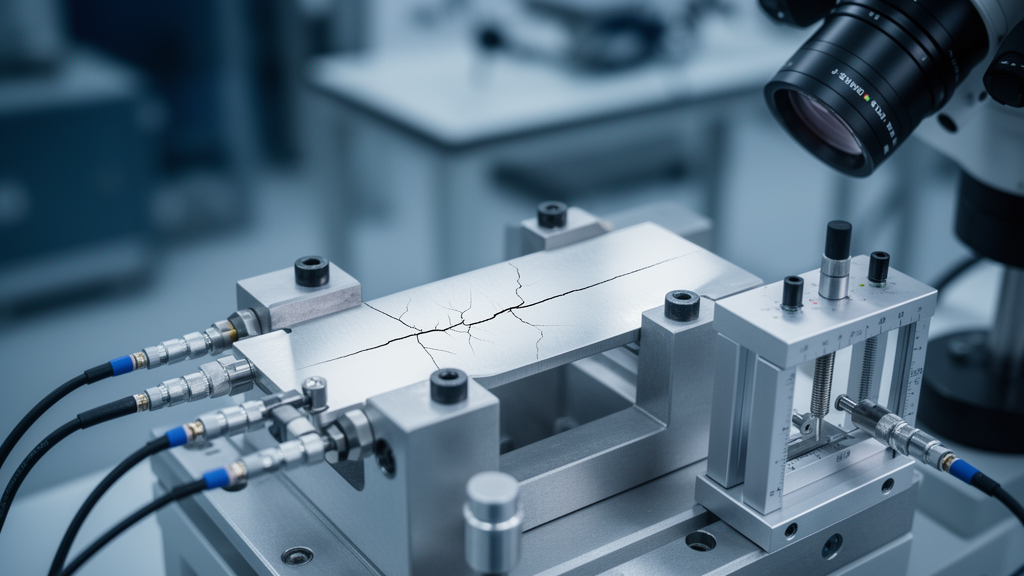
A dynamically updated fatigue-life prediction framework reproduced unusual acceleration and retardation in crack growth across five aerospace-component specimens in an experimental validation study published in the International Journal of Aeronautical and Space Sciences. The method combines reconstructed operating loads with damage identification based on changes in structural dynamic properties. For specimen S3, which exhibited late-stage crack-growth retardation, the mean relative prediction error fell from 15.49% to 3.09% under full calibration; across all five specimens, the maximum MRPE was 5.79%.
Conventional prognostic models commonly focus on adjusting model parameters, but the study notes that such approaches can overlook time-varying uncertainty from fluctuating loads and from the evolution of structural dynamic properties as damage accumulates. The proposed framework addresses uncertainty associated with model inputs, model evolution and model parameters through a coupled calibration process. Reconstructed loads provide a time-varying representation of the component’s operating conditions, while modal damage identification tracks changes in structural behavior associated with deterioration.
The technical objective is to allow the predictive model to change as the structure changes, rather than extrapolating crack growth from a fixed initial state. The framework updates both the structural finite-element model and the crack-propagation law. Load reconstruction supplies information about changing inputs, and modal damage identification links evolving structural dynamics to the damaged component. In this way, the calibration mechanism coordinates the model’s representation of external loading with its representation of damage-related behavior.
The method was tested on a typical aerospace component using five specimens. Its performance was evaluated by how accurately the predicted crack-growth behavior matched the experimental observations. The most challenging case was S3, whose late-stage retardation was associated with the largest improvement: its MRPE decreased from 15.49% to 3.09% with full calibration. This result indicates that the comparison method had substantially greater error for the specimen that displayed the unusual growth pattern.
Beyond reducing numerical error, the dynamic framework reproduced both crack-growth acceleration and crack-growth retardation observed in the later stages of testing. The study attributes these anomalous behaviors to alterations in structural dynamic characteristics. The result matters for fatigue-life prediction because a framework that can account for evolving dynamics may capture changes in crack-growth behavior that a parameter-only update misses. The supplied study summary does not specify the component geometry, loading spectrum, material details or individual modal measurement procedure.
The aggregate result was a maximum MRPE of 5.79% across the five specimens under full calibration. That figure summarizes predictive performance for the experimental set, but it does not establish performance for other component designs, materials or operating histories. The study therefore supports the method as experimentally validated on the tested aerospace component, not as a universal solution for fatigue-crack prognostics. It also evaluates prediction accuracy rather than demonstrating extended service life, prevention of failure or outcomes from operational deployment.
Within those limits, the study presents a physics-linked approach to updating a structural model and a crack-propagation law together as damage progresses. Its reported contribution is the ability to model both ordinary and anomalous fatigue-crack growth behavior more accurately, particularly in a specimen with late-stage retardation. The authors identify condition-based maintenance and precise mission planning for reusable structures as areas where the framework may provide technical support, without the study directly testing either application.
Overall, the experimental findings show that dynamic load reconstruction and model calibration can work together to capture time-dependent changes in fatigue-crack growth. The most notable result is the improvement for S3, where full calibration reduced MRPE from 15.49% to 3.09%, alongside a maximum MRPE of 5.79% across all five specimens. Further evidence would be needed to determine how the framework transfers to different aerospace structures and operating conditions.
Subject of Research: Experimental validation of dynamic fatigue-crack prediction for aerospace components
Article Title: A Dynamic Prediction Framework Synergizing Load Reconstruction and Model Calibration to Unveil Crack Growth Anomalies
Article References: Ye, Y., Han, G., Ma, J., & Chen, C. (2026). A Dynamic Prediction Framework Synergizing Load Reconstruction and Model Calibration to Unveil Crack Growth Anomalies. International Journal of Aeronautical and Space Sciences. https://doi.org/10.1007/s42405-026-01316-2
Image Credits: AI Generated
DOI: 10.1007/s42405-026-01316-2
Keywords: fatigue crack growth, aerospace structures, load reconstruction, dynamic calibration, finite-element modeling, damage identification, structural dynamics, life prediction, experimental validation, Dynamic, Prediction, Framework
Cite Scienmag News
Grant Pearson. (October 21, 2026). Dynamic calibration reproduces anomalous fatigue crack growth in aerospace tests. Scienmag. https://scienmag.com/dynamic-calibration-reproduces-anomalous-fatigue-crack-growth-in-aerospace-tests/
Grant Pearson. "Dynamic calibration reproduces anomalous fatigue crack growth in aerospace tests." Scienmag, 21 October 2026, https://scienmag.com/dynamic-calibration-reproduces-anomalous-fatigue-crack-growth-in-aerospace-tests/. Accessed 21 October 2026.
Grant Pearson. "Dynamic calibration reproduces anomalous fatigue crack growth in aerospace tests." Scienmag. October 21, 2026. https://scienmag.com/dynamic-calibration-reproduces-anomalous-fatigue-crack-growth-in-aerospace-tests/


